Flintlock: The Siege of Dawn
Guns, a fox god, and axe-swinging against undead hordes: Flintlock is a lean, accessible Souls-lite that punches above its AA budget but runs out of ideas before the credits roll.
GamerScout Verdict
Best for Souls-curious players who want a story with their combat and can forgive a game that ends before it fully blooms.
Compare Prices(0 stores)
Loading prices...
We may earn a commission when you buy games through links on this page — at no extra cost to you. It never affects our rankings or verdicts.
Screenshots & Media
About Flintlock: The Siege of Dawn
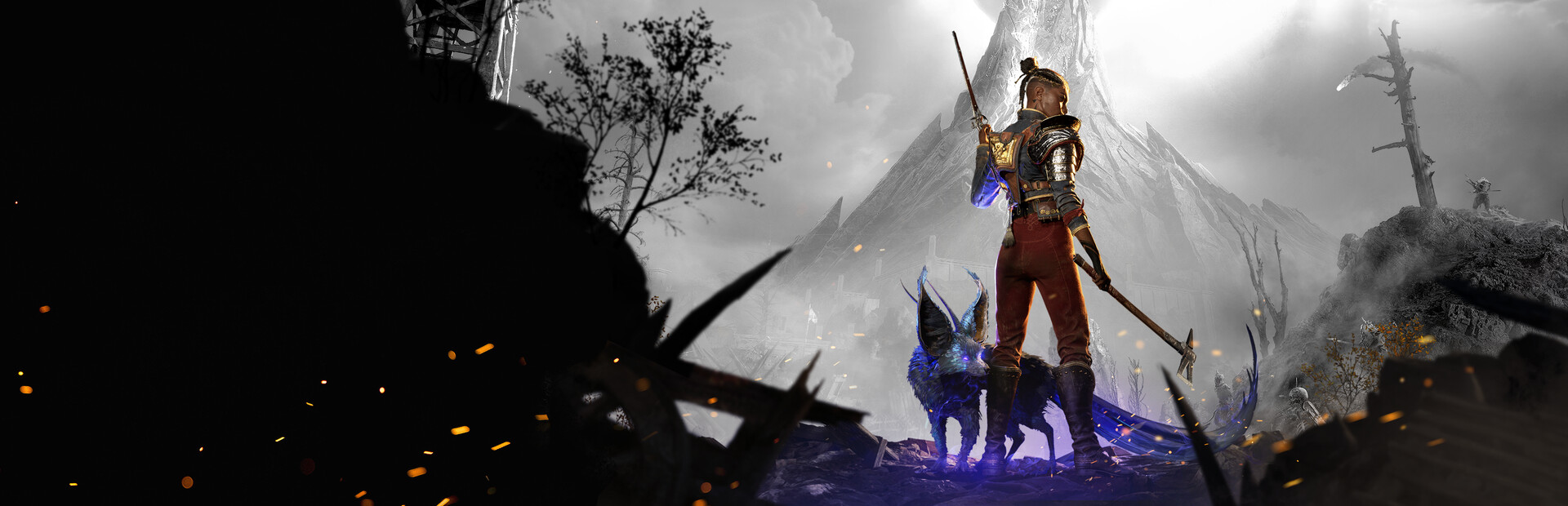
My first honest reaction after a few hours with Flintlock: The Siege of Dawn was that A44 had built something genuinely interesting and then left about thirty percent of it on the cutting room floor. You play as Nor Vanek, a Coalition sapper with a one-handed axe, a Bloodborne-style pistol for interrupting enemy attacks, and a longer-range rifle that unlocks within the first hour. The real wrinkle is Enki, a small fox-like deity who rides your shoulder and brings a third combat pillar into play: a suite of magic abilities that can curse enemies, spread those curses to nearby targets via Chain of Misfortune, and even trigger chain explosions when you land a critical hit on a cursed foe. On paper, that three-way synergy between Steel, Powder, and Magic is exactly the kind of interlocking system I look for. In practice it clicks, but not as deeply as you want it to. The setting deserves real credit. Flintlock Fantasy as a subgenre blends Napoleonic-era weaponry with divine mythology, and A44 leans into that mix by grounding their world of Kian in something that feels closer to Mesopotamian myth than the usual northern European pastiche. Nor's dynamic with Enki, a god helping you kill other gods for reasons that stay usefully murky for a while, carries most of the narrative weight. The story moves at pace, short well-edited cutscenes keep things propulsive, and the dialogue between the two leads during exploration fills in character beats without demanding you sit through a codex wall. It is not Disco Elysium, but it is not pretending to be; the writing is economical and the performances are strong enough to make the revenge-quest premise land. Where the game wobbles is in its ambition versus its scope. The skill tree splits into three paths mirroring the combat pillars, and skills like Poised Shot (a ranged parry), Destructive Descent (a powder-fuelled aerial slam), and Shadow Self (a once-per-rest revival by Enki) all feel purposefully designed rather than stat-padded filler. But build depth plateaus faster than it should. Once you land on a working approach, say a parry-heavy Steel build that funnels into Countershot finishers, there is little mechanical pressure to experiment further. The loot system adds gear set bonuses and weapon upgrades, though the overall complexity sits considerably below what a genre veteran might expect after hour fifteen. The complaint that critics landed on most consistently is fair: the game ends before it fully opens up, and the three semi-open maps, a snowy mountain region, a desert, and the city of Dawn itself, reward exploration but do not offer the density to fill that gap. Rush the main quest and you might clock eight to ten hours; slow down and it stretches to something more satisfying. Combat also has a feel problem that a portion of players will not shake. Animations are detailed and look great, but they read as slightly stiff under the fingers. Enemies do not flinch convincingly to individual hits, which makes mid-fight rhythm harder to find early on. The game compensates by opening up as skills unlock, and by that midpoint the axe-to-pistol-interrupt-to-Enki-curse loop becomes genuinely fluid. The difficulty, even on Normal, asks you to read attack patterns and punish windows rather than mash through, without reaching the wall-slamming peaks of a FromSoftware title. Lodestones (the bonfire equivalent) are sensibly spaced, and the Reputation economy (souls, functionally) is generous enough that grinding feels optional rather than mandatory, which my patience appreciated. For RPG players who bounced off Elden Ring's silence and inscrutability, Flintlock offers a structured narrative, a companion whose active presence in combat feels like a genuine co-op lane, and a world with enough lore letters and side content to reward the curious without padding every hour with filler quests. For buildcraft obsessives who want forty hours of theory-crafting depth, this is going to feel thin. It is a confident, flawed, and often lovely game from a studio that clearly has a bigger vision than its current budget allowed to land all at once.

RPGs
Tags
System Requirements
Minimum
- OS
- Windows 10
- Processor
- Intel Core i5-8400 / AMD Ryzen 3 3300X
- Memory
- 8 GB RAM
- Graphics
- GTX 1060 / Radeon RX 580 / Intel Arc A380 (6GB+ RAM)
- DirectX
- Version 11
- Storage
- 30 GB available space Addition…
Recommended
- OS
- Windows 10
- Processor
- Intel Core i7-8700K / AMD Ryzen 5 3600X
- Memory
- 16 GB RAM
- Graphics
- GTX 2060 Super / Radeon RX 5700 / Intel Arc A750 (8GB+ RAM)
- DirectX
- Version 12
- Storage
- 30 GB available sp…
Keep exploring
Community Discussion
Be the first to comment on Flintlock: The Siege of Dawn.
Reviews & Ratings
Game Info
- Developer
- A44 Games
- Publisher
- Kepler Interactive
- Release Date
- Jul 17, 2024