
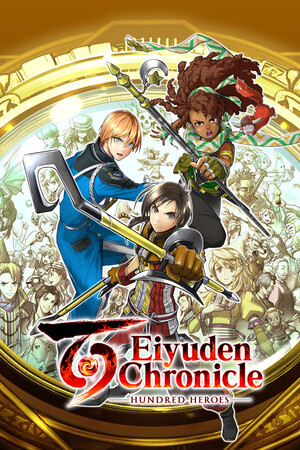
Eiyuden Chronicle: Hundred Heroes
Suikoden creator Yoshitaka Murayama's swan song delivers a 80-plus-hour JRPG that earns its roster of 100+ recruitable heroes, though it demands patience from anyone allergic to slow burns and random encounters.
GamerScout Verdict
Best for JRPG fans who want a sprawling character-collector with old-school bones and are willing to grind past a slow opening.
Compare Prices(9 stores)
Every store in this table quotes us in euros, so the EUR figure is the price the seller actually set, not our arithmetic — which is why EUR is also the currency we rank in. We only list an offer here when the store gives us its price in euros, so nothing in this table is a number we invented.
Pick USD, PLN, GBP, CAD or AUD in the header and we convert from EUR at the European Central Bank reference rate — converted amounts are prefixed with ~. Your bank or the store may apply a different rate at checkout. We never hide offers based on where you are: everyone sees this whole table.
We may earn a commission when you buy games through links on this page — at no extra cost to you. It never affects our rankings or verdicts.
Price History
Screenshots & Media
About Eiyuden Chronicle: Hundred Heroes
I put roughly forty hours into Eiyuden Chronicle: Hundred Heroes before I even started feeling the full weight of its ensemble cast, and that pacing divide is the first thing you need to know before committing. The opening ten to fifteen hours are unhurried by modern standards, introducing Nowa, a village kid swept into a continental war between the Galdean Empire and a growing resistance, alongside two additional perspective characters, the imperial officer Seign and the resourceful Marisa. The main arc is deliberately classical: empire bad, rune-lens MacGuffin at stake, unlikely alliance rises. The broad strokes are familiar. What saves the story from feeling rote is the texture underneath it, the small conversations at your castle, the way characters chime in on current events during town exploration, the occasional perspective switch that reframes who you were rooting for. That is where the writing earns its keep. Combat is turn-based, party-capped at six active members arranged in front and rear rows, with a seventh support slot for passive buffs. On top of standard turns, stamina-gated Hero Attacks let specific character pairings or trios chain into combo animations that are genuinely satisfying to watch land. Rune-lens magic covers the usual elemental spread, though magic point costs feel punishing early on, pushing you toward physical builds until your economy stabilises. War sequences swap the six-person format for a Risk-adjacent legion system where you position forces on a battlefield grid and then largely watch the numbers resolve, which is either pleasingly cinematic or disappointingly passive depending on your tolerance. One-on-one duels round out the combat variety, using a read-your-opponent tension meter that puts a fresh enough spin on the rock-paper-scissors duel format Suikoden fans will remember. None of these modes feel underbaked, though none of them are going to dethrone better-tuned strategy or tactics games in their respective niches. The recruitment loop is the engine that keeps all of this running. Tracking down 100-plus heroes involves revisiting earlier dungeons, winning specific minigames, locating rare items, and occasionally defeating optional bosses. The castle-building mechanic is tied directly to recruits: certain heroes are required to unlock specific facilities, and those facilities gate further recruits, creating a satisfying but occasionally opaque dependency chain. Fast travel eventually arrives, which is necessary because random encounters during puzzle-heavy dungeons become genuinely aggravating before you have it. The minigame suite, covering a collectible card game, a top-spinning battle mode, cooking, sand racing, and commodities trading, ranges from diverting to throwaway. The card game in particular has surprising depth, while the top battles exist mostly as a comedy of absurd lore. Visually, the 2D sprite-over-3D-background aesthetic is one of the most consistent artistic choices in recent JRPG memory. The spritework is detailed enough that each of the 100-plus characters reads as visually distinct at a glance, from punk mohawks to animated tree-creatures. The soundtrack from Motoi Sakuraba and Michiko Naruke is a genuine highlight. Where the game wobbles is quality-of-life: a Metacritic of 79 reflects a split between critics who found the retro design philosophy charming and those who found it obstructive. The honest read is that both camps are right. Lacking modern conveniences like early fast travel, high MP costs for spells, and encounter rates in dungeons that do not respect your time are real friction points, not nostalgic charm. This is the final project from Murayama before his passing in 2024, and it carries the weight of that context without demanding you treat it as a sacred artifact. Taken purely as a game, it is a generous, sometimes shaggy JRPG that prioritises breadth of character over tight mechanical innovation. If you have never played Suikoden and want to know what the fuss was about, this is a valid entry point. If you are a Suikoden veteran, expect familiar comfort food with a few rough edges the original games also had. If you want a JRPG that respects your time and modernises its systems, this is not that game, and that is a fair reason to look elsewhere.

RPGs
Tags
System Requirements
Minimum
- OS
- Windows 7, 8.1, 10 x64
- Processor
- AMD FX-4350 / Intel® Core™ i3-3210
- Memory
- 4 GB RAM
- Graphics
- AMD Radeon™ R7 260X (2GB VRAM) / NVIDIA® GeForce® GTX 750(2GB VRAM)
- Storage
- 22 GB available space
Recommended
- OS
- Windows 10
- Processor
- CPU: Intel Core i5-6600K (4 * 3500) / AMD FX-9590 (8 * 4700)
- Memory
- 8 GB RAM
- Graphics
- GPU: GeForce GTX 1650 (4096 MB) / Radeon RX 570 (8192 MB)
- Storage
- 30 GB available space…
DLC & Add-ons for Eiyuden Chronicle: Hundred Heroes1
Expansions, DLC packs and add-on content for this game. Click any item to see store offers.
Keep exploring
Community Discussion
Be the first to comment on Eiyuden Chronicle: Hundred Heroes.
Reviews & Ratings
Game Info
- Developer
- Rabbit & Bear Studios
- Publisher
- 505 Games
- Release Date
- Apr 23, 2024