

Arcanum: Of Steamworks and Magick Obscura
Few CRPGs have ever built a world this conceptually rich and then shipped it in a state this rough around the edges. Worth every frustrating minute if worldbuilding is your drug of choice.
GamerScout Verdict
Essential for worldbuilding-obsessed CRPG fans willing to patch before playing and forgive combat that never quite matches the ambition of everything else.
Compare Prices(4 stores)
Every store in this table quotes us in euros, so the EUR figure is the price the seller actually set, not our arithmetic — which is why EUR is also the currency we rank in. We only list an offer here when the store gives us its price in euros, so nothing in this table is a number we invented.
Pick USD, PLN, GBP, CAD or AUD in the header and we convert from EUR at the European Central Bank reference rate — converted amounts are prefixed with ~. Your bank or the store may apply a different rate at checkout. We never hide offers based on where you are: everyone sees this whole table.
We may earn a commission when you buy games through links on this page — at no extra cost to you. It never affects our rankings or verdicts.
Price History
Screenshots & Media
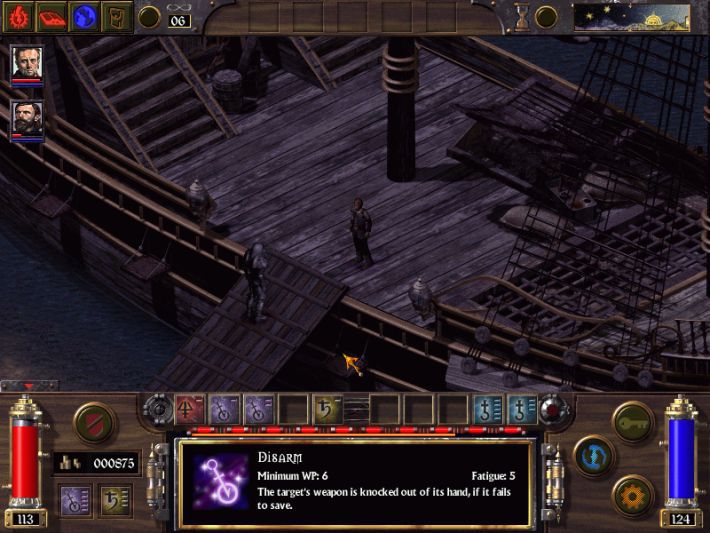
About Arcanum: Of Steamworks and Magick Obscura
I've gone back to Arcanum more times than I can justify, and every run confirms the same bittersweet truth: the ideas here are so far ahead of their time that the actual execution still can't fully contain them. Troika Games, founded by key members of the original Fallout team including Tim Cain, Leonard Boyarsky, and Jason Anderson, built a Victorian-industrial fantasy where orcs demand workers' union rights, electric streetlamps flicker next to crumbling temples, and a powerful mage gets bumped to third-class seating on a steam train because her presence might interfere with the engine. That level of systemic worldbuilding, where the magick-vs-technology tension reaches into every social layer of the setting, is genuinely rare even by today's standards. The character system is the game's beating heart. There are no classes, just a classless point-based build that spans eight races, 64 selectable backgrounds, sixteen colleges of magick with five spells each, and eight technological disciplines covering everything from gunsmithing to electrical engineering. The magick-technology aptitude slider is the masterstroke: the more you invest in spell colleges, the less reliable your firearms become in your hands, and vice versa. Playing a half-orc gunslinging technologist who can barely light a candle with a spell plays radically differently from a half-elf necromancer who wouldn't touch a steam-powered axe on principle. The dialogue system leans into this hard. NPCs read your stats, your race, your beauty score, your reputation, and your companions before deciding how to address you. Dump your intelligence to one and the entire game ships you an alternate script of limited, blunt dialogue options. That is a design commitment you almost never see. The story earns its runtime. You begin as the sole survivor of a zeppelin crash, handed a dying gnome's silver ring and a prophecy you may or may not believe. The main quest threads through political intrigue, religious cults, ancient conspiracies, and eventually confronts questions about free will and fate that the writing handles with genuine care. Quest solutions are genuinely multi-path: the same problem can be resolved through combat, persuasion, thievery, or bribery, and the game tracks your moral alignment with enough nuance that companions like Virgil will actually leave if your conduct crosses lines they won't tolerate. That kind of reactive companion writing was ahead of most contemporaries. Now the caveats, because there are several and they matter. Combat is the weak seam running through everything. The real-time mode is chaotic and poorly balanced, and while switching to turn-based helps significantly, the system never reaches the tactical satisfaction of an Infinity Engine game. Companion AI is infamous for standing in fire until their equipment degrades to nothing. Pathfinding is atrocious. The UI is clunky in ways that feel unfinished rather than charmingly old-fashioned. Running the game on modern Windows without the Unofficial Arcanum Patch is not recommended; freezing on multi-core CPUs and memory leak slowdowns are documented issues, and the patch also unlocks a high-resolution mode and upgrades the audio quality considerably. Treat the UAP as mandatory, not optional. Once patched, the experience is much more stable, though never silky. For players who can tolerate rough edges in exchange for worldbuilding density and build variety that holds up across multiple playthroughs, this remains one of the most singular CRPGs ever shipped. The string quartet soundtrack sets a melancholy, atmospheric tone that no other game in the genre has quite matched. If you bounced off it years ago due to the technical state, the patched modern version is meaningfully better. If you are expecting combat that feels like BG3 or even the original Fallout, recalibrate. Arcanum asks you to engage with its world on its own odd, brilliant, occasionally infuriating terms.

RPGs
Tags
System Requirements
Minimum
- OS
- Windows XP / Vista / 7 / 8
- Memory
- 256 MB RAM
- DirectX
- Version 7.0
- Storage
- 1200 MB available space
- Graphics
- DirectX 7 Compatible 3D Card
- Processor
- 1.0 GHz
- Sound Card
- DirectX Compatible
Recommended
- Memory
- 512 MB RAM
- DirectX
- Version 9.0
- Graphics
- DirectX 9 Compatible 3D Card
- Processor
- 1.4 GHz
- Sound Card
- DirectX Compatible
Keep exploring
Community Discussion
Be the first to comment on Arcanum: Of Steamworks and Magick Obscura.
Reviews & Ratings
Game Info
- Developer
- Troika Games
- Publisher
- Activision
- Release Date
- Aug 29, 2016