Compara los precios de Zeus + Poseidon en tiendas de claves de confianza y encuentra la mejor oferta. Desarrollado por Impressions Games. Publicado por Activision. Lanzado el 15/12/2016. Disponible en PC. Géneros: Strategy.

A city-builder from 2000 that Steam players still rate 96% positive today - the Greek mythology setting and scenario-driven structure make this an easy entry point without sacrificing the resource chain depth that keeps veterans hooked.

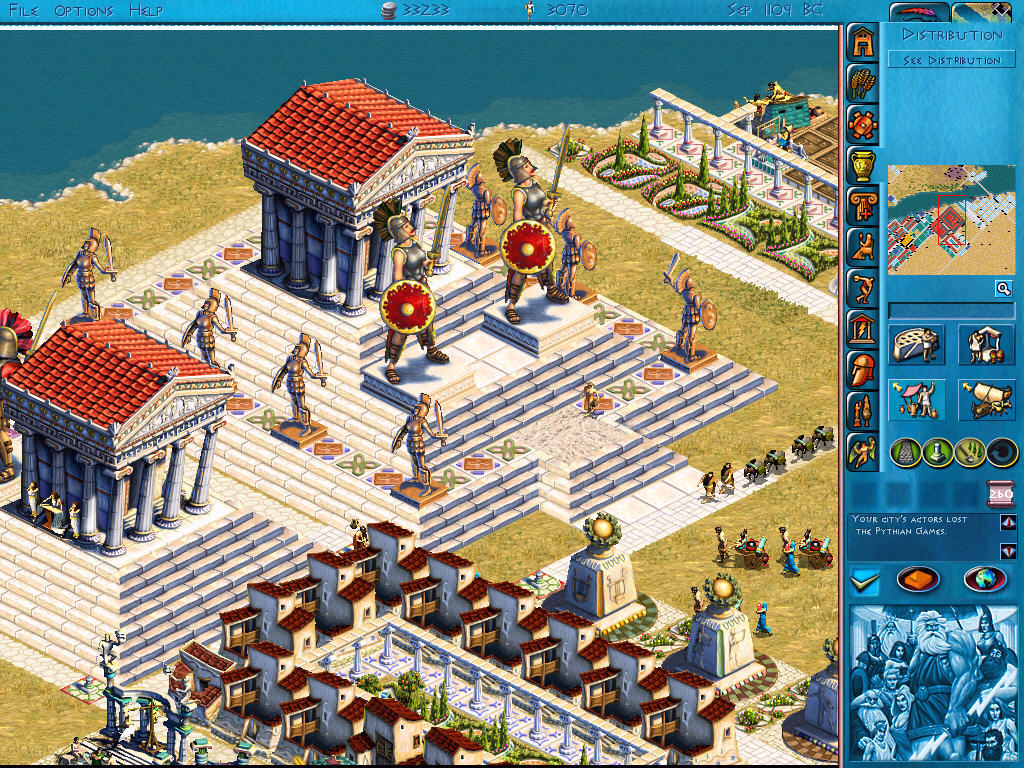
My spreadsheet brain lit up the first time I mapped out a Greek city-state in Zeus, and it has not dimmed in the decades since Impressions Games originally shipped this. This is a city-builder in the Impressions lineage - Caesar III, Pharaoh, then Zeus - and the bundle you are buying bundles both Zeus: Master of Olympus and its Poseidon expansion into one package covering two full civilizations: ancient Greece and the mythological lost continent of Atlantis. The core loop is a classic walker-based economy. You lay roads, place housing, then feed citizen needs through a chain of production and distribution buildings. Farms, granaries, olive presses, fisheries, and marble quarries all feed into the city's health and culture ratings, which in turn determine how far your housing upgrades and how much tax income you generate. The system is deliberately simpler than its predecessor Pharaoh - some veteran city-builder fans have noted the reduced mechanical complexity - but that accessibility is a feature for new players, not a flaw. Five difficulty tiers run from Beginner up to Olympian, and the difficulty scaling mostly works by tightening your starting Drachmas and increasing the frequency of god-sent disasters and enemy raids. Newcomers can genuinely learn the rhythm of the game on the lower settings before anything from the Greek pantheon decides your city is having too much fun. What separates Zeus from a generic economic sandbox is the mythology layer. Gods are not passive stat bonuses sitting in a menu - you build sanctuaries, dispatch priests to collect sacrifices, and manage individual deity favor. Ares helps in battle, Poseidon blesses maritime industries, Hades makes silver mines more productive, and Atlas (added in the expansion) speeds up the construction of Atlantean pyramids and monuments. Hero summons - figures like Bellerophon and Atalanta - are called in to deal with specific monster threats: the Sphinx, the Chimera, Medusa, the Harpy, and others that periodically target your districts. Managing which heroes to attract, which temples to prioritize, and whether your current favor balance can survive the next monster event is genuinely strategic. Military is the weakest pillar: combat mostly rewards having a bigger army, and bribery is frequently the smarter option. That criticism has followed the game for twenty years and remains accurate. The Poseidon campaign adds a second playable civilization with a meaningfully different building roster. Greek culture buildings like theaters and gymnasiums are replaced by Atlantean science structures: observatories, bibliothecas, universities, and laboratories. The Atlantis scenario arc draws loosely on Plato's account and delivers a coherent story from the founding of the kingdom through its exploration and eventual collapse - a narrative arc that holds up better than most story-driven city-builders today. Both campaigns are structured as scenario-based adventures with named episodes and concrete objectives rather than open sandboxes, which keeps progression meaningful and prevents the late-game drift that plagues pure sandbox builders. A fully featured Adventure Editor is also included, and a small but persistent community has continued producing custom campaigns - some uploaded as recently as 2022 - which extends replayability well past the base content. One practical note for modern buyers: the game's original resolution is limited and the UI was designed for early-2000s monitors. A fan-made widescreen patch is freely available and widely recommended by the Steam community. Installing it takes minutes and makes a real difference to the experience. Texture and audio quality are period-accurate, and a hard sprite limit prevents truly massive late-game cities, though you will realistically never hit that ceiling during normal play. If you bounced off Anno or Cities: Skylines because the sandbox felt directionless, Zeus is worth a serious look. The scenario structure keeps you accountable to goals, the mythology flavor gives each campaign a distinct identity, and the difficulty ladder means there is a comfortable entry point regardless of experience level. Diego, Scout Team

Zeus + Poseidon

Zeus + Poseidon

15 dic 2016Impressions GamesActivision
GamerScout opina

A city-builder from 2000 that Steam players still rate 96% positive today - the Greek mythology setting and scenario-driven structure make this an easy entry point without sacrificing the resource chain depth that keeps veterans hooked.

PC
Steam Deck UnsupportedProtonDB Gold
Mejor precio disponible
€0.00
en N/A
Mínimo histórico: €6.60

Comparar precios(0 tiendas)

Cargando precios...

We may earn a commission when you buy games through links on this page — at no extra cost to you. It never affects our rankings or verdicts.

Historial de precios

Historical low
€6.608 Jun 2026
Keyshops
€6.23€6.59€6.96€7.328 Jun13 Jun18 Jun23 Jun28 Jun
Tracking prices since 8 Jun 2026
Create alert

Capturas y multimedia

Captura

Acerca de Zeus + Poseidon

My spreadsheet brain lit up the first time I mapped out a Greek city-state in Zeus, and it has not dimmed in the decades since Impressions Games originally shipped this. This is a city-builder in the Impressions lineage - Caesar III, Pharaoh, then Zeus - and the bundle you are buying bundles both Zeus: Master of Olympus and its Poseidon expansion into one package covering two full civilizations: ancient Greece and the mythological lost continent of Atlantis. The core loop is a classic walker-based economy. You lay roads, place housing, then feed citizen needs through a chain of production and distribution buildings. Farms, granaries, olive presses, fisheries, and marble quarries all feed into the city's health and culture ratings, which in turn determine how far your housing upgrades and how much tax income you generate. The system is deliberately simpler than its predecessor Pharaoh - some veteran city-builder fans have noted the reduced mechanical complexity - but that accessibility is a feature for new players, not a flaw. Five difficulty tiers run from Beginner up to Olympian, and the difficulty scaling mostly works by tightening your starting Drachmas and increasing the frequency of god-sent disasters and enemy raids. Newcomers can genuinely learn the rhythm of the game on the lower settings before anything from the Greek pantheon decides your city is having too much fun. What separates Zeus from a generic economic sandbox is the mythology layer. Gods are not passive stat bonuses sitting in a menu - you build sanctuaries, dispatch priests to collect sacrifices, and manage individual deity favor. Ares helps in battle, Poseidon blesses maritime industries, Hades makes silver mines more productive, and Atlas (added in the expansion) speeds up the construction of Atlantean pyramids and monuments. Hero summons - figures like Bellerophon and Atalanta - are called in to deal with specific monster threats: the Sphinx, the Chimera, Medusa, the Harpy, and others that periodically target your districts. Managing which heroes to attract, which temples to prioritize, and whether your current favor balance can survive the next monster event is genuinely strategic. Military is the weakest pillar: combat mostly rewards having a bigger army, and bribery is frequently the smarter option. That criticism has followed the game for twenty years and remains accurate. The Poseidon campaign adds a second playable civilization with a meaningfully different building roster. Greek culture buildings like theaters and gymnasiums are replaced by Atlantean science structures: observatories, bibliothecas, universities, and laboratories. The Atlantis scenario arc draws loosely on Plato's account and delivers a coherent story from the founding of the kingdom through its exploration and eventual collapse - a narrative arc that holds up better than most story-driven city-builders today. Both campaigns are structured as scenario-based adventures with named episodes and concrete objectives rather than open sandboxes, which keeps progression meaningful and prevents the late-game drift that plagues pure sandbox builders. A fully featured Adventure Editor is also included, and a small but persistent community has continued producing custom campaigns - some uploaded as recently as 2022 - which extends replayability well past the base content. One practical note for modern buyers: the game's original resolution is limited and the UI was designed for early-2000s monitors. A fan-made widescreen patch is freely available and widely recommended by the Steam community. Installing it takes minutes and makes a real difference to the experience. Texture and audio quality are period-accurate, and a hard sprite limit prevents truly massive late-game cities, though you will realistically never hit that ceiling during normal play. If you bounced off Anno or Cities: Skylines because the sandbox felt directionless, Zeus is worth a serious look. The scenario structure keeps you accountable to goals, the mythology flavor gives each campaign a distinct identity, and the difficulty ladder means there is a comfortable entry point regardless of experience level.

Diego
Diego · Scout Team

Strategy & simulation

Etiquetas

singleplayertier:indieWalker-Based EconomyScenario-DrivenMythology MechanicsAdventure EditorFive Difficulty TiersGod ManagementHero SummonsWidescreen Patch RequiredCommunity Campaigns

Requisitos del sistema

Mínimos

OS
Windows XP / Vista / 7 / 8 / 10
Memory
512 MB RAM
DirectX
Version 7.0
Storage
2 GB available space
Graphics
DirectX 7 Compatible 3D Card
Processor
1.8 GHz
Sound Card
Direct X Compatible

Recomendados

Memory
1 GB RAM
DirectX
Version 9.0
Graphics
DirectX 9 Compatible 3D Card

Sigue explorando

Community Discussion

Be the first to comment on Zeus + Poseidon.

Reseñas y valoraciones

No hay valoraciones disponibles

Información del juego

Desarrolladora
Impressions Games
Distribuidora
Activision
Fecha de lanzamiento
15 dic 2016

Alerta de precio

¡Recibe un aviso cuando el precio baje de tu objetivo!

Crear alerta

Más de Impressions Games

Compra mejor: guías útiles

¿Buscas más? Mira juegos como Zeus + Poseidon →

Preguntas frecuentes sobre Zeus + Poseidon

¿Cuánto cuesta Zeus + Poseidon?

El precio de Zeus + Poseidon cambia a menudo y varía según la tienda, la edición y la región. La tabla de precios en vivo de esta página compara las ofertas más baratas en stock de tiendas de claves de confianza como Eneba y Kinguin, para que siempre veas el precio más bajo actual antes de comprar.

¿Dónde puedo comprar Zeus + Poseidon más barato?

Compara los precios de Zeus + Poseidon en todas las tiendas verificadas en la tabla de precios de esta página. Listamos las ofertas de claves y tiendas más baratas en stock, actualizadas con frecuencia, para que siempre veas la mejor oferta actual antes de comprar.

¿En qué plataformas está disponible Zeus + Poseidon?

Zeus + Poseidon está disponible en PC.

¿Cuándo se lanzó Zeus + Poseidon?

Zeus + Poseidon se lanzó el 15 de diciembre de 2016.

¿Quién desarrolló Zeus + Poseidon?

Zeus + Poseidon fue desarrollado por Impressions Games y publicado por Activision.