
Compara los precios de Who's Lila? en tiendas de claves de confianza y encuentra la mejor oferta. Desarrollado por Garage Heathen. Publicado por Garage Heathen. Lanzado el 23/2/2022. Disponible en PC. Géneros: Adventure, Casual, Indie, RPG.

Sculpt a sociopath's face to dodge a murder investigation, all rendered in a ditherpunk aesthetic that feels like a Game Boy dreamed it up after watching Twin Peaks. One of the most quietly singular games to come out of the indie scene in years.

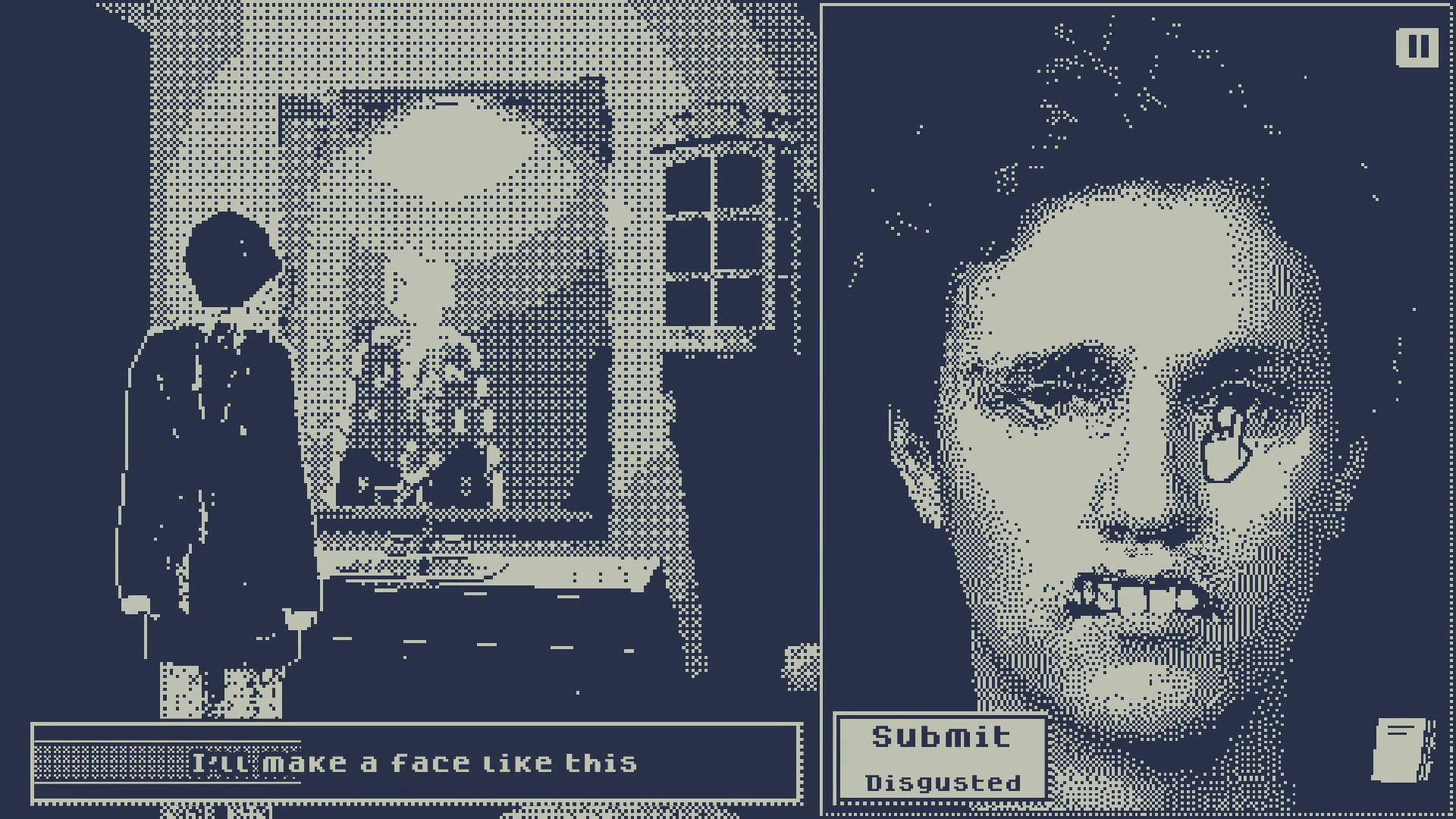
My first hour with Who's Lila? was spent doing something no game has ever asked of me: dragging a young man's eyebrows, lips, and chin into the shape of a convincing smile so that his classmates would not immediately suspect him of murder. The facial expression mechanic sounds like a party trick on paper. It is absolutely not a party trick. You play as William, a teenager who cannot produce emotions naturally and must consciously choreograph every muscle in his face before each social interaction. The split-screen layout captures this perfectly: the left side shows William navigating a hazy, ditherpunk world of school corridors and steam-filled factories, while the right side holds a close-up of his face, which you sculpt using click-and-drag controls during dialogue. A neural network reads seven possible emotions (neutral, happy, sad, angry, surprised, disgusted, fear) and routes the conversation accordingly. Get the expression wrong and characters grow suspicious. Get it right and new paths crack open. The tension in what should be a mundane hallway conversation is extraordinary, because a smile at the wrong moment can derail everything. There is even an involuntary twitch system, where William's face starts to betray him under stress, and you have to fight his own muscles to maintain composure. Easy mode lets you turn that off, which is a thoughtful concession, but leave it on if you can stomach it. The nonlinear structure gives Who's Lila? its real staying power. There are 15 endings plus additional hidden ones, and the loop of replaying each day, catching different buses to new locations, and trying fresh expression combinations never feels like padding. Collected endings are represented as tarot cards, which can be brought to a specific character for additional lore fragments, a small but elegant design choice that rewards completionists without punishing casual players. The game also stretches outside its own borders through ARG elements, including fictional social media profiles and a separate companion program that unlocks certain events. Some of those external hooks have become harder to access over time as platforms shift, and the developer has flagged plans to migrate that content to their own site. The ditherpunk visual style divides people, and honestly it should. Characters are rendered in a limited one-bit palette that sits somewhere between a dot-matrix printout and an old LCD screen. Environments are intentionally ambiguous, and some players will spend their opening thirty minutes unable to parse what they are looking at. That confusion is partially by design; the school's layout is deliberately labyrinthine, doors not always leading where logic suggests. Stick with it. Once the aesthetic clicks, it does something remarkable: the limited palette makes every colour change in key scenes feel charged, and the close-up face on the right side of the screen becomes genuinely unsettling in moments the game has carefully earned. Rock Paper Shotgun called the face-pulling mechanic "both incredibly clever and incredibly creepy," and that lands. The soundtrack, over 50 pieces written specifically for the game, earns its own paragraph in a fairer world. It moves between melancholy ambience and distorted industrial drones, and certain tracks have the kind of staying power that players are still requesting as a standalone release years after launch. The honest caveats: the left-side navigation can feel sticky, especially when camera angles shift in certain environments. A small number of expression puzzles offer no hint as to which emotion is needed to progress, and a walkthrough lookup feels inevitable at least once per playthrough. The story, too, leans hard into abstraction and occasionally lets its supernatural characters talk at length about consciousness and perception in ways that test patience. But Garage Heathen, a one-person studio, built something here that prompted an academic thesis, spawned a dedicated wiki, and has players returning years later to chase the last hidden endings. That kind of gravity is rare and worth your attention. Kai, Scout Team

Who's Lila?

Who's Lila?

23 feb 2022Garage Heathen
GamerScout opina

Sculpt a sociopath's face to dodge a murder investigation, all rendered in a ditherpunk aesthetic that feels like a Game Boy dreamed it up after watching Twin Peaks. One of the most quietly singular games to come out of the indie scene in years.

PC
Steam Deck VerifiedProtonDB Gold
Mejor precio disponible
€0.00
en N/A
Mínimo histórico: €1.37

Comparar precios(0 tiendas)

Cargando precios...

We may earn a commission when you buy games through links on this page — at no extra cost to you. It never affects our rankings or verdicts.

Historial de precios

Historical low
€1.3726 Jun 2026
Keyshops
€1.27€1.35€1.42€1.505 Jun11 Jun17 Jun22 Jun28 Jun
Tracking prices since 5 Jun 2026
Create alert

Capturas y multimedia

Captura

Acerca de Who's Lila?

My first hour with Who's Lila? was spent doing something no game has ever asked of me: dragging a young man's eyebrows, lips, and chin into the shape of a convincing smile so that his classmates would not immediately suspect him of murder. The facial expression mechanic sounds like a party trick on paper. It is absolutely not a party trick. You play as William, a teenager who cannot produce emotions naturally and must consciously choreograph every muscle in his face before each social interaction. The split-screen layout captures this perfectly: the left side shows William navigating a hazy, ditherpunk world of school corridors and steam-filled factories, while the right side holds a close-up of his face, which you sculpt using click-and-drag controls during dialogue. A neural network reads seven possible emotions (neutral, happy, sad, angry, surprised, disgusted, fear) and routes the conversation accordingly. Get the expression wrong and characters grow suspicious. Get it right and new paths crack open. The tension in what should be a mundane hallway conversation is extraordinary, because a smile at the wrong moment can derail everything. There is even an involuntary twitch system, where William's face starts to betray him under stress, and you have to fight his own muscles to maintain composure. Easy mode lets you turn that off, which is a thoughtful concession, but leave it on if you can stomach it. The nonlinear structure gives Who's Lila? its real staying power. There are 15 endings plus additional hidden ones, and the loop of replaying each day, catching different buses to new locations, and trying fresh expression combinations never feels like padding. Collected endings are represented as tarot cards, which can be brought to a specific character for additional lore fragments, a small but elegant design choice that rewards completionists without punishing casual players. The game also stretches outside its own borders through ARG elements, including fictional social media profiles and a separate companion program that unlocks certain events. Some of those external hooks have become harder to access over time as platforms shift, and the developer has flagged plans to migrate that content to their own site. The ditherpunk visual style divides people, and honestly it should. Characters are rendered in a limited one-bit palette that sits somewhere between a dot-matrix printout and an old LCD screen. Environments are intentionally ambiguous, and some players will spend their opening thirty minutes unable to parse what they are looking at. That confusion is partially by design; the school's layout is deliberately labyrinthine, doors not always leading where logic suggests. Stick with it. Once the aesthetic clicks, it does something remarkable: the limited palette makes every colour change in key scenes feel charged, and the close-up face on the right side of the screen becomes genuinely unsettling in moments the game has carefully earned. Rock Paper Shotgun called the face-pulling mechanic "both incredibly clever and incredibly creepy," and that lands. The soundtrack, over 50 pieces written specifically for the game, earns its own paragraph in a fairer world. It moves between melancholy ambience and distorted industrial drones, and certain tracks have the kind of staying power that players are still requesting as a standalone release years after launch. The honest caveats: the left-side navigation can feel sticky, especially when camera angles shift in certain environments. A small number of expression puzzles offer no hint as to which emotion is needed to progress, and a walkthrough lookup feels inevitable at least once per playthrough. The story, too, leans hard into abstraction and occasionally lets its supernatural characters talk at length about consciousness and perception in ways that test patience. But Garage Heathen, a one-person studio, built something here that prompted an academic thesis, spawned a dedicated wiki, and has players returning years later to chase the last hidden endings. That kind of gravity is rare and worth your attention.

Kai
Kai · Scout Team

Indie & narrative

Etiquetas

singleplayerachievementstrading-cardsworkshopcloud-savestier:sub-5DitherpunkPsychological HorrorARG ElementsFace MechanicsMultiple EndingsNonlinearLo-Fi HorrorOne-Dev StudioTarot Endings

Requisitos del sistema

Mínimos

OS
Windows 10
Memory
4 GB RAM
DirectX
Version 10
Storage
715 MB available space
Graphics
Intel HD Graphics Family
Processor
i3–4150 CPU

Sigue explorando

Community Discussion

Be the first to comment on Who's Lila?.

Reseñas y valoraciones

No hay valoraciones disponibles

Información del juego

Desarrolladora
Garage Heathen
Distribuidora
Garage Heathen
Fecha de lanzamiento
23 feb 2022

Alerta de precio

¡Recibe un aviso cuando el precio baje de tu objetivo!

Crear alerta

Compra mejor: guías útiles

¿Buscas más? Mira juegos como Who's Lila? →

Preguntas frecuentes sobre Who's Lila?

¿Cuánto cuesta Who's Lila??

El precio de Who's Lila? cambia a menudo y varía según la tienda, la edición y la región. La tabla de precios en vivo de esta página compara las ofertas más baratas en stock de tiendas de claves de confianza como Eneba y Kinguin, para que siempre veas el precio más bajo actual antes de comprar.

¿Dónde puedo comprar Who's Lila? más barato?

Compara los precios de Who's Lila? en todas las tiendas verificadas en la tabla de precios de esta página. Listamos las ofertas de claves y tiendas más baratas en stock, actualizadas con frecuencia, para que siempre veas la mejor oferta actual antes de comprar.

¿En qué plataformas está disponible Who's Lila??

Who's Lila? está disponible en PC.

¿Cuándo se lanzó Who's Lila??

Who's Lila? se lanzó el 23 de febrero de 2022.

¿Quién desarrolló Who's Lila??

Who's Lila? fue desarrollado por Garage Heathen.