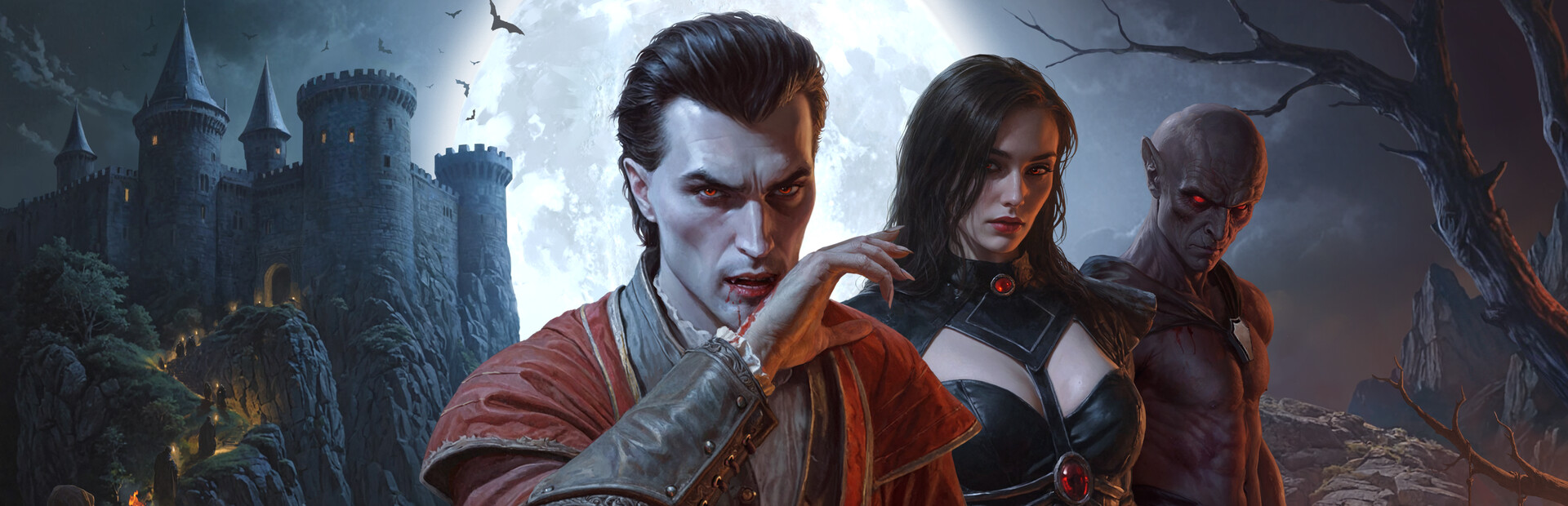

Compara los precios de Vampires: Bloodlord Rising en tiendas de claves de confianza y encuentra la mejor oferta. Desarrollado por Mehuman Games. Publicado por Toplitz Productions. Lanzado el 30/1/2026. Disponible en PC. Géneros: Action, Adventure, RPG, Simulation, Early Access.

Gothic castle-sim meets open-world action-RPG with a vampire-lord power fantasy that earns its fangs in co-op and loses them slightly to Early Access roughness.

My instinct with any sim-adjacent RPG is to map the progression loop before anything else, and Bloodlord Rising's loop is genuinely interesting on paper: feed the Castle Core to unlock new zones, convert villagers into thralls via the Kiss of Eternal Life, assign them to Gathering Stations and crafting benches, then push further into the open world of Sangavia as your gothic fortress grows around you. That chain of dependencies is exactly the kind of interlocking system I want to see from a game pitching itself at the management-RPG crossover audience. The good news is that the foundation mostly holds. The bad news is that 'mostly' is doing a lot of work in this Early Access build. Combat sits at the action end of the dial rather than the strategy end, but it has more texture than you might expect. Dragos has claw strikes, shield-breaking moves, and counters alongside a supernatural ability set called Arcanes, unlocked by collecting Vampire Tears scattered across the world. The bat traversal doubles as both a fast-travel substitute and a genuine scouting tool, letting you read enemy patrol routes from above before dropping in. Combat escalates fast when Inquisition groups pile on, and the game punishes button-mashing by asking you to manage stamina and cooldowns simultaneously. It stops short of Souls-level punishment, but careless players will die to groups of holy knights more than once. The social stealth layer adds the most interesting decision-making: walking Medestri and nearby villages in Aristocrat mode to gather NPC intel, then switching to Hunter form in a blind spot to deliver the Kiss of Eternal Life without witnesses, because getting spotted tanks your village production and puts the Inquisition on alert. That predator-in-plain-sight tension is the game at its sharpest. Castle building is the backbone, not the garnish. Your fort houses crafting stations for lumber, limestone, and clay processing, plus coffins for every thrall you recruit. Servant traits matter: a former blacksmith will outperform a converted farmer at weapon crafting, so you are effectively running a small workforce with specialisations. The flexible snap-to-grid editor handles halls, crypts, workshops, and throne rooms with enough freedom that two players' castles will look meaningfully different after twenty hours. The grind does tighten up around mid-game, though. Crafting progression can feel bottlenecked, and the Castle Core's blood-reserve gate for new regions means you are sometimes waiting on a resource drip rather than making decisions. That is a balance problem, not a design problem, and it is the kind of thing Early Access patches can fix. The 4-player co-op works on persistent shared worlds, meaning progress carries across sessions. Dividing labour, one player gathering, one building, one pushing combat, makes the early hours considerably more manageable, though co-op progression syncing can leave friends feeling like spectators when the story gates content to the host's choices. The narrative itself is competent gothic comfort food set against Eastern European folklore, with voice acting that reviews have split on (some find it charming, others call it cheesy). The main story wraps in roughly 8 hours of the current build, with the developer targeting three times that content at full release. Technically, performance on mid-range hardware is workable around 60-80fps at 1440p, but expect minor stutters in dense towns and some servant pathfinding that can charitably be described as 'creative'. These are fixable, but they are present. If you are the kind of player who sketches out their thrall roster and castle layout before logging in, Bloodlord Rising offers a genuinely distinctive loop with no close equivalent on the market right now. The publisher's Medieval Dynasty DNA is visible in the settlement-sim pacing, and this shares that game's slow-burn appeal. Newcomers who ignore the tutorial pop-ups will struggle, but anyone willing to read the systems will find a vampire fantasy with more managerial depth than its gothic coat suggests. At Early Access prices with a 12-month roadmap, the risk is real, but the foundation is one of the stronger ones I have seen in this space. Diego, Scout Team

Vampires: Bloodlord Rising

Vampires: Bloodlord Rising

30 ene 2026Mehuman GamesToplitz Productions
GamerScout opina

Gothic castle-sim meets open-world action-RPG with a vampire-lord power fantasy that earns its fangs in co-op and loses them slightly to Early Access roughness.

PC
Steam Deck UnsupportedProtonDB Gold
Mejor precio disponible
€0.00
en N/A
Mínimo histórico: €10.60

Comparar precios(0 tiendas)

Cargando precios...

We may earn a commission when you buy games through links on this page — at no extra cost to you. It never affects our rankings or verdicts.

Historial de precios

Historical low
€10.608 Jun 2026
Keyshops
€10.06€11.91€13.77€15.628 Jun13 Jun18 Jun23 Jun28 Jun
Tracking prices since 8 Jun 2026
Create alert

Capturas y multimedia

Acerca de Vampires: Bloodlord Rising

My instinct with any sim-adjacent RPG is to map the progression loop before anything else, and Bloodlord Rising's loop is genuinely interesting on paper: feed the Castle Core to unlock new zones, convert villagers into thralls via the Kiss of Eternal Life, assign them to Gathering Stations and crafting benches, then push further into the open world of Sangavia as your gothic fortress grows around you. That chain of dependencies is exactly the kind of interlocking system I want to see from a game pitching itself at the management-RPG crossover audience. The good news is that the foundation mostly holds. The bad news is that 'mostly' is doing a lot of work in this Early Access build. Combat sits at the action end of the dial rather than the strategy end, but it has more texture than you might expect. Dragos has claw strikes, shield-breaking moves, and counters alongside a supernatural ability set called Arcanes, unlocked by collecting Vampire Tears scattered across the world. The bat traversal doubles as both a fast-travel substitute and a genuine scouting tool, letting you read enemy patrol routes from above before dropping in. Combat escalates fast when Inquisition groups pile on, and the game punishes button-mashing by asking you to manage stamina and cooldowns simultaneously. It stops short of Souls-level punishment, but careless players will die to groups of holy knights more than once. The social stealth layer adds the most interesting decision-making: walking Medestri and nearby villages in Aristocrat mode to gather NPC intel, then switching to Hunter form in a blind spot to deliver the Kiss of Eternal Life without witnesses, because getting spotted tanks your village production and puts the Inquisition on alert. That predator-in-plain-sight tension is the game at its sharpest. Castle building is the backbone, not the garnish. Your fort houses crafting stations for lumber, limestone, and clay processing, plus coffins for every thrall you recruit. Servant traits matter: a former blacksmith will outperform a converted farmer at weapon crafting, so you are effectively running a small workforce with specialisations. The flexible snap-to-grid editor handles halls, crypts, workshops, and throne rooms with enough freedom that two players' castles will look meaningfully different after twenty hours. The grind does tighten up around mid-game, though. Crafting progression can feel bottlenecked, and the Castle Core's blood-reserve gate for new regions means you are sometimes waiting on a resource drip rather than making decisions. That is a balance problem, not a design problem, and it is the kind of thing Early Access patches can fix. The 4-player co-op works on persistent shared worlds, meaning progress carries across sessions. Dividing labour, one player gathering, one building, one pushing combat, makes the early hours considerably more manageable, though co-op progression syncing can leave friends feeling like spectators when the story gates content to the host's choices. The narrative itself is competent gothic comfort food set against Eastern European folklore, with voice acting that reviews have split on (some find it charming, others call it cheesy). The main story wraps in roughly 8 hours of the current build, with the developer targeting three times that content at full release. Technically, performance on mid-range hardware is workable around 60-80fps at 1440p, but expect minor stutters in dense towns and some servant pathfinding that can charitably be described as 'creative'. These are fixable, but they are present. If you are the kind of player who sketches out their thrall roster and castle layout before logging in, Bloodlord Rising offers a genuinely distinctive loop with no close equivalent on the market right now. The publisher's Medieval Dynasty DNA is visible in the settlement-sim pacing, and this shares that game's slow-burn appeal. Newcomers who ignore the tutorial pop-ups will struggle, but anyone willing to read the systems will find a vampire fantasy with more managerial depth than its gothic coat suggests. At Early Access prices with a 12-month roadmap, the risk is real, but the foundation is one of the stronger ones I have seen in this space.

Diego
Diego · Scout Team

Strategy & simulation

Etiquetas

singleplayermultiplayercooponline-coopachievementscontroller-supporttrading-cardscloud-savestier:aaaCastle Core ProgressionThrall ManagementAristocrat-Hunter Dual FormArcane Ability TreePersistent Co-op WorldGothic Settlement SimInquisition Faction PressureChoices and Consequences

Requisitos del sistema

Mínimos

OS
Windows 10 (x64)
Memory
16 GB RAM
DirectX
Version 12
Storage
20 GB available space
Graphics
NVIDIA GeForce GTX 1070, 8 GB or AMD Radeon RX Vega 56, 8 GB or Intel Arc A580, 8 GB
Processor
Intel Core i5-12600K or AMD Ryzen 5 5600X

Recomendados

OS
Windows 11 (x64)
Memory
32 GB RAM
DirectX
Version 12
Storage
20 GB available space
Graphics
NVIDIA GeForce RTX 3060 Ti, 8 GB or AMD Radeon RX 6700 XT, 12 GB
Processor
Intel Core i9-14900K or AMD Ryzen 9 7950X

Sigue explorando

Community Discussion

Be the first to comment on Vampires: Bloodlord Rising.

Reseñas y valoraciones

No hay valoraciones disponibles

Información del juego

Desarrolladora
Mehuman Games
Distribuidora
Toplitz Productions
Fecha de lanzamiento
30 ene 2026

Alerta de precio

¡Recibe un aviso cuando el precio baje de tu objetivo!

Crear alerta

Compra mejor: guías útiles

¿Buscas más? Mira juegos como Vampires: Bloodlord Rising →

Preguntas frecuentes sobre Vampires: Bloodlord Rising

¿Cuánto cuesta Vampires: Bloodlord Rising?

El precio de Vampires: Bloodlord Rising cambia a menudo y varía según la tienda, la edición y la región. La tabla de precios en vivo de esta página compara las ofertas más baratas en stock de tiendas de claves de confianza como Eneba y Kinguin, para que siempre veas el precio más bajo actual antes de comprar.

¿Dónde puedo comprar Vampires: Bloodlord Rising más barato?

Compara los precios de Vampires: Bloodlord Rising en todas las tiendas verificadas en la tabla de precios de esta página. Listamos las ofertas de claves y tiendas más baratas en stock, actualizadas con frecuencia, para que siempre veas la mejor oferta actual antes de comprar.

¿En qué plataformas está disponible Vampires: Bloodlord Rising?

Vampires: Bloodlord Rising está disponible en PC.

¿Cuándo se lanzó Vampires: Bloodlord Rising?

Vampires: Bloodlord Rising se lanzó el 30 de enero de 2026.

¿Quién desarrolló Vampires: Bloodlord Rising?

Vampires: Bloodlord Rising fue desarrollado por Mehuman Games y publicado por Toplitz Productions.