Compara los precios de UBERMOSH:BLACK en tiendas de claves de confianza y encuentra la mejor oferta. Desarrollado por Walter Machado. Publicado por Walter Machado. Lanzado el 17/2/2016. Disponible en PC, Linux. Géneros: Action, Indie.

Ninety seconds, one arena, no mercy: UBERMOSH:BLACK distills arcade brutality into a one-person love letter that rewards the obsessive and punishes the impatient.

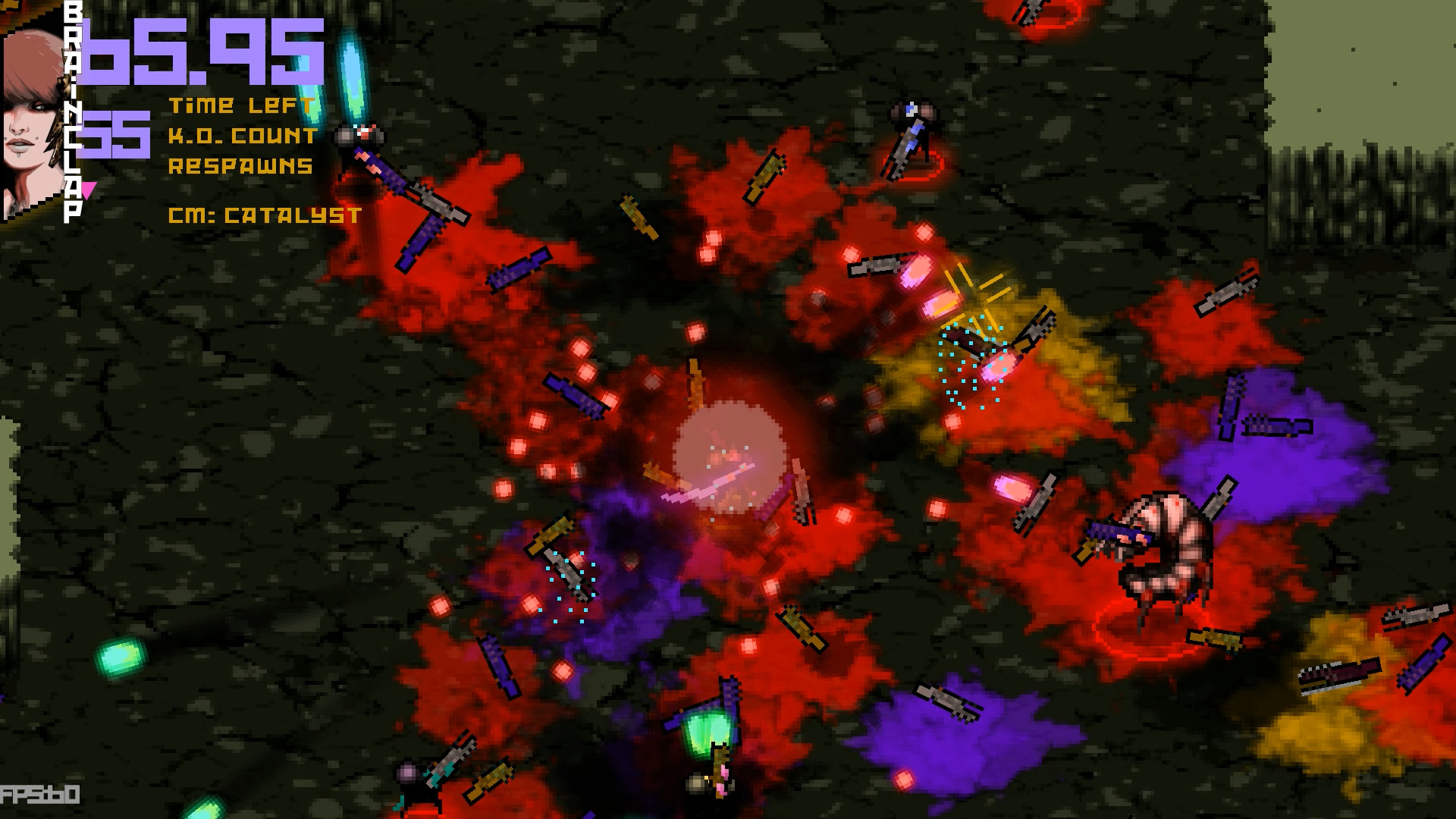
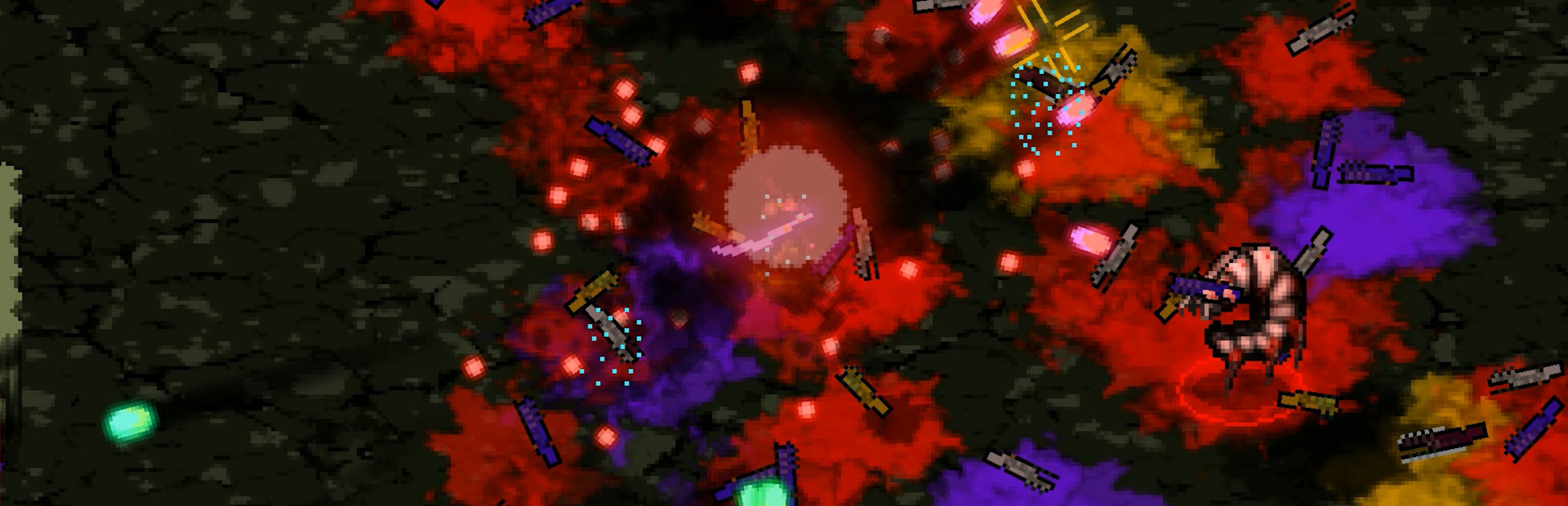
I keep coming back to the absurd purity of what Walter Machado built here. One arena. Ninety seconds. A sword that cuts bullets and a rotating pool of dropped guns, and somewhere in that frantic blur of pixels and metal music, something genuinely special lives. UBERMOSH:BLACK is the second volume in a series that has grown into a cult franchise on the strength of its commitment to one idea executed with total sincerity. The core loop is as tight as arcade design gets. You play as the Blade Saint, dropped into a pit where enemies spawn and charge. Your sword deflects incoming bullets back at their senders, and every kill drops a firearm you can pick up, though watch your feet because the game swaps your current weapon automatically if you walk over a new one, a wrinkle borrowed from old Contra muscle memory. Guns vary in spread, fire rate, and bullet count, so there is quiet decision-making underneath the chaos. BLACK's headline addition is the brainclap: a psionic wave that detonates after a kill threshold is reached, clearing out nearby enemies in a spray of visceral feedback. It sounds simple. Landing one in the middle of a swarm that has you pinned feels like unlocking a superpower you earned rather than one you were handed. The Kensai class mod flips the formula further by stripping guns entirely and leaning into pure blade work with extra respawns. The tension the game creates in ninety seconds is real and renewable. The first few sessions feel unfair, and honestly, they are slightly. The field of view clips enemies into your personal space before you have time to react, and the difficulty ramp is steep. But that friction is also the point. Like a Touhou run or a high-score arcade cabinet, survival here is about rhythm, pattern recognition, and the slow creep of competence. The achievements give you concrete milestones to chase, and the time-to-completion is short enough that you reach them before the loop wears out its welcome. The presentation is honest about its budget origins. The sprites are rough, and there is no story to speak of, no character arc, no world-building beyond the faintest cyberpunk silhouette. What Machado does spend his craft on is the soundtrack: a self-composed blend of rock, metal, and electronica that hits the same note the gameplay does, aggressive and purposeful without a single wasted bar. The sound design on bullet deflections is a small joy in its own right, a crisp percussive snap that turns every good parry into its own reward. Where BLACK stumbles is in what it refuses to add. One arena means one arena, session after session. Players who crave variety in map layout, enemy types, or any kind of progression system outside of score and achievements will find the walls closing in quickly. As a second volume it adds the brainclap, a new gun, a new class mod, and harder enemy density, which is a meaningful but narrow expansion of the original formula. If you are new to the series, starting here is fine. If you already know UBERMOSH and want evolution, BLACK is a refinement, not a reinvention. What it is, though, is a handcrafted micro-experience that knows what it is and refuses to pretend otherwise. Walter Machado released a series of eight volumes, shaped by community feedback, each one a small iteration. BLACK sits early in that arc, raw and compact, and it has the unpolished conviction of someone making exactly the game they wanted to make. For players who like arcade games that ask something of them, who find 90 seconds both too short and somehow enough, this is worth the low asking price without hesitation. Kai, Scout Team

UBERMOSH:BLACK

UBERMOSH:BLACK

17 feb 2016Walter Machado
GamerScout opina

Ninety seconds, one arena, no mercy: UBERMOSH:BLACK distills arcade brutality into a one-person love letter that rewards the obsessive and punishes the impatient.

PCLinux
Steam Deck VerifiedProtonDB Platinum
Mejor precio disponible
€0.00
en N/A
Mínimo histórico: €0.53

Comparar precios(0 tiendas)

Cargando precios...

We may earn a commission when you buy games through links on this page — at no extra cost to you. It never affects our rankings or verdicts.

Historial de precios

Historical low
€0.539 Jun 2026
Keyshops
€0.49€0.52€0.55€0.587 Jun12 Jun18 Jun23 Jun28 Jun
Tracking prices since 7 Jun 2026
Create alert

Capturas y multimedia

Captura

Acerca de UBERMOSH:BLACK

I keep coming back to the absurd purity of what Walter Machado built here. One arena. Ninety seconds. A sword that cuts bullets and a rotating pool of dropped guns, and somewhere in that frantic blur of pixels and metal music, something genuinely special lives. UBERMOSH:BLACK is the second volume in a series that has grown into a cult franchise on the strength of its commitment to one idea executed with total sincerity. The core loop is as tight as arcade design gets. You play as the Blade Saint, dropped into a pit where enemies spawn and charge. Your sword deflects incoming bullets back at their senders, and every kill drops a firearm you can pick up, though watch your feet because the game swaps your current weapon automatically if you walk over a new one, a wrinkle borrowed from old Contra muscle memory. Guns vary in spread, fire rate, and bullet count, so there is quiet decision-making underneath the chaos. BLACK's headline addition is the brainclap: a psionic wave that detonates after a kill threshold is reached, clearing out nearby enemies in a spray of visceral feedback. It sounds simple. Landing one in the middle of a swarm that has you pinned feels like unlocking a superpower you earned rather than one you were handed. The Kensai class mod flips the formula further by stripping guns entirely and leaning into pure blade work with extra respawns. The tension the game creates in ninety seconds is real and renewable. The first few sessions feel unfair, and honestly, they are slightly. The field of view clips enemies into your personal space before you have time to react, and the difficulty ramp is steep. But that friction is also the point. Like a Touhou run or a high-score arcade cabinet, survival here is about rhythm, pattern recognition, and the slow creep of competence. The achievements give you concrete milestones to chase, and the time-to-completion is short enough that you reach them before the loop wears out its welcome. The presentation is honest about its budget origins. The sprites are rough, and there is no story to speak of, no character arc, no world-building beyond the faintest cyberpunk silhouette. What Machado does spend his craft on is the soundtrack: a self-composed blend of rock, metal, and electronica that hits the same note the gameplay does, aggressive and purposeful without a single wasted bar. The sound design on bullet deflections is a small joy in its own right, a crisp percussive snap that turns every good parry into its own reward. Where BLACK stumbles is in what it refuses to add. One arena means one arena, session after session. Players who crave variety in map layout, enemy types, or any kind of progression system outside of score and achievements will find the walls closing in quickly. As a second volume it adds the brainclap, a new gun, a new class mod, and harder enemy density, which is a meaningful but narrow expansion of the original formula. If you are new to the series, starting here is fine. If you already know UBERMOSH and want evolution, BLACK is a refinement, not a reinvention. What it is, though, is a handcrafted micro-experience that knows what it is and refuses to pretend otherwise. Walter Machado released a series of eight volumes, shaped by community feedback, each one a small iteration. BLACK sits early in that arc, raw and compact, and it has the unpolished conviction of someone making exactly the game they wanted to make. For players who like arcade games that ask something of them, who find 90 seconds both too short and somehow enough, this is worth the low asking price without hesitation.

Kai
Kai · Scout Team

Indie & narrative

Etiquetas

singleplayerachievementscontroller-supporttrading-cardstier:sub-5Twin-Stick ShooterBullet DeflectionScore AttackMicro-ArcadeClass ModsBrainclap MechanicCult ClassicHigh-Score Chase

Requisitos del sistema

Mínimos

OS
Windows XP
Memory
4 GB RAM
DirectX
Version 9.0c
Storage
420 MB available space
Graphics
1GB
Processor
2.5Ghz+

Recomendados

3.0Ghz

Sigue explorando

Community Discussion

Be the first to comment on UBERMOSH:BLACK.

Reseñas y valoraciones

No hay valoraciones disponibles

Información del juego

Desarrolladora
Walter Machado
Distribuidora
Walter Machado
Fecha de lanzamiento
17 feb 2016

Alerta de precio

¡Recibe un aviso cuando el precio baje de tu objetivo!

Crear alerta

Más de Walter Machado

Compra mejor: guías útiles

¿Buscas más? Mira juegos como UBERMOSH:BLACK →

Preguntas frecuentes sobre UBERMOSH:BLACK

¿Cuánto cuesta UBERMOSH:BLACK?

El precio de UBERMOSH:BLACK cambia a menudo y varía según la tienda, la edición y la región. La tabla de precios en vivo de esta página compara las ofertas más baratas en stock de tiendas de claves de confianza como Eneba y Kinguin, para que siempre veas el precio más bajo actual antes de comprar.

¿Dónde puedo comprar UBERMOSH:BLACK más barato?

Compara los precios de UBERMOSH:BLACK en todas las tiendas verificadas en la tabla de precios de esta página. Listamos las ofertas de claves y tiendas más baratas en stock, actualizadas con frecuencia, para que siempre veas la mejor oferta actual antes de comprar.

¿En qué plataformas está disponible UBERMOSH:BLACK?

UBERMOSH:BLACK está disponible en PC, Linux.

¿Cuándo se lanzó UBERMOSH:BLACK?

UBERMOSH:BLACK se lanzó el 17 de febrero de 2016.

¿Quién desarrolló UBERMOSH:BLACK?

UBERMOSH:BLACK fue desarrollado por Walter Machado.