Compara los precios de The Mooseman en tiendas de claves de confianza y encuentra la mejor oferta. Desarrollado por Morteshka. Publicado por Morteshka. Lanzado el 17/2/2017. Disponible en PC, Mac, Linux, Xbox. Géneros: Adventure, Indie. Puntuación Metacritic: 77/100.

A two-hour walk through a mythology almost nobody outside Russia's Perm region has ever heard of, and somehow that's exactly what makes it worth every quiet minute.

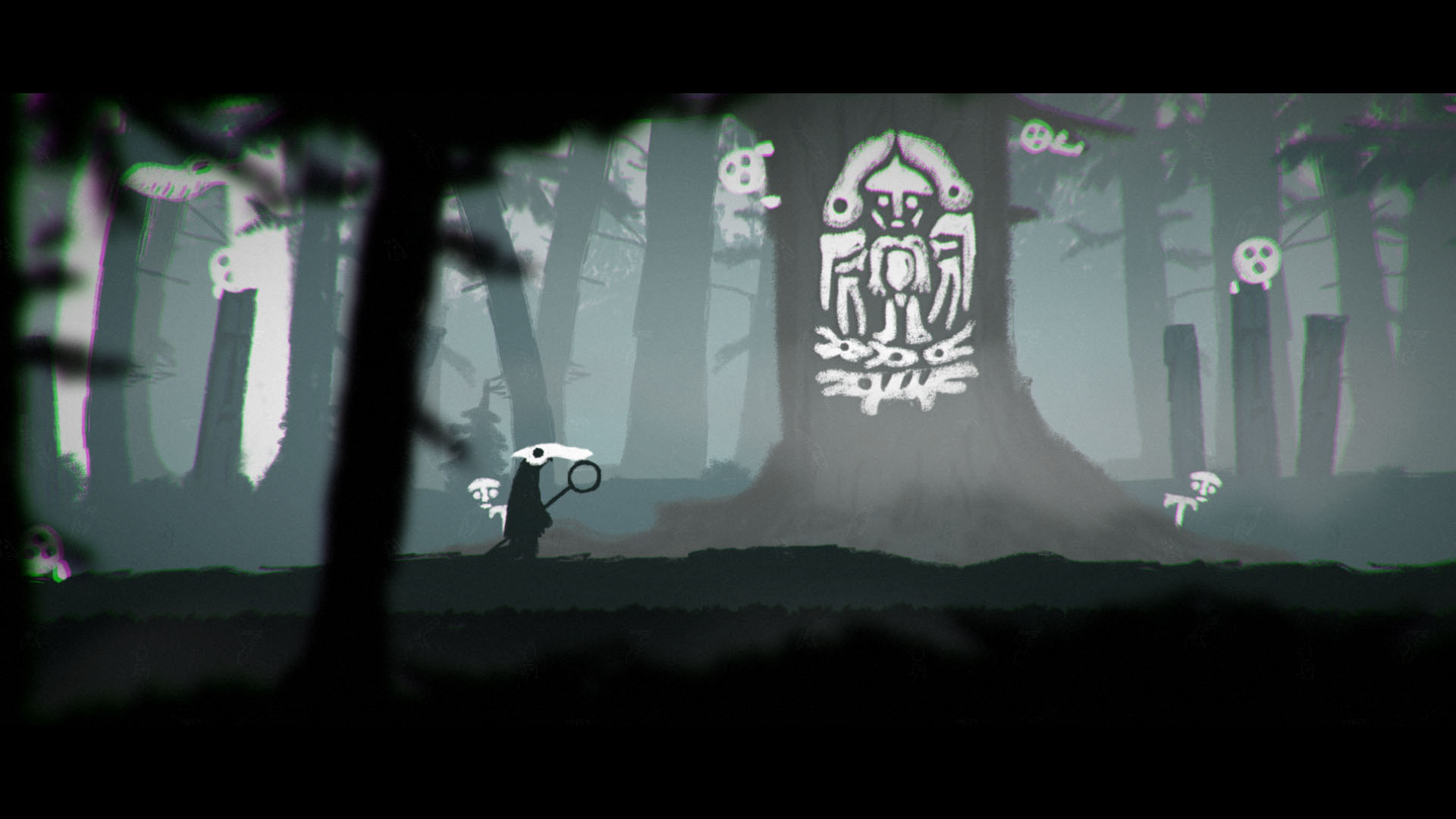
I keep a short list of games that feel genuinely handmade in a way that no studio budget could replicate. The Mooseman sits near the top of it. It was built by two people from Perm, Russia: Vladimir Beletsky handled art, code, design, and writing simultaneously, while Mikhail Shvachko composed and designed the sound. The subject matter they chose is Finno-Ugric mythology, specifically the creation myths of the Komi-Permyak and Komi-Zyrian peoples, a tradition so obscure that the developers sent their press releases to history newspapers rather than games press because that was where the audience actually lived. That context matters when you sit down to play. This is not a game about a fictional fantasy world. It is an earnest reconstruction of something real, something mostly forgotten, and that weight is present in every frame. The core mechanic is a single button: the moose skull mask. Putting it on shifts you between the physical plane and the spirit world, and nearly every puzzle in the game is built on that toggle. Stationary rocks become animated spirits you can coax into position as bridges. Logs move when a snake spirit drags them in the other realm. The bear-man Kudym-Osh blocks your path until you read the world correctly and slip between layers to pass him. Later you gain Shondi, a fragment of the sun that acts as a one-hit shield against the violent dead in the Sir-Yu River, and at one point the game hands you a bow for a brief stretch. None of these mechanics are deep by conventional design standards, and that is the most common complaint you will see in reviews, and also the one that misunderstands the intent entirely. The Mooseman is not a puzzle game wearing mythology as a coat. It is a mythology text wearing just enough interactivity to keep your hands occupied while your mind absorbs the creation story of a god named Yen, his seven sons, and a shaman carrying stolen sunlight upward through three layered worlds toward a giant bird called Kars. The art holds up. The visual style is rooted in Perm animal style metalwork, the actual bronze artefacts cast by Komi people in the Middle Ages. Thick scratchy lines and mostly monochromatic silhouettes give the whole game the texture of charcoal on stone. Collectible artefacts, many of them hidden just a few steps to the left of where the path pushes you right, are drawn directly from pieces held in Perm Regional Museum, each with a museum-style note written with the museum's help. The soundtrack is something else entirely. Ambient synth and eerie low percussion hold the baseline, but at specific transitions the score opens into full choral arrangements performed by the student choir of the Perm Krai College of Arts and Culture, singing in Komi-Permyak. Those moments have physical presence. Certain reviewers described it as the hair on their arms standing up, and I understand the reaction completely. The legitimate criticisms are worth naming honestly. The game is short: two to three hours if you read everything, under an hour if you do not. A hidden shield ability goes completely unexplained by any in-game prompt, which has stranded more than a few players at a specific bridge encounter. The UI is clumsy, menu navigation fumbles across all versions, and the subtitle font is thin and occasionally obscured by background elements. If you come in expecting Limbo-level precision platforming or puzzle complexity in the vein of Braid, the low-friction obstacle design will feel like underdevelopment. It is not. The game knows exactly when it ends and why. This is one of those rare short experiences that earns its runtime rather than padding it, and the completionist layer, hunting every glyph and artefact, adds genuine texture to a second pass without manufacturing false difficulty. The Mooseman is for players who treat a two-hour game as a valid format, who find something quietly thrilling about learning a mythology they never knew existed, and who can accept that a soundtrack performed by a college choir in a near-extinct language is doing more work than any combat system could. It is not for players looking for mechanical depth, meaningful challenge, or anything resembling action. It sits closer to Year Walk or Never Alone than to anything with a skill tree. I defend slow openings when the payoff justifies them. The payoff here is a cosmology that once belonged to real people, reconstructed with care and genuine love, and that is a thing worth two hours of anyone's attention. Kai, Scout Team

The Mooseman

The Mooseman

17 feb 2017Morteshka
GamerScout opina

A two-hour walk through a mythology almost nobody outside Russia's Perm region has ever heard of, and somehow that's exactly what makes it worth every quiet minute.

PCMacLinuxXbox
ProtonDB Platinum
Mejor precio disponible
€0.00
en N/A
Mínimo histórico: €2.00

Comparar precios(0 tiendas)

Cargando precios...

We may earn a commission when you buy games through links on this page — at no extra cost to you. It never affects our rankings or verdicts.

Historial de precios

Historical low
€2.0013 Jun 2026
Keyshops
€1.91€2.22€2.53€2.845 Jun11 Jun17 Jun22 Jun28 Jun
Tracking prices since 5 Jun 2026
Create alert

Capturas y multimedia

Captura

Acerca de The Mooseman

I keep a short list of games that feel genuinely handmade in a way that no studio budget could replicate. The Mooseman sits near the top of it. It was built by two people from Perm, Russia: Vladimir Beletsky handled art, code, design, and writing simultaneously, while Mikhail Shvachko composed and designed the sound. The subject matter they chose is Finno-Ugric mythology, specifically the creation myths of the Komi-Permyak and Komi-Zyrian peoples, a tradition so obscure that the developers sent their press releases to history newspapers rather than games press because that was where the audience actually lived. That context matters when you sit down to play. This is not a game about a fictional fantasy world. It is an earnest reconstruction of something real, something mostly forgotten, and that weight is present in every frame. The core mechanic is a single button: the moose skull mask. Putting it on shifts you between the physical plane and the spirit world, and nearly every puzzle in the game is built on that toggle. Stationary rocks become animated spirits you can coax into position as bridges. Logs move when a snake spirit drags them in the other realm. The bear-man Kudym-Osh blocks your path until you read the world correctly and slip between layers to pass him. Later you gain Shondi, a fragment of the sun that acts as a one-hit shield against the violent dead in the Sir-Yu River, and at one point the game hands you a bow for a brief stretch. None of these mechanics are deep by conventional design standards, and that is the most common complaint you will see in reviews, and also the one that misunderstands the intent entirely. The Mooseman is not a puzzle game wearing mythology as a coat. It is a mythology text wearing just enough interactivity to keep your hands occupied while your mind absorbs the creation story of a god named Yen, his seven sons, and a shaman carrying stolen sunlight upward through three layered worlds toward a giant bird called Kars. The art holds up. The visual style is rooted in Perm animal style metalwork, the actual bronze artefacts cast by Komi people in the Middle Ages. Thick scratchy lines and mostly monochromatic silhouettes give the whole game the texture of charcoal on stone. Collectible artefacts, many of them hidden just a few steps to the left of where the path pushes you right, are drawn directly from pieces held in Perm Regional Museum, each with a museum-style note written with the museum's help. The soundtrack is something else entirely. Ambient synth and eerie low percussion hold the baseline, but at specific transitions the score opens into full choral arrangements performed by the student choir of the Perm Krai College of Arts and Culture, singing in Komi-Permyak. Those moments have physical presence. Certain reviewers described it as the hair on their arms standing up, and I understand the reaction completely. The legitimate criticisms are worth naming honestly. The game is short: two to three hours if you read everything, under an hour if you do not. A hidden shield ability goes completely unexplained by any in-game prompt, which has stranded more than a few players at a specific bridge encounter. The UI is clumsy, menu navigation fumbles across all versions, and the subtitle font is thin and occasionally obscured by background elements. If you come in expecting Limbo-level precision platforming or puzzle complexity in the vein of Braid, the low-friction obstacle design will feel like underdevelopment. It is not. The game knows exactly when it ends and why. This is one of those rare short experiences that earns its runtime rather than padding it, and the completionist layer, hunting every glyph and artefact, adds genuine texture to a second pass without manufacturing false difficulty. The Mooseman is for players who treat a two-hour game as a valid format, who find something quietly thrilling about learning a mythology they never knew existed, and who can accept that a soundtrack performed by a college choir in a near-extinct language is doing more work than any combat system could. It is not for players looking for mechanical depth, meaningful challenge, or anything resembling action. It sits closer to Year Walk or Never Alone than to anything with a skill tree. I defend slow openings when the payoff justifies them. The payoff here is a cosmology that once belonged to real people, reconstructed with care and genuine love, and that is a thing worth two hours of anyone's attention.

Kai
Kai · Scout Team

Indie & narrative

Etiquetas

singleplayerachievementstrading-cardstier:aaaMythologyWalking Sim AdjacentSpirit World MechanicArtifact HuntingFolkloreChoral SoundtrackMuseum-style LoreShort-but-Complete

Requisitos del sistema

Mínimos

OS
Windows XP and up
Memory
1 GB RAM
Storage
600 MB available space
Graphics
500 MB and up
Processor
1 Ghz and up

Sigue explorando

Community Discussion

Be the first to comment on The Mooseman.

Reseñas y valoraciones

Metacritic
77

Información del juego

Desarrolladora
Morteshka
Distribuidora
Morteshka
Fecha de lanzamiento
17 feb 2017

Alerta de precio

¡Recibe un aviso cuando el precio baje de tu objetivo!

Crear alerta

Más de Morteshka

Compra mejor: guías útiles

¿Buscas más? Mira juegos como The Mooseman →

Preguntas frecuentes sobre The Mooseman

¿Cuánto cuesta The Mooseman?

El precio de The Mooseman cambia a menudo y varía según la tienda, la edición y la región. La tabla de precios en vivo de esta página compara las ofertas más baratas en stock de tiendas de claves de confianza como Eneba y Kinguin, para que siempre veas el precio más bajo actual antes de comprar.

¿Dónde puedo comprar The Mooseman más barato?

Compara los precios de The Mooseman en todas las tiendas verificadas en la tabla de precios de esta página. Listamos las ofertas de claves y tiendas más baratas en stock, actualizadas con frecuencia, para que siempre veas la mejor oferta actual antes de comprar.

¿En qué plataformas está disponible The Mooseman?

The Mooseman está disponible en PC, Mac, Linux, Xbox.

¿Cuándo se lanzó The Mooseman?

The Mooseman se lanzó el 17 de febrero de 2017.

¿Quién desarrolló The Mooseman?

The Mooseman fue desarrollado por Morteshka.

¿Merece la pena comprar The Mooseman?

The Mooseman tiene una puntuación Metacritic de 77/100, lo que lo convierte en uno de los títulos destacados de Adventure. Mira las reseñas completas, las valoraciones y los tiempos de duración en esta página para decidir.