Compara los precios de Super House of Dead Ninjas en tiendas de claves de confianza y encuentra la mejor oferta. Desarrollado por Megadev. Publicado por Bitmap Bureau. Lanzado el 18/2/2013. Disponible en PC. Géneros: Action, Indie. Puntuación Metacritic: 79/100.

Thirty seconds on the clock, a tower 350 floors deep, and one-hit deaths throughout. If that sounds like a dare, this game was made for you.

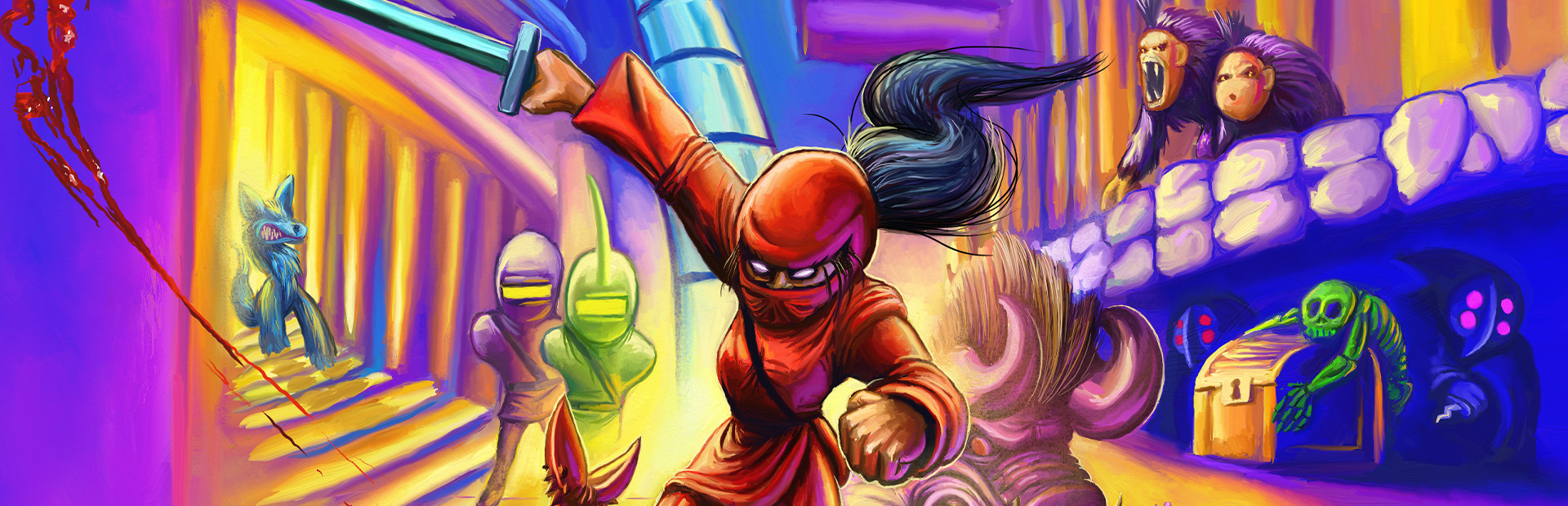
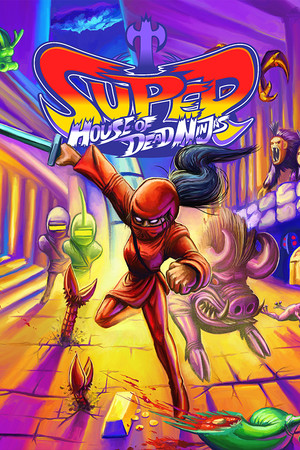
I've fed plenty of hours into arcade-hard platformers, but Super House of Dead Ninjas has a particular kind of ruthlessness that feels handcrafted rather than arbitrary. You drop as the Crimson Ninja, Nintai Ryoko, from floor 350 downward, and the tower does not stop throwing problems at you. Every attack in the game kills you instantly, from a stray shuriken to a spike in your path, and the only lives-count variable across the three difficulty tiers is how many times you're allowed to be wrong before the screen stops caring about you. The 30-second timer is the design decision the whole game hinges on. Let it drain to zero and a giant red Grim Reaper materializes and pursues you through walls at a speed that makes calm decision-making impossible. The intent is obvious: you have to keep moving, scanning floors for the Extra Time pickups that reset the countdown, dispatching enemies without stopping to think too hard. What makes this pressure feel fair rather than cruel is the movement itself. The controls are genuinely exceptional. Double jumps, wall bounces, a spinning screw-attack jump, and a downward stab for punching through floors all feel immediate and precise, so when you die, and you will die constantly, the game rarely makes you feel cheated. You start with a Katana, shurikens, bombs, and basic ninja magic. Everything else, nunchucks, the kusarigama, the axe that arcs over enemies, the Ha-Hadouken fireball that punches through walls, the Token Gun, the Taming Whip, the absurdly named Ricochet of Litigious Possibilities, gets unlocked by completing specific in-run challenges. Killing a boss within 30 seconds, maintaining Rage Mode for a sustained chain of melee kills, juggling a duck for three seconds. These unlock conditions read like dares, and chasing them gives runs direction that pure roguelites sometimes lack. The Rage mechanic deserves its own mention: build your melee kill chain and the bar fills; sustain it long enough and Nintai briefly becomes invincible, which on deeper floors shifts from a cool bonus to something you are actively building toward. The tower itself procedurally shuffles floor order and boss placement, so you can encounter a boss you have never seen before on a given run, which keeps pressure from collapsing into memorization. The aesthetic lands somewhere between a sharp SNES action game and an 80s ninja film, pixel art that is clean and readable at speed, gore that is entirely gratuitous in the best way, and a retro-leaning soundtrack that sounds like it belongs on cartridge hardware. The comic-style tutorial tucked into the main menu is a small, clever touch, written in the voice of a mysterious Lodge Lady who hands out cryptic tips and unlocks a costume if you read it properly. It is the kind of detail that signals a game made with genuine attention. The criticisms land in a specific place. Critics noted that the randomization shuffles room order more than room content, meaning the tower can start feeling repetitive once you have pattern-matched the enemy types. Patrol ninjas, charging skeletons, fox demons, scorpions, bouncing birds. You learn them fast, and after that the challenge is execution rather than surprise. Boss rooms spike the wall with spikes to prevent wall-climbing abuse, which makes sense, but the resulting combat can feel narrow. These are real limitations for anyone expecting the open chaos of something like Rogue Legacy. The game also strongly favors a controller. Keyboard play is technically possible, but reviewers consistently flag it as an unnecessary handicap given how tight the timing windows get. For what it is, this is a tightly wound arcade game that knows its own scope. The Steam version adds an extra Transdimensional tower mode, a map editor with Steam Workshop sharing, upgraded audio, and a broader spread of unlockables beyond what the original Flash version offered. Seeing the true final floor requires a Hard mode clear, which withholds the continue option, and that gating feels intentional rather than padded. The community has built a thorough unlock guide ecosystem around the game, which tells you something about the kind of player it retains. Short burst sessions work. Long completionist grinds work. Speedrunning the floor count works. The loop is small but it holds. Kai, Scout Team

Super House of Dead Ninjas

Super House of Dead Ninjas

18 feb 2013MegadevBitmap Bureau
GamerScout opina

Thirty seconds on the clock, a tower 350 floors deep, and one-hit deaths throughout. If that sounds like a dare, this game was made for you.

PC
Steam Deck PlayableProtonDB Gold
Mejor precio disponible
€0.00
en N/A
Mínimo histórico: €3.52

Comparar precios(0 tiendas)

Cargando precios...

We may earn a commission when you buy games through links on this page — at no extra cost to you. It never affects our rankings or verdicts.

Historial de precios

Historical low
€3.5223 Jun 2026
Keyshops
€3.48€3.63€3.77€3.926 Jun12 Jun17 Jun23 Jun28 Jun
Tracking prices since 6 Jun 2026
Create alert

Capturas y multimedia

Acerca de Super House of Dead Ninjas

I've fed plenty of hours into arcade-hard platformers, but Super House of Dead Ninjas has a particular kind of ruthlessness that feels handcrafted rather than arbitrary. You drop as the Crimson Ninja, Nintai Ryoko, from floor 350 downward, and the tower does not stop throwing problems at you. Every attack in the game kills you instantly, from a stray shuriken to a spike in your path, and the only lives-count variable across the three difficulty tiers is how many times you're allowed to be wrong before the screen stops caring about you. The 30-second timer is the design decision the whole game hinges on. Let it drain to zero and a giant red Grim Reaper materializes and pursues you through walls at a speed that makes calm decision-making impossible. The intent is obvious: you have to keep moving, scanning floors for the Extra Time pickups that reset the countdown, dispatching enemies without stopping to think too hard. What makes this pressure feel fair rather than cruel is the movement itself. The controls are genuinely exceptional. Double jumps, wall bounces, a spinning screw-attack jump, and a downward stab for punching through floors all feel immediate and precise, so when you die, and you will die constantly, the game rarely makes you feel cheated. You start with a Katana, shurikens, bombs, and basic ninja magic. Everything else, nunchucks, the kusarigama, the axe that arcs over enemies, the Ha-Hadouken fireball that punches through walls, the Token Gun, the Taming Whip, the absurdly named Ricochet of Litigious Possibilities, gets unlocked by completing specific in-run challenges. Killing a boss within 30 seconds, maintaining Rage Mode for a sustained chain of melee kills, juggling a duck for three seconds. These unlock conditions read like dares, and chasing them gives runs direction that pure roguelites sometimes lack. The Rage mechanic deserves its own mention: build your melee kill chain and the bar fills; sustain it long enough and Nintai briefly becomes invincible, which on deeper floors shifts from a cool bonus to something you are actively building toward. The tower itself procedurally shuffles floor order and boss placement, so you can encounter a boss you have never seen before on a given run, which keeps pressure from collapsing into memorization. The aesthetic lands somewhere between a sharp SNES action game and an 80s ninja film, pixel art that is clean and readable at speed, gore that is entirely gratuitous in the best way, and a retro-leaning soundtrack that sounds like it belongs on cartridge hardware. The comic-style tutorial tucked into the main menu is a small, clever touch, written in the voice of a mysterious Lodge Lady who hands out cryptic tips and unlocks a costume if you read it properly. It is the kind of detail that signals a game made with genuine attention. The criticisms land in a specific place. Critics noted that the randomization shuffles room order more than room content, meaning the tower can start feeling repetitive once you have pattern-matched the enemy types. Patrol ninjas, charging skeletons, fox demons, scorpions, bouncing birds. You learn them fast, and after that the challenge is execution rather than surprise. Boss rooms spike the wall with spikes to prevent wall-climbing abuse, which makes sense, but the resulting combat can feel narrow. These are real limitations for anyone expecting the open chaos of something like Rogue Legacy. The game also strongly favors a controller. Keyboard play is technically possible, but reviewers consistently flag it as an unnecessary handicap given how tight the timing windows get. For what it is, this is a tightly wound arcade game that knows its own scope. The Steam version adds an extra Transdimensional tower mode, a map editor with Steam Workshop sharing, upgraded audio, and a broader spread of unlockables beyond what the original Flash version offered. Seeing the true final floor requires a Hard mode clear, which withholds the continue option, and that gating feels intentional rather than padded. The community has built a thorough unlock guide ecosystem around the game, which tells you something about the kind of player it retains. Short burst sessions work. Long completionist grinds work. Speedrunning the floor count works. The loop is small but it holds.

Kai
Kai · Scout Team

Indie & narrative

Etiquetas

singleplayerachievementscontroller-supporttrading-cardsworkshoptier:aaaOne-Hit DeathTimer PressureWeapon UnlocksRage MechanicArcade PrecisionVertical DescentFlash Game RemakeCompletionist UnlocksController Recommended

Requisitos del sistema

Mínimos

Memory
512 MB RAM
Hard Drive
200 MB HD space

Recomendados

Memory
1024 MB RAM
Hard Drive
200 MB HD space

Sigue explorando

Community Discussion

Be the first to comment on Super House of Dead Ninjas.

Reseñas y valoraciones

Metacritic
79

Información del juego

Desarrolladora
Megadev
Distribuidora
Bitmap Bureau
Fecha de lanzamiento
18 feb 2013

Alerta de precio

¡Recibe un aviso cuando el precio baje de tu objetivo!

Crear alerta

Compra mejor: guías útiles

¿Buscas más? Mira juegos como Super House of Dead Ninjas →

Preguntas frecuentes sobre Super House of Dead Ninjas

¿Cuánto cuesta Super House of Dead Ninjas?

El precio de Super House of Dead Ninjas cambia a menudo y varía según la tienda, la edición y la región. La tabla de precios en vivo de esta página compara las ofertas más baratas en stock de tiendas de claves de confianza como Eneba y Kinguin, para que siempre veas el precio más bajo actual antes de comprar.

¿Dónde puedo comprar Super House of Dead Ninjas más barato?

Compara los precios de Super House of Dead Ninjas en todas las tiendas verificadas en la tabla de precios de esta página. Listamos las ofertas de claves y tiendas más baratas en stock, actualizadas con frecuencia, para que siempre veas la mejor oferta actual antes de comprar.

¿En qué plataformas está disponible Super House of Dead Ninjas?

Super House of Dead Ninjas está disponible en PC.

¿Cuándo se lanzó Super House of Dead Ninjas?

Super House of Dead Ninjas se lanzó el 18 de febrero de 2013.

¿Quién desarrolló Super House of Dead Ninjas?

Super House of Dead Ninjas fue desarrollado por Megadev y publicado por Bitmap Bureau.

¿Merece la pena comprar Super House of Dead Ninjas?

Super House of Dead Ninjas tiene una puntuación Metacritic de 79/100, lo que lo convierte en uno de los títulos destacados de Action. Mira las reseñas completas, las valoraciones y los tiempos de duración en esta página para decidir.