Compara los precios de Sudoku Quest en tiendas de claves de confianza y encuentra la mejor oferta. Desarrollado por Harbinger Beard. Publicado por Harbinger Beard. Lanzado el 3/6/2016. Disponible en PC. Géneros: Casual, Indie.

Endless procedurally generated Sudoku with a lives system and three board variants - the rare PC option for number-logic devotees, rough edges and all.

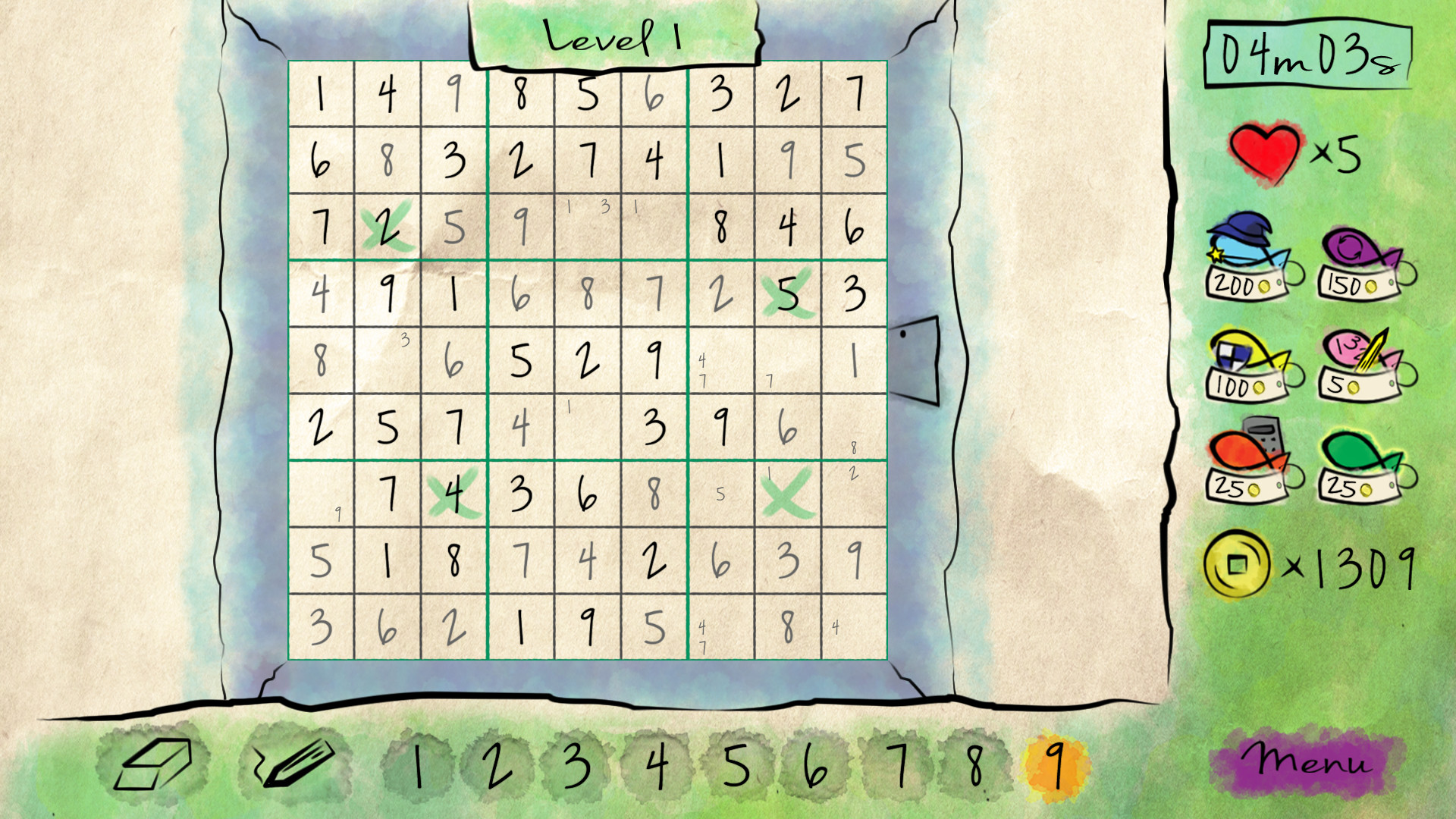
I'll be honest with you: if you search Steam for a solid Sudoku client, the pickings are genuinely thin. That scarcity is probably the most important context for evaluating Sudoku Quest, a modest solo effort from Harbinger Beard that has been quietly sitting in the catalog since 2016. It is not a showcase. It is not an artistic statement. What it is, for the right kind of player, is a functional and surprisingly deep number-puzzle loop that keeps generating fresh boards for as long as your patience holds. The core structure is a mode called Adventure, where you chain puzzles one after another against a shared pool of ten lives. Every wrong cell entry costs you one heart, and those hearts do not reset between boards - so a careless run through a Nonomino puzzle can leave you limping into the next Classic with barely enough margin for error. The difficulty ratchets up steadily by reducing the number of given cells per board, which is a clean and honest difficulty curve. Alongside the classic 9x9 grid, the game offers Overlapped Classics (multiple boards sharing cells along their borders) and Nonomino Sudoku, where the familiar 3x3 square houses are replaced by irregularly shaped colored regions. Those variants land harder than their labeled difficulty suggests, and they genuinely require rethinking standard solving strategies. A Custom mode lets you dial in board type, starting givens, allowed mistakes, and starting gold, which makes it a reasonable practice sandbox too. Power-ups sit in the corner of the screen, bought with coins you earn by completing boards. Reveal Cell, Possible Values (auto-pencil a chosen cell), Remaining Values (count how many hidden cells hold a specific digit), Highlight, and Shuffle are all unlocked from the start. The catch: using any of them cuts into your gold reward for that run. It is a sensible tension for experienced solvers and a useful safety net for newcomers, though the game fails to explain what each power-up does once you are inside a board. The help text lives only in the main menu, so your first couple of sessions will likely involve backtracking to re-read it. That is a small but repeated friction that the developer never addressed. Stability is the harder conversation. The Steam discussions and reviews from launch onward mention crashes on startup, boards partially obscured by the UI, and occasional generation quirks where a puzzle carries more than one valid solution. The review score sits at a mixed 60% across a very small sample, and some of the negative voices are pointing at technical issues rather than design ones. Whether those bugs affect your system today is something I cannot guarantee; the game has not received visible post-launch support, and the discussion board has been quiet for years. If you run a fairly standard Windows setup you will likely be fine, but the risk is real and worth knowing. For what it gets right: the procedural generation means you will never exhaust the puzzle supply, the color palette is easy on the eyes during long sessions, and the leaderboard for both Adventure and Custom modes gives completionists a target to chase. The 35 Steam achievements add a secondary objective layer for those who like structured progress markers. What it gets wrong is almost entirely a UI and polish problem - power-up discoverability, no in-session help text, bare visual theming with no way to change backgrounds or board skins, and sound design that a few players noted they switched off in favor of their own music. Sudoku Quest rewards exactly one type of player: someone who genuinely loves the logic of Sudoku, wants an endless supply of procedurally unique boards in three variants, and is willing to forgive the bare-bones presentation and shaky launch history. If you already own a newspaper and a pencil, this is for you digitized. If you want atmosphere, accessibility options, or the reassurance of a polished product, the narrow Steam Sudoku shelf is still a frustrating place to shop. Kai, Scout Team

Sudoku Quest

Sudoku Quest

3 jun 2016Harbinger Beard
GamerScout opina

Endless procedurally generated Sudoku with a lives system and three board variants - the rare PC option for number-logic devotees, rough edges and all.

PC
Mejor precio disponible
€0.00
en N/A
Mínimo histórico: €1.43

Comparar precios(0 tiendas)

Cargando precios...

We may earn a commission when you buy games through links on this page — at no extra cost to you. It never affects our rankings or verdicts.

Historial de precios

Historical low
€1.4313 Jun 2026
Keyshops
€1.32€1.40€1.47€1.557 Jun12 Jun18 Jun23 Jun28 Jun
Tracking prices since 7 Jun 2026
Create alert

Capturas y multimedia

Captura

Acerca de Sudoku Quest

I'll be honest with you: if you search Steam for a solid Sudoku client, the pickings are genuinely thin. That scarcity is probably the most important context for evaluating Sudoku Quest, a modest solo effort from Harbinger Beard that has been quietly sitting in the catalog since 2016. It is not a showcase. It is not an artistic statement. What it is, for the right kind of player, is a functional and surprisingly deep number-puzzle loop that keeps generating fresh boards for as long as your patience holds. The core structure is a mode called Adventure, where you chain puzzles one after another against a shared pool of ten lives. Every wrong cell entry costs you one heart, and those hearts do not reset between boards - so a careless run through a Nonomino puzzle can leave you limping into the next Classic with barely enough margin for error. The difficulty ratchets up steadily by reducing the number of given cells per board, which is a clean and honest difficulty curve. Alongside the classic 9x9 grid, the game offers Overlapped Classics (multiple boards sharing cells along their borders) and Nonomino Sudoku, where the familiar 3x3 square houses are replaced by irregularly shaped colored regions. Those variants land harder than their labeled difficulty suggests, and they genuinely require rethinking standard solving strategies. A Custom mode lets you dial in board type, starting givens, allowed mistakes, and starting gold, which makes it a reasonable practice sandbox too. Power-ups sit in the corner of the screen, bought with coins you earn by completing boards. Reveal Cell, Possible Values (auto-pencil a chosen cell), Remaining Values (count how many hidden cells hold a specific digit), Highlight, and Shuffle are all unlocked from the start. The catch: using any of them cuts into your gold reward for that run. It is a sensible tension for experienced solvers and a useful safety net for newcomers, though the game fails to explain what each power-up does once you are inside a board. The help text lives only in the main menu, so your first couple of sessions will likely involve backtracking to re-read it. That is a small but repeated friction that the developer never addressed. Stability is the harder conversation. The Steam discussions and reviews from launch onward mention crashes on startup, boards partially obscured by the UI, and occasional generation quirks where a puzzle carries more than one valid solution. The review score sits at a mixed 60% across a very small sample, and some of the negative voices are pointing at technical issues rather than design ones. Whether those bugs affect your system today is something I cannot guarantee; the game has not received visible post-launch support, and the discussion board has been quiet for years. If you run a fairly standard Windows setup you will likely be fine, but the risk is real and worth knowing. For what it gets right: the procedural generation means you will never exhaust the puzzle supply, the color palette is easy on the eyes during long sessions, and the leaderboard for both Adventure and Custom modes gives completionists a target to chase. The 35 Steam achievements add a secondary objective layer for those who like structured progress markers. What it gets wrong is almost entirely a UI and polish problem - power-up discoverability, no in-session help text, bare visual theming with no way to change backgrounds or board skins, and sound design that a few players noted they switched off in favor of their own music. Sudoku Quest rewards exactly one type of player: someone who genuinely loves the logic of Sudoku, wants an endless supply of procedurally unique boards in three variants, and is willing to forgive the bare-bones presentation and shaky launch history. If you already own a newspaper and a pencil, this is for you digitized. If you want atmosphere, accessibility options, or the reassurance of a polished product, the narrow Steam Sudoku shelf is still a frustrating place to shop.

Kai
Kai · Scout Team

Indie & narrative

Etiquetas

singleplayerachievementstrading-cardscloud-savestier:sub-5Procedural GenerationLogic PuzzleNonominoEndless ModeLeaderboardLives SystemPower-upsNumber Puzzle

Requisitos del sistema

Mínimos

OS
Windows 7, Windows 8 (8.1), Windows 10
Memory
2 GB RAM
Storage
500 MB available space
Processor
2 GHz Dual Core

Sigue explorando

Community Discussion

Be the first to comment on Sudoku Quest.

Reseñas y valoraciones

No hay valoraciones disponibles

Información del juego

Desarrolladora
Harbinger Beard
Distribuidora
Harbinger Beard
Fecha de lanzamiento
3 jun 2016

Alerta de precio

¡Recibe un aviso cuando el precio baje de tu objetivo!

Crear alerta

Compra mejor: guías útiles

Preguntas frecuentes sobre Sudoku Quest

¿Cuánto cuesta Sudoku Quest?

El precio de Sudoku Quest cambia a menudo y varía según la tienda, la edición y la región. La tabla de precios en vivo de esta página compara las ofertas más baratas en stock de tiendas de claves de confianza como Eneba y Kinguin, para que siempre veas el precio más bajo actual antes de comprar.

¿Dónde puedo comprar Sudoku Quest más barato?

Compara los precios de Sudoku Quest en todas las tiendas verificadas en la tabla de precios de esta página. Listamos las ofertas de claves y tiendas más baratas en stock, actualizadas con frecuencia, para que siempre veas la mejor oferta actual antes de comprar.

¿En qué plataformas está disponible Sudoku Quest?

Sudoku Quest está disponible en PC.

¿Cuándo se lanzó Sudoku Quest?

Sudoku Quest se lanzó el 3 de junio de 2016.

¿Quién desarrolló Sudoku Quest?

Sudoku Quest fue desarrollado por Harbinger Beard.