Compara los precios de Solar 2 en tiendas de claves de confianza y encuentra la mejor oferta. Desarrollado por Murudai. Publicado por Murudai. Lanzado el 17/6/2011. Disponible en PC, Mac, Linux. Géneros: Action, Adventure, Casual, Indie, Simulation. Puntuación Metacritic: 72/100.

Forget managing resources or plotting supply lines. Solar 2 hands you a single rock and asks how big you can get before the universe stops you.

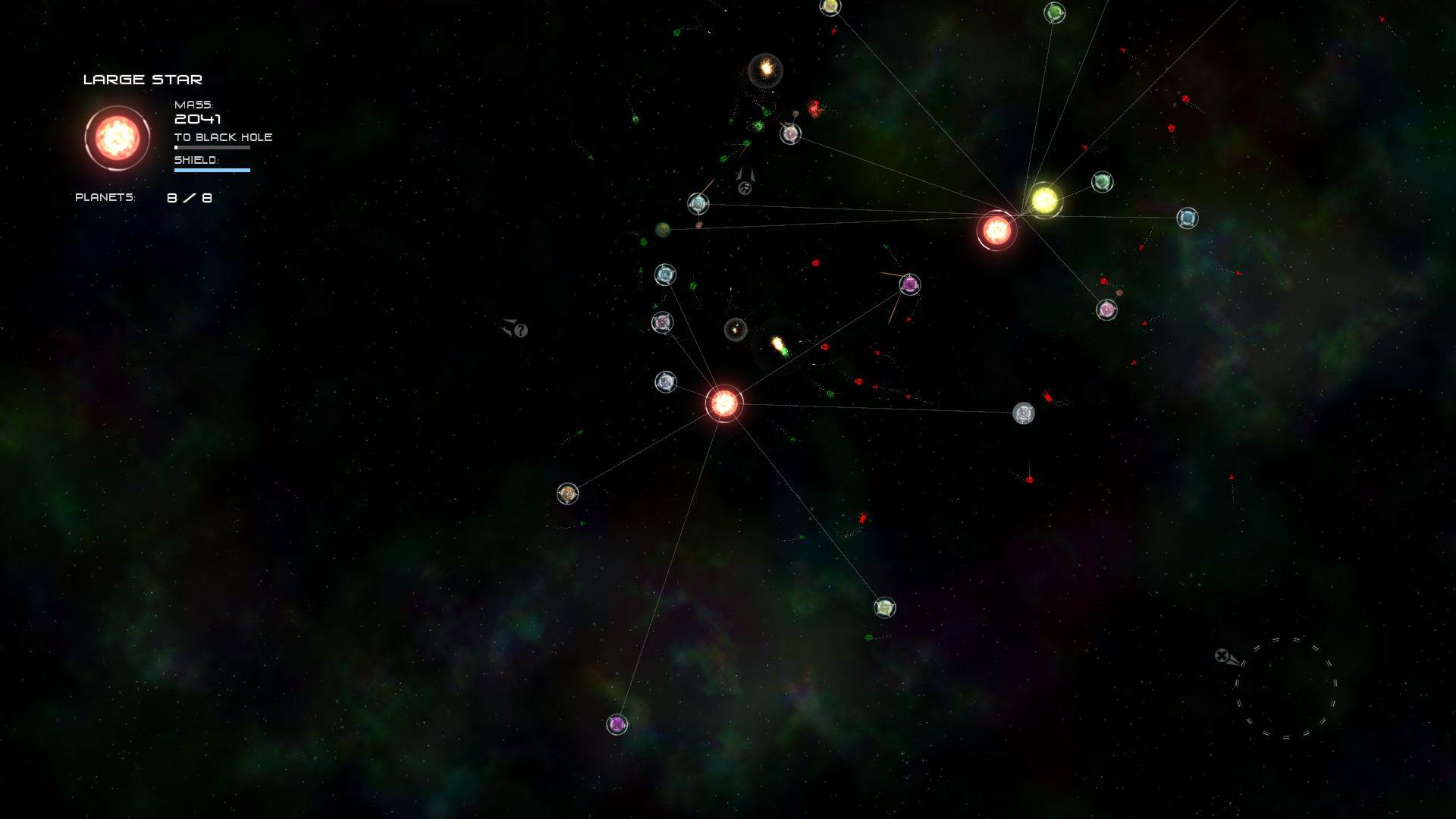
My first instinct when loading Solar 2 was to look for a tech tree or a build queue. There is neither, and that absence is precisely the point. What Murudai built is a physics-driven progression sandbox where the unit of currency is mass, the build order is asteroid to planet to star to black hole, and the win condition is literally becoming a Big Crunch that triggers a new Big Bang. The decision loop is tighter than it looks from the outside, and I mean that as a compliment. The eight object types you cycle through, from a lowly asteroid all the way to a neutron star and then singularity, each behave like a distinct game mode bolted together by consistent physics. As an asteroid you ram into debris to grow. As a planet you coax smaller rocks into orbit by matching their momentum, then absorb them. Once you tip over into small star territory, you start accumulating orbiting planets, nurturing life on them, watching civilizations build fleets, and then deciding whether to let those planets keep growing into secondary stars, forming binary or even multi-star systems, or to absorb them outright for a faster collapse into a black hole. That fork, grow-the-system versus eat-everything, is where the game's only real strategic depth lives, and it is genuinely interesting for a couple of playthroughs. The gravity simulation underneath it all is convincing enough that miscalculated momentum will send a planet careening out of orbit at exactly the worst moment, which critics at the time rightly flagged as a recurring frustration, particularly when a planet-to-star transition reshuffles the entire orbit pattern with chaotic results. The mission layer, handed down by an absurdist deity called The Entity, gives structure to what would otherwise be pure aimless drifting. Missions are optional, waypointed around the universe, and range from protecting a vulnerable planet to fending off enemy fleets. They are poorly balanced, with many requiring a mass threshold you cannot reach until late in a run, and the all-automated space combat means you are essentially a bystander watching your life-bearing planets duke it out with no direct input over your ships. That passivity is the sharpest criticism the game earned at launch, and it still holds. A 72 Metacritic score from eight reviews at release, with critics split between praising the physics and soundtrack while knocking the mission difficulty and repetition, is an honest representation of what this game is. For a sim specialist, the honest read is this: Solar 2 is not a deep game. The full asteroid-to-black-hole arc can be done in under an hour if you skip the mission structure entirely. There is no mod ecosystem, no late-game optimization puzzle, no AI opponent with genuine strategic pressure. The physics options and unlockable "God Options" add some replayability, and the save-anywhere system lets you checkpoint specific solar configurations to experiment from, but the ceiling is low. Where it earns real goodwill is in accessibility. The controls are WASD and a handful of buttons. There is no tutorial that wastes your time because the feedback loop teaches you everything within the first five minutes. Someone who has never touched a strategy or sim game can understand what is happening and why on their first run. For that audience, or for anyone wanting a thirty-minute decompression session between heavier titles, the value proposition is clear. For players expecting systemic depth comparable to even a light city-builder, the repetition will set in fast. Diego, Scout Team

Solar 2

Solar 2

17 jun 2011Murudai
GamerScout opina

Forget managing resources or plotting supply lines. Solar 2 hands you a single rock and asks how big you can get before the universe stops you.

PCMacLinux
Steam Deck VerifiedProtonDB Platinum
Mejor precio disponible
€0.00
en N/A
Mínimo histórico: €2.31

Comparar precios(0 tiendas)

Cargando precios...

We may earn a commission when you buy games through links on this page — at no extra cost to you. It never affects our rankings or verdicts.

Historial de precios

Historical low
€2.3117 Jun 2026
Keyshops
€2.23€2.49€2.76€3.029 Jun14 Jun19 Jun23 Jun28 Jun
Tracking prices since 9 Jun 2026
Create alert

Capturas y multimedia

Captura

Acerca de Solar 2

My first instinct when loading Solar 2 was to look for a tech tree or a build queue. There is neither, and that absence is precisely the point. What Murudai built is a physics-driven progression sandbox where the unit of currency is mass, the build order is asteroid to planet to star to black hole, and the win condition is literally becoming a Big Crunch that triggers a new Big Bang. The decision loop is tighter than it looks from the outside, and I mean that as a compliment. The eight object types you cycle through, from a lowly asteroid all the way to a neutron star and then singularity, each behave like a distinct game mode bolted together by consistent physics. As an asteroid you ram into debris to grow. As a planet you coax smaller rocks into orbit by matching their momentum, then absorb them. Once you tip over into small star territory, you start accumulating orbiting planets, nurturing life on them, watching civilizations build fleets, and then deciding whether to let those planets keep growing into secondary stars, forming binary or even multi-star systems, or to absorb them outright for a faster collapse into a black hole. That fork, grow-the-system versus eat-everything, is where the game's only real strategic depth lives, and it is genuinely interesting for a couple of playthroughs. The gravity simulation underneath it all is convincing enough that miscalculated momentum will send a planet careening out of orbit at exactly the worst moment, which critics at the time rightly flagged as a recurring frustration, particularly when a planet-to-star transition reshuffles the entire orbit pattern with chaotic results. The mission layer, handed down by an absurdist deity called The Entity, gives structure to what would otherwise be pure aimless drifting. Missions are optional, waypointed around the universe, and range from protecting a vulnerable planet to fending off enemy fleets. They are poorly balanced, with many requiring a mass threshold you cannot reach until late in a run, and the all-automated space combat means you are essentially a bystander watching your life-bearing planets duke it out with no direct input over your ships. That passivity is the sharpest criticism the game earned at launch, and it still holds. A 72 Metacritic score from eight reviews at release, with critics split between praising the physics and soundtrack while knocking the mission difficulty and repetition, is an honest representation of what this game is. For a sim specialist, the honest read is this: Solar 2 is not a deep game. The full asteroid-to-black-hole arc can be done in under an hour if you skip the mission structure entirely. There is no mod ecosystem, no late-game optimization puzzle, no AI opponent with genuine strategic pressure. The physics options and unlockable "God Options" add some replayability, and the save-anywhere system lets you checkpoint specific solar configurations to experiment from, but the ceiling is low. Where it earns real goodwill is in accessibility. The controls are WASD and a handful of buttons. There is no tutorial that wastes your time because the feedback loop teaches you everything within the first five minutes. Someone who has never touched a strategy or sim game can understand what is happening and why on their first run. For that audience, or for anyone wanting a thirty-minute decompression session between heavier titles, the value proposition is clear. For players expecting systemic depth comparable to even a light city-builder, the repetition will set in fast.

Diego
Diego · Scout Team

Strategy & simulation

Etiquetas

singleplayerachievementscloud-savestier:aaaPhysics SandboxMass-Based ProgressionGod-Game ElementsZen GameplayEvolution LoopAmbient SoundtrackShort Playthrough

Requisitos del sistema

Los requisitos del sistema de Solar 2 aún no están listados. Consulta la página de la tienda para ver las especificaciones más recientes.

Sigue explorando

Community Discussion

Be the first to comment on Solar 2.

Reseñas y valoraciones

Metacritic
72

Información del juego

Desarrolladora
Murudai
Distribuidora
Murudai
Fecha de lanzamiento
17 jun 2011

Alerta de precio

¡Recibe un aviso cuando el precio baje de tu objetivo!

Crear alerta

Compra mejor: guías útiles

¿Buscas más? Mira juegos como Solar 2 →

Preguntas frecuentes sobre Solar 2

¿Cuánto cuesta Solar 2?

El precio de Solar 2 cambia a menudo y varía según la tienda, la edición y la región. La tabla de precios en vivo de esta página compara las ofertas más baratas en stock de tiendas de claves de confianza como Eneba y Kinguin, para que siempre veas el precio más bajo actual antes de comprar.

¿Dónde puedo comprar Solar 2 más barato?

Compara los precios de Solar 2 en todas las tiendas verificadas en la tabla de precios de esta página. Listamos las ofertas de claves y tiendas más baratas en stock, actualizadas con frecuencia, para que siempre veas la mejor oferta actual antes de comprar.

¿En qué plataformas está disponible Solar 2?

Solar 2 está disponible en PC, Mac, Linux.

¿Cuándo se lanzó Solar 2?

Solar 2 se lanzó el 17 de junio de 2011.

¿Quién desarrolló Solar 2?

Solar 2 fue desarrollado por Murudai.

¿Merece la pena comprar Solar 2?

Solar 2 tiene una puntuación Metacritic de 72/100, lo que lo convierte en uno de los títulos destacados de Action. Mira las reseñas completas, las valoraciones y los tiempos de duración en esta página para decidir.