
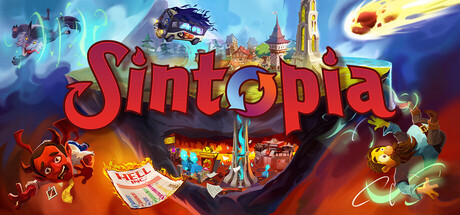
Compara los precios de Sintopia en tiendas de claves de confianza y encuentra la mejor oferta. Desarrollado por Piraknights Games. Publicado por Team17. Lanzado el 16/4/2026. Disponible en PC. Géneros: Indie, Simulation, Strategy.

Running Hell as a logistics puzzle with god-game levers on top is a genuinely fresh combo, though the feedback systems will frustrate anyone who expects the game to tell them what went wrong.

I have a spreadsheet template I use for every new management sim, and Sintopia broke it inside the first hour. The game splits your attention between two linked systems: a Hell-side factory where you build sin-processing rooms, route Imployees (yes, the pun is intentional and legally binding), and keep soul corruption within useful parameters; and an Overworld where you nudge a civilization of chickpea-shaped beings called Humus toward sin or away from demonic invasion using a small toolkit of spells including Push, Fire, and Lightning. That dual-loop structure is the real pitch here. Most sims hand you one layer to optimize. Sintopia makes the two layers feed directly into each other, so your Overworld decisions set the volume and quality of incoming souls, and your Hell layout determines whether you can actually handle what arrives. Neglect either side long enough and the whole operation collapses in a way that feels earned rather than arbitrary. The Hell management layer is where the sim depth lives. You are building a soul-processing facility: routing logistics paths between specialist Sinology rooms, staffing stations with Imployees who have morale and payroll requirements, and treating soul corruption not as a simple failure state but as a dial with tradeoffs. High corruption accelerates throughput at the cost of structural instability, which means there is a real optimization question embedded in that mechanic rather than a simple minimize-the-bar problem. Souls that hit Deviant status in a specific sin category require dedicated specialist rooms, and when a soul carries sin across multiple categories, it will clog the entire chain if you have not pre-built routing logic to handle it. The campaign's four-act structure introduces these systems incrementally, which is smarter pacing than the genre average. Newcomers willing to take the campaign seriously before touching Challenge Mode or Sandbox will find the on-ramp respectful of their time. The god-game Overworld side is where the design gets uneven. Ten divine spells give you tools to prod the Humus population, but how much that prodding actually shapes outcomes varies. Crowned kings get randomly assigned personalities, and while a warlike ruler versus a technology-focused one should change your planning calculus, multiple reviewers noted that the downstream effects of those personality types often feel thin. You can kill a king to cycle to the next one, but the impact can feel disconnected from your actual decisions. The supply-chain logic is sound on paper: what happens above affects what flows below. In practice, the Overworld loop can feel more like watching than governing, which undercuts the god-game fantasy the concept promises. Where Sintopia earns goodwill is presentation. The 1980s-inspired art direction is bright and cartoonish rather than grimdark, and that tonal choice does real work. A fully voiced campaign in both English and French is genuinely unexpected at this price tier, and the voice performances, particularly Lili the succubus manager who guides you through the early game, carry more personality than the writing alone deserves. The dark humor lands often enough to be a feature rather than a warning label. On the friction side: some systems do not communicate why something failed clearly enough. A soul processing line backs up, a facility drops efficiency, and the game does not always give you a readable diagnosis. Experienced management sim players will troubleshoot by instinct. Everyone else will hit walls and not know which lever to pull. There is also a late-game economy trap where Imployees strike if payroll dries up, and because striking workers cannot process souls, the income to fix the problem disappears precisely when you need it. Save early, save often, save before new acts. With around 30 to 35 hours for the campaign and additional replayability through Challenge Mode's Mandate-based modifiers and Prestige Points system, Sintopia is a solid amount of game for management sim regulars who can stomach opaque feedback and want something that actually uses the god-game half of its concept rather than treating it as wallpaper. Genre newcomers should start on the lower difficulty settings, where resource scarcity and Overworld chaos are dialed back enough to let the underlying systems breathe. The Dungeon Keeper and Black and White comparisons you will see everywhere are accurate in spirit, even if the execution does not fully reach those reference points. Diego, Scout Team

Sintopia

Sintopia

16 abr 2026Piraknights GamesTeam17
GamerScout opina

Running Hell as a logistics puzzle with god-game levers on top is a genuinely fresh combo, though the feedback systems will frustrate anyone who expects the game to tell them what went wrong.

PC
Steam Deck UnsupportedProtonDB Gold
Mejor precio disponible
€0.00
en N/A
Mínimo histórico: €19.91

Comparar precios(0 tiendas)

Cargando precios...

We may earn a commission when you buy games through links on this page — at no extra cost to you. It never affects our rankings or verdicts.

Historial de precios

Historical low
€19.9126 Jun 2026
Keyshops
€19.40€21.17€22.93€24.708 Jun13 Jun18 Jun23 Jun28 Jun
Tracking prices since 8 Jun 2026
Create alert

Capturas y multimedia

Acerca de Sintopia

I have a spreadsheet template I use for every new management sim, and Sintopia broke it inside the first hour. The game splits your attention between two linked systems: a Hell-side factory where you build sin-processing rooms, route Imployees (yes, the pun is intentional and legally binding), and keep soul corruption within useful parameters; and an Overworld where you nudge a civilization of chickpea-shaped beings called Humus toward sin or away from demonic invasion using a small toolkit of spells including Push, Fire, and Lightning. That dual-loop structure is the real pitch here. Most sims hand you one layer to optimize. Sintopia makes the two layers feed directly into each other, so your Overworld decisions set the volume and quality of incoming souls, and your Hell layout determines whether you can actually handle what arrives. Neglect either side long enough and the whole operation collapses in a way that feels earned rather than arbitrary. The Hell management layer is where the sim depth lives. You are building a soul-processing facility: routing logistics paths between specialist Sinology rooms, staffing stations with Imployees who have morale and payroll requirements, and treating soul corruption not as a simple failure state but as a dial with tradeoffs. High corruption accelerates throughput at the cost of structural instability, which means there is a real optimization question embedded in that mechanic rather than a simple minimize-the-bar problem. Souls that hit Deviant status in a specific sin category require dedicated specialist rooms, and when a soul carries sin across multiple categories, it will clog the entire chain if you have not pre-built routing logic to handle it. The campaign's four-act structure introduces these systems incrementally, which is smarter pacing than the genre average. Newcomers willing to take the campaign seriously before touching Challenge Mode or Sandbox will find the on-ramp respectful of their time. The god-game Overworld side is where the design gets uneven. Ten divine spells give you tools to prod the Humus population, but how much that prodding actually shapes outcomes varies. Crowned kings get randomly assigned personalities, and while a warlike ruler versus a technology-focused one should change your planning calculus, multiple reviewers noted that the downstream effects of those personality types often feel thin. You can kill a king to cycle to the next one, but the impact can feel disconnected from your actual decisions. The supply-chain logic is sound on paper: what happens above affects what flows below. In practice, the Overworld loop can feel more like watching than governing, which undercuts the god-game fantasy the concept promises. Where Sintopia earns goodwill is presentation. The 1980s-inspired art direction is bright and cartoonish rather than grimdark, and that tonal choice does real work. A fully voiced campaign in both English and French is genuinely unexpected at this price tier, and the voice performances, particularly Lili the succubus manager who guides you through the early game, carry more personality than the writing alone deserves. The dark humor lands often enough to be a feature rather than a warning label. On the friction side: some systems do not communicate why something failed clearly enough. A soul processing line backs up, a facility drops efficiency, and the game does not always give you a readable diagnosis. Experienced management sim players will troubleshoot by instinct. Everyone else will hit walls and not know which lever to pull. There is also a late-game economy trap where Imployees strike if payroll dries up, and because striking workers cannot process souls, the income to fix the problem disappears precisely when you need it. Save early, save often, save before new acts. With around 30 to 35 hours for the campaign and additional replayability through Challenge Mode's Mandate-based modifiers and Prestige Points system, Sintopia is a solid amount of game for management sim regulars who can stomach opaque feedback and want something that actually uses the god-game half of its concept rather than treating it as wallpaper. Genre newcomers should start on the lower difficulty settings, where resource scarcity and Overworld chaos are dialed back enough to let the underlying systems breathe. The Dungeon Keeper and Black and White comparisons you will see everywhere are accurate in spirit, even if the execution does not fully reach those reference points.

Diego
Diego · Scout Team

Strategy & simulation

Etiquetas

singleplayerachievementscloud-savestier:aaaDual-Loop DesignGod-Game MechanicsFactory AutomationSeven Deadly Sins SystemImployee ManagementCampaign + Challenge ModesDark SatireCorruption MechanicAsymmetric World Management

Requisitos del sistema

Mínimos

OS
Windows 10 x64
Memory
12 GB RAM
Graphics
RTX 2060 SUPER (8 GB) / RX 5700 XT (8 GB)
Processor
i5 10400 (6 x 2.9GHz) / Ryzen 5 3600 (6 x 3.6GHz)

Recomendados

OS
Windows 11 x64
Memory
32 GB RAM
Graphics
RTX 4080 (8GB) / RX 7900 XT (16GB)
Processor
i7 11700k (8 x 3.6GHz) / Ryzen 7 5800x (8 x 3.8GHz)

DLC y complementos de Sintopia1

Expansiones, packs de DLC y contenido adicional de este juego. Haz clic en cualquier elemento para ver las ofertas de las tiendas.

Sigue explorando

Community Discussion

Be the first to comment on Sintopia.

Reseñas y valoraciones

No hay valoraciones disponibles

Información del juego

Desarrolladora
Piraknights Games
Distribuidora
Team17
Fecha de lanzamiento
16 abr 2026

Alerta de precio

¡Recibe un aviso cuando el precio baje de tu objetivo!

Crear alerta

Compra mejor: guías útiles

Sintopia en directo en Twitch

¿Buscas más? Mira juegos como Sintopia →

Preguntas frecuentes sobre Sintopia

¿Cuánto cuesta Sintopia?

El precio de Sintopia cambia a menudo y varía según la tienda, la edición y la región. La tabla de precios en vivo de esta página compara las ofertas más baratas en stock de tiendas de claves de confianza como Eneba y Kinguin, para que siempre veas el precio más bajo actual antes de comprar.

¿Dónde puedo comprar Sintopia más barato?

Compara los precios de Sintopia en todas las tiendas verificadas en la tabla de precios de esta página. Listamos las ofertas de claves y tiendas más baratas en stock, actualizadas con frecuencia, para que siempre veas la mejor oferta actual antes de comprar.

¿En qué plataformas está disponible Sintopia?

Sintopia está disponible en PC.

¿Cuándo se lanzó Sintopia?

Sintopia se lanzó el 16 de abril de 2026.

¿Quién desarrolló Sintopia?

Sintopia fue desarrollado por Piraknights Games y publicado por Team17.