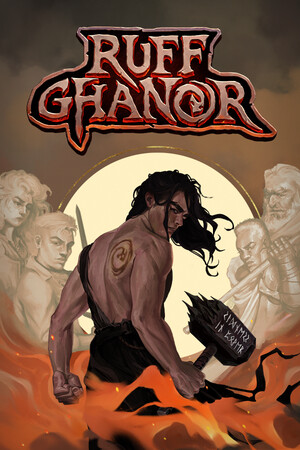
Compara los precios de Ruff Ghanor en tiendas de claves de confianza y encuentra la mejor oferta. Desarrollado por DX Gameworks. Publicado por DX Gameworks. Lanzado el 22/2/2024. Disponible en PC, Xbox, Nintendo Switch. Géneros: Indie, Strategy.

Solid Slay the Spire-adjacent deckbuilder with a lore-rich Brazilian fantasy backdrop - worth a look if you want your card synergies wrapped in an actual story with stakes.

I went into Ruff Ghanor expecting a budget-tier clone with a coat of fantasy paint. What I got instead was a focused, mechanically coherent deckbuilder that punches noticeably above its indie weight class. The premise pulls from a Brazilian fantasy novel series, and that source material gives the run structure something most Slay the Spire successors lack: genuine narrative momentum. You are playing a cleric-in-training named Ruff, grinding toward a showdown with Zamir, a tyrannical dragon who filled the power vacuum left by an even worse threat. The three-act structure moves with purpose, and Narrative and Exploration Encounters break up the combat rhythm in ways that actually affect your path forward, not just your loot rolls. The card system sits on three pillars: Attack cards for direct damage (sometimes with debuffs attached), Control cards for shields and enemy status effects, and Prayer cards that deal magic damage while feeding your Faith resource. That Faith bar is the engine behind Miracle abilities, and building toward a reliable Miracle activation is where the real deck-theory starts. You draw five cards per turn and spend three Action Points to play them, with relics and card effects capable of expanding that AP ceiling. Crucially, Ruff's health total does not reset between combat encounters, which means every fight carries forward cost. Sloppy play in Act 1 compounds by Act 3, and that persistent pressure is the game's sharpest design decision. For newcomers to the genre, the approachability is better than the difficulty curve first suggests. The tutorial is always accessible at the start of a new run, not gated behind a menu. Act 2 introduces a farming layer that lets you shore up a struggling deck before the late-game gauntlet tightens. The Forge lets you upgrade or remove cards, and early access to full deck editing means a bad starting hand does not lock you into a losing build. A first completion runs roughly 7 to 11 hours depending on how many runs end in the red. That is a compact, honest scope for the genre. The cracks are real but mostly minor. Healing cards have an awkward action-point-to-recovery ratio that makes sustain builds feel undervalued compared to aggressive pressure lines. Enemy targeting during combat is not clearly communicated except for area attacks, so you are sometimes guessing which ally absorbs the next hit. Some reviewers flagged the English writing as stilted in places, which tracks for a title with clear Brazilian-Portuguese roots. The RNG reward pool is also on the punishing side: high-value relics tend to be locked behind the fights you needed the relics to survive in the first place. None of these are run-killers, but they are friction points the developers have not fully smoothed out. What keeps Ruff Ghanor worth recommending is the ratio of content to completion time and the fact that the Steam player base sits at a strong majority positive rating. The hand-drawn art holds up, the bestiary is varied enough to keep combat encounters from blurring together, and the ally mechanic, where recruited companions bring their own decks into battle, adds a combinatorial layer that solo-protagonist deckbuilders often skip. If your Slay the Spire backlog is finally clear and you want something with more story glue between fights, this fills that slot competently. Diego, Scout Team

Ruff Ghanor

Ruff Ghanor

22 feb 2024DX Gameworks
GamerScout opina

Solid Slay the Spire-adjacent deckbuilder with a lore-rich Brazilian fantasy backdrop - worth a look if you want your card synergies wrapped in an actual story with stakes.

PCXboxNintendo Switch
Steam Deck PlayableProtonDB Gold
Mejor precio disponible
€0.00
en N/A
Mínimo histórico: €2.01

Comparar precios(0 tiendas)

Cargando precios...

We may earn a commission when you buy games through links on this page — at no extra cost to you. It never affects our rankings or verdicts.

Historial de precios

Historical low
€2.0126 Jun 2026
Keyshops
€0.81€4.94€9.06€13.198 Jun13 Jun18 Jun23 Jun28 Jun
Tracking prices since 8 Jun 2026
Create alert

Capturas y multimedia

Acerca de Ruff Ghanor

I went into Ruff Ghanor expecting a budget-tier clone with a coat of fantasy paint. What I got instead was a focused, mechanically coherent deckbuilder that punches noticeably above its indie weight class. The premise pulls from a Brazilian fantasy novel series, and that source material gives the run structure something most Slay the Spire successors lack: genuine narrative momentum. You are playing a cleric-in-training named Ruff, grinding toward a showdown with Zamir, a tyrannical dragon who filled the power vacuum left by an even worse threat. The three-act structure moves with purpose, and Narrative and Exploration Encounters break up the combat rhythm in ways that actually affect your path forward, not just your loot rolls. The card system sits on three pillars: Attack cards for direct damage (sometimes with debuffs attached), Control cards for shields and enemy status effects, and Prayer cards that deal magic damage while feeding your Faith resource. That Faith bar is the engine behind Miracle abilities, and building toward a reliable Miracle activation is where the real deck-theory starts. You draw five cards per turn and spend three Action Points to play them, with relics and card effects capable of expanding that AP ceiling. Crucially, Ruff's health total does not reset between combat encounters, which means every fight carries forward cost. Sloppy play in Act 1 compounds by Act 3, and that persistent pressure is the game's sharpest design decision. For newcomers to the genre, the approachability is better than the difficulty curve first suggests. The tutorial is always accessible at the start of a new run, not gated behind a menu. Act 2 introduces a farming layer that lets you shore up a struggling deck before the late-game gauntlet tightens. The Forge lets you upgrade or remove cards, and early access to full deck editing means a bad starting hand does not lock you into a losing build. A first completion runs roughly 7 to 11 hours depending on how many runs end in the red. That is a compact, honest scope for the genre. The cracks are real but mostly minor. Healing cards have an awkward action-point-to-recovery ratio that makes sustain builds feel undervalued compared to aggressive pressure lines. Enemy targeting during combat is not clearly communicated except for area attacks, so you are sometimes guessing which ally absorbs the next hit. Some reviewers flagged the English writing as stilted in places, which tracks for a title with clear Brazilian-Portuguese roots. The RNG reward pool is also on the punishing side: high-value relics tend to be locked behind the fights you needed the relics to survive in the first place. None of these are run-killers, but they are friction points the developers have not fully smoothed out. What keeps Ruff Ghanor worth recommending is the ratio of content to completion time and the fact that the Steam player base sits at a strong majority positive rating. The hand-drawn art holds up, the bestiary is varied enough to keep combat encounters from blurring together, and the ally mechanic, where recruited companions bring their own decks into battle, adds a combinatorial layer that solo-protagonist deckbuilders often skip. If your Slay the Spire backlog is finally clear and you want something with more story glue between fights, this fills that slot competently.

Diego
Diego · Scout Team

Strategy & simulation

Etiquetas

singleplayerachievementscontroller-supporttier:indieFaith MechanicAlly Deck SystemPersistent HealthThree-Act StructureCard RemovalRelic BuildingBrazilian FantasyNarrative EncountersCleric Class

Requisitos del sistema

Mínimos

OS
Windows 7/10/11
Memory
4 GB RAM
Storage
3 GB available space
Graphics
2GB Dedicated GPU Memomy
Processor
Intel Core i5-3470; AMD FX-4350

Recomendados

OS
Windows 10/11
Memory
6 GB RAM
Storage
3 GB available space
Graphics
2GB Dedicated GPU Memomy
Processor
Intel Core i5-3470; AMD FX-4350

Sigue explorando

Community Discussion

Be the first to comment on Ruff Ghanor.

Reseñas y valoraciones

No hay valoraciones disponibles

Información del juego

Desarrolladora
DX Gameworks
Distribuidora
DX Gameworks
Fecha de lanzamiento
22 feb 2024

Alerta de precio

¡Recibe un aviso cuando el precio baje de tu objetivo!

Crear alerta

Compra mejor: guías útiles

¿Buscas más? Mira juegos como Ruff Ghanor →

Preguntas frecuentes sobre Ruff Ghanor

¿Cuánto cuesta Ruff Ghanor?

El precio de Ruff Ghanor cambia a menudo y varía según la tienda, la edición y la región. La tabla de precios en vivo de esta página compara las ofertas más baratas en stock de tiendas de claves de confianza como Eneba y Kinguin, para que siempre veas el precio más bajo actual antes de comprar.

¿Dónde puedo comprar Ruff Ghanor más barato?

Compara los precios de Ruff Ghanor en todas las tiendas verificadas en la tabla de precios de esta página. Listamos las ofertas de claves y tiendas más baratas en stock, actualizadas con frecuencia, para que siempre veas la mejor oferta actual antes de comprar.

¿En qué plataformas está disponible Ruff Ghanor?

Ruff Ghanor está disponible en PC, Xbox, Nintendo Switch.

¿Cuándo se lanzó Ruff Ghanor?

Ruff Ghanor se lanzó el 22 de febrero de 2024.

¿Quién desarrolló Ruff Ghanor?

Ruff Ghanor fue desarrollado por DX Gameworks.