
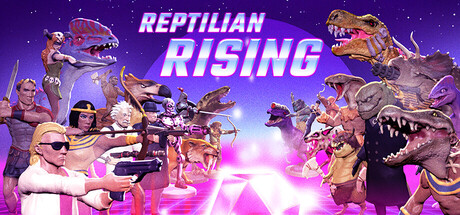
Compara los precios de Reptilian Rising en tiendas de claves de confianza y encuentra la mejor oferta. Desarrollado por Gregarious Games. Publicado por Numskull Games. Lanzado el 23/4/2026. Disponible en PC. Géneros: Indie, Strategy.

Cleopatra, Einstein, and Churchill on a grid-based tabletop fighting laser raptors - Reptilian Rising earns its absurdity, though late-game balance cracks are real and the tutorial outstays its welcome.

I have a mental checklist for whether a tactics game is worth the time investment, and Reptilian Rising ticks enough boxes to keep me at my desk well past midnight - even if a few of those boxes are circled in red pen. The setup is gleefully unserious: a faction called The Ouroboros has fractured the timeline, and your job is to recruit 20-plus historical and mythological figures across seven eras, from prehistoric jungles through to dystopian futures, and push back against an army of Manborgs, Lazer Raptors, and the three-headed Dictatorsaur. The premise should not work as a tactical framework. Somehow it does. The core loop is grid-based and deliberate. Each hero gets two actions per turn - move, attack, claim a Time Gate, block a spawn manhole, interact with the environment. Heroes fall into four classes: Scout, Warrior, Elite, and Heavy, and Scouts in particular reward aggressive gate play by closing distance fast while your Heavy units anchor the frontline. The genuine hook is the time energy system. You can spend this resource to create temporal clones of your own units, open time-gates to reposition heroes across the map in a single turn, or call in reinforcements from alternate eras. When you chain a gate capture with a clone ability to double your pressure on a spawn point, the game snaps into focus in a way that most budget tactics titles never manage. Enemy spawns refresh every three rounds through uncaptured gates and eggs, so the map never goes quiet, and the pressure to move forward rather than turtling gives each mission a ticking-clock tension that I genuinely appreciate. That said, the balance spreadsheet has some obvious red ink. Ranged heroes with area-of-effect attacks - Ankha being the clearest example - exploit the melee-heavy enemy spawn design to a degree that flattens difficulty once you understand what is happening. The four difficulty settings do not add smarter AI; they primarily extend match length, which is a frustrating non-solution when a standard run already sits in the 20-to-40-minute range per mission. Outside of the nine boss encounters, the standard AI is reactive only to numbers, not positioning, meaning experienced tactics players will stop sweating after the first handful of eras. Late-game mission objectives also recycle zone-control and elimination templates more than they should, and reviewers across the board noted the tutorial's text walls and a handful of UI bugs where grid elements are obscured. This is launch-day roughness, not fundamental design failure, but it is the kind of friction you feel. Presentation is where the game makes its case most convincingly. The claymation-style miniature aesthetic is consistent from the menus through to the final era, and deliberately so - a hyper-realistic visual treatment would kill the tabletop toy-box identity that makes the whole thing cohere. Voice acting sits firmly in so-bad-it-is-good territory, with exaggerated accents for every historical figure that land more often than they misfire. The cassette collection mechanic for unlocking alternate soundtrack tracks is a small but smart bit of world-building. Between missions the upgrade shop splits Gold and Obsidian currencies: Gold goes into hero perk upgrades, Obsidian into the Time Tech branch covering cloning, gate upgrades, and Healing Tank improvements that extend how many lives your roster carries into each run. The mission-branching structure means your campaign path is not fully fixed, and optional bonus objectives on replayed stages keep the replayability argument honest without requiring a full restart. A solo campaign run clocks somewhere between 10 and 12 hours. One-and-done players will feel the value ceiling. Those willing to run a second campaign on hard with a deliberately different hero lineup - skipping the obvious ranged-AoE picks - will find the systems under the surface are deeper than the easy-mode experience suggests. Reptilian Rising is not a tactics game that will stress a veteran's late-game optimisation instincts the way something with a richer AI would, but for players who want a well-built, short-burst tabletop tactics experience wrapped in the most committed B-movie aesthetic of 2026, it makes a persuasive argument for itself. Diego, Scout Team

Reptilian Rising

Reptilian Rising

23 abr 2026Gregarious GamesNumskull Games
GamerScout opina

Cleopatra, Einstein, and Churchill on a grid-based tabletop fighting laser raptors - Reptilian Rising earns its absurdity, though late-game balance cracks are real and the tutorial outstays its welcome.

PC
Steam Deck Playable
Mejor precio disponible
€0.00
en N/A
Mínimo histórico: €8.99

Comparar precios(0 tiendas)

Cargando precios...

We may earn a commission when you buy games through links on this page — at no extra cost to you. It never affects our rankings or verdicts.

Historial de precios

Historical low
€8.998 Jun 2026
Official storesKeyshops
€7.87€11.73€15.59€19.458 Jun13 Jun18 Jun23 Jun28 Jun
Tracking prices since 8 Jun 2026
Create alert

Capturas y multimedia

Acerca de Reptilian Rising

I have a mental checklist for whether a tactics game is worth the time investment, and Reptilian Rising ticks enough boxes to keep me at my desk well past midnight - even if a few of those boxes are circled in red pen. The setup is gleefully unserious: a faction called The Ouroboros has fractured the timeline, and your job is to recruit 20-plus historical and mythological figures across seven eras, from prehistoric jungles through to dystopian futures, and push back against an army of Manborgs, Lazer Raptors, and the three-headed Dictatorsaur. The premise should not work as a tactical framework. Somehow it does. The core loop is grid-based and deliberate. Each hero gets two actions per turn - move, attack, claim a Time Gate, block a spawn manhole, interact with the environment. Heroes fall into four classes: Scout, Warrior, Elite, and Heavy, and Scouts in particular reward aggressive gate play by closing distance fast while your Heavy units anchor the frontline. The genuine hook is the time energy system. You can spend this resource to create temporal clones of your own units, open time-gates to reposition heroes across the map in a single turn, or call in reinforcements from alternate eras. When you chain a gate capture with a clone ability to double your pressure on a spawn point, the game snaps into focus in a way that most budget tactics titles never manage. Enemy spawns refresh every three rounds through uncaptured gates and eggs, so the map never goes quiet, and the pressure to move forward rather than turtling gives each mission a ticking-clock tension that I genuinely appreciate. That said, the balance spreadsheet has some obvious red ink. Ranged heroes with area-of-effect attacks - Ankha being the clearest example - exploit the melee-heavy enemy spawn design to a degree that flattens difficulty once you understand what is happening. The four difficulty settings do not add smarter AI; they primarily extend match length, which is a frustrating non-solution when a standard run already sits in the 20-to-40-minute range per mission. Outside of the nine boss encounters, the standard AI is reactive only to numbers, not positioning, meaning experienced tactics players will stop sweating after the first handful of eras. Late-game mission objectives also recycle zone-control and elimination templates more than they should, and reviewers across the board noted the tutorial's text walls and a handful of UI bugs where grid elements are obscured. This is launch-day roughness, not fundamental design failure, but it is the kind of friction you feel. Presentation is where the game makes its case most convincingly. The claymation-style miniature aesthetic is consistent from the menus through to the final era, and deliberately so - a hyper-realistic visual treatment would kill the tabletop toy-box identity that makes the whole thing cohere. Voice acting sits firmly in so-bad-it-is-good territory, with exaggerated accents for every historical figure that land more often than they misfire. The cassette collection mechanic for unlocking alternate soundtrack tracks is a small but smart bit of world-building. Between missions the upgrade shop splits Gold and Obsidian currencies: Gold goes into hero perk upgrades, Obsidian into the Time Tech branch covering cloning, gate upgrades, and Healing Tank improvements that extend how many lives your roster carries into each run. The mission-branching structure means your campaign path is not fully fixed, and optional bonus objectives on replayed stages keep the replayability argument honest without requiring a full restart. A solo campaign run clocks somewhere between 10 and 12 hours. One-and-done players will feel the value ceiling. Those willing to run a second campaign on hard with a deliberately different hero lineup - skipping the obvious ranged-AoE picks - will find the systems under the surface are deeper than the easy-mode experience suggests. Reptilian Rising is not a tactics game that will stress a veteran's late-game optimisation instincts the way something with a richer AI would, but for players who want a well-built, short-burst tabletop tactics experience wrapped in the most committed B-movie aesthetic of 2026, it makes a persuasive argument for itself.

Diego
Diego · Scout Team

Strategy & simulation

Etiquetas

singleplayerachievementscloud-savestier:aaaTime Energy MechanicFour-Class Squad SystemGate Control ObjectiveClaymation AestheticBranching CampaignAlternate History RosterDictatorsaur BossTemporal Clone AbilityCassette Unlock SystemOnline PvP

Requisitos del sistema

Mínimos

OS
Windows 7 and above
Memory
4 GB RAM
DirectX
Version 11
Network
Broadband Internet connection
Storage
6 GB available space
Graphics
Video card with 1GB of VRAM
Processor
Intel Core i3 2.5 Ghz or AMD Phenom II 2.6 Ghz or greater
Sound Card
DirectX compatible

Recomendados

OS
Windows 7 and above
Memory
8 GB RAM
DirectX
Version 11
Network
Broadband Internet connection
Storage
6 GB available space
Graphics
Video card with 2GB of VRAM
Processor
Fourth Generation Intel Core i5 2.5 Ghz or AMD FX8350 4.0 Ghz or greater
Sound Card
DirectX compatible

Sigue explorando

Community Discussion

Be the first to comment on Reptilian Rising.

Reseñas y valoraciones

No hay valoraciones disponibles

Información del juego

Desarrolladora
Gregarious Games
Distribuidora
Numskull Games
Fecha de lanzamiento
23 abr 2026

Alerta de precio

¡Recibe un aviso cuando el precio baje de tu objetivo!

Crear alerta

Compra mejor: guías útiles

Preguntas frecuentes sobre Reptilian Rising

¿Cuánto cuesta Reptilian Rising?

El precio de Reptilian Rising cambia a menudo y varía según la tienda, la edición y la región. La tabla de precios en vivo de esta página compara las ofertas más baratas en stock de tiendas de claves de confianza como Eneba y Kinguin, para que siempre veas el precio más bajo actual antes de comprar.

¿Dónde puedo comprar Reptilian Rising más barato?

Compara los precios de Reptilian Rising en todas las tiendas verificadas en la tabla de precios de esta página. Listamos las ofertas de claves y tiendas más baratas en stock, actualizadas con frecuencia, para que siempre veas la mejor oferta actual antes de comprar.

¿En qué plataformas está disponible Reptilian Rising?

Reptilian Rising está disponible en PC.

¿Cuándo se lanzó Reptilian Rising?

Reptilian Rising se lanzó el 23 de abril de 2026.

¿Quién desarrolló Reptilian Rising?

Reptilian Rising fue desarrollado por Gregarious Games y publicado por Numskull Games.