
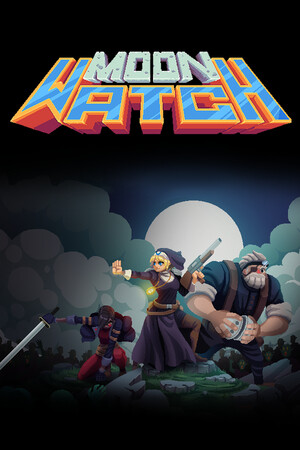
Compara los precios de Moon Watch en tiendas de claves de confianza y encuentra la mejor oferta. Desarrollado por Jaspel. Publicado por Pretty Soon. Lanzado el 4/12/2024. Disponible en PC, Mac, Linux. Géneros: Action, Adventure, Casual, Indie, RPG, Strategy, Early Access.

Vampire Survivors meets Slay the Spire, then Superhot walks in and slows everything down. If you ever wished bullet heaven games would let you actually think, Moon Watch is built for you.

I respect any three-person studio willing to throw three genre rulebooks into a blender and call the result a feature. Moon Watch does exactly that: it borrows the endless-horde feel of bullet heaven games, grafts on a card-based combat system, then rips out the reflex requirement entirely by making time move only when you move. Stand still and the vampire hordes freeze mid-lunge. That single design choice turns what could have been a chaotic auto-attack fest into something that rewards the kind of player who wants to read every tooltip before committing to a position. The core loop runs like this: you move, enemies and projectiles advance, you stop, everything pauses, you play cards from your hand to attack or reposition, then repeat. Cards cost power that recharges with movement, so there is a genuine push-pull between staying still to plan and moving to refuel. Each of the three launch characters pulls this loop in a different direction. The starter character leans on garlic-zone control and ranged projectiles, keeping things legible for newcomers. Nina, the melee specialist, rewards aggressive dashing and weaving close to enemies while using a curse ability to debuff targets before closing in. Encio is the one for systems-obsessed players: a pinball-movement character who drops turrets, chains electricity, and can charm enemies into fighting each other. The character diversity is already the strongest argument for the game at Early Access launch, because switching from one to another genuinely feels like a different decision tree rather than a palette swap. Content depth at launch sits at three acts across 50-plus randomly selected stages, three mode types (Classic, Horde, and Wave), around 80 cards, 43 relics, and an Infinite Loop mode that lets you keep scaling a completed build until it collapses. Meta-progression is achievement-gated, which is a sensible design choice that avoids the trap of locking core cards behind grind walls. The main honest criticism from early players is that runs can feel somewhat similar after a few sessions, which is a fair flag. The card pool and relic count are solid for Early Access but not yet wide enough to produce the kind of wildly divergent builds that make games like this endlessly replayable. The developer has been transparent that balance and build variety are top priorities for the roadmap, with more cards, characters, enemies, and an expanded meta-progression tech tree all planned before 1.0. For strategy-minded players who bounced off Vampire Survivors because it felt passive, or who found Slay the Spire lonely for want of spatial positioning, Moon Watch is a genuinely novel intersection. The time-stop hook is not a gimmick bolted on for marketing purposes; it is the load-bearing wall of the whole experience. The tutorial does a workmanlike job of introducing the power system and card mechanics without drowning the player in text. It is light enough that someone new to deckbuilders can find their footing, and the pause-at-will design removes the punishment for slow readers. Early Access status means accepting that the back half of the content is still being built, but the foundation is mechanically coherent in a way that early Backpack Hero was before it found its stride. Diego, Scout Team

Moon Watch

Moon Watch

4 dic 2024JaspelPretty Soon
GamerScout opina

Vampire Survivors meets Slay the Spire, then Superhot walks in and slows everything down. If you ever wished bullet heaven games would let you actually think, Moon Watch is built for you.

PCMacLinux
Steam Deck Playable
Mejor precio disponible
€0.00
en N/A
Mínimo histórico: €3.49

Comparar precios(0 tiendas)

Cargando precios...

We may earn a commission when you buy games through links on this page — at no extra cost to you. It never affects our rankings or verdicts.

Historial de precios

Historical low
€3.4915 Jun 2026
Keyshops
€3.45€3.58€3.70€3.839 Jun14 Jun19 Jun23 Jun28 Jun
Tracking prices since 9 Jun 2026
Create alert

Capturas y multimedia

Acerca de Moon Watch

I respect any three-person studio willing to throw three genre rulebooks into a blender and call the result a feature. Moon Watch does exactly that: it borrows the endless-horde feel of bullet heaven games, grafts on a card-based combat system, then rips out the reflex requirement entirely by making time move only when you move. Stand still and the vampire hordes freeze mid-lunge. That single design choice turns what could have been a chaotic auto-attack fest into something that rewards the kind of player who wants to read every tooltip before committing to a position. The core loop runs like this: you move, enemies and projectiles advance, you stop, everything pauses, you play cards from your hand to attack or reposition, then repeat. Cards cost power that recharges with movement, so there is a genuine push-pull between staying still to plan and moving to refuel. Each of the three launch characters pulls this loop in a different direction. The starter character leans on garlic-zone control and ranged projectiles, keeping things legible for newcomers. Nina, the melee specialist, rewards aggressive dashing and weaving close to enemies while using a curse ability to debuff targets before closing in. Encio is the one for systems-obsessed players: a pinball-movement character who drops turrets, chains electricity, and can charm enemies into fighting each other. The character diversity is already the strongest argument for the game at Early Access launch, because switching from one to another genuinely feels like a different decision tree rather than a palette swap. Content depth at launch sits at three acts across 50-plus randomly selected stages, three mode types (Classic, Horde, and Wave), around 80 cards, 43 relics, and an Infinite Loop mode that lets you keep scaling a completed build until it collapses. Meta-progression is achievement-gated, which is a sensible design choice that avoids the trap of locking core cards behind grind walls. The main honest criticism from early players is that runs can feel somewhat similar after a few sessions, which is a fair flag. The card pool and relic count are solid for Early Access but not yet wide enough to produce the kind of wildly divergent builds that make games like this endlessly replayable. The developer has been transparent that balance and build variety are top priorities for the roadmap, with more cards, characters, enemies, and an expanded meta-progression tech tree all planned before 1.0. For strategy-minded players who bounced off Vampire Survivors because it felt passive, or who found Slay the Spire lonely for want of spatial positioning, Moon Watch is a genuinely novel intersection. The time-stop hook is not a gimmick bolted on for marketing purposes; it is the load-bearing wall of the whole experience. The tutorial does a workmanlike job of introducing the power system and card mechanics without drowning the player in text. It is light enough that someone new to deckbuilders can find their footing, and the pause-at-will design removes the punishment for slow readers. Early Access status means accepting that the back half of the content is still being built, but the foundation is mechanically coherent in a way that early Backpack Hero was before it found its stride.

Diego
Diego · Scout Team

Strategy & simulation

Etiquetas

singleplayercontroller-supporttier:sub-5Time-Stop MechanicPause-and-PlanCharacter AsymmetryPower-Recharge EconomyHorde PositioningMeta-Progression GatingVampire Theme

Requisitos del sistema

Mínimos

OS
Windows 7 (SP1+), Windows 10 and Windows 11
Memory
1 GB RAM
DirectX
Version 10
Graphics
DX10, DX11, DX12 capable.
Processor
1.1 GHz Processor

Sigue explorando

Community Discussion

Be the first to comment on Moon Watch.

Reseñas y valoraciones

No hay valoraciones disponibles

Información del juego

Desarrolladora
Jaspel
Distribuidora
Pretty Soon
Fecha de lanzamiento
4 dic 2024

Alerta de precio

¡Recibe un aviso cuando el precio baje de tu objetivo!

Crear alerta

Más de Jaspel

Compra mejor: guías útiles

Preguntas frecuentes sobre Moon Watch

¿Cuánto cuesta Moon Watch?

El precio de Moon Watch cambia a menudo y varía según la tienda, la edición y la región. La tabla de precios en vivo de esta página compara las ofertas más baratas en stock de tiendas de claves de confianza como Eneba y Kinguin, para que siempre veas el precio más bajo actual antes de comprar.

¿Dónde puedo comprar Moon Watch más barato?

Compara los precios de Moon Watch en todas las tiendas verificadas en la tabla de precios de esta página. Listamos las ofertas de claves y tiendas más baratas en stock, actualizadas con frecuencia, para que siempre veas la mejor oferta actual antes de comprar.

¿En qué plataformas está disponible Moon Watch?

Moon Watch está disponible en PC, Mac, Linux.

¿Cuándo se lanzó Moon Watch?

Moon Watch se lanzó el 4 de diciembre de 2024.

¿Quién desarrolló Moon Watch?

Moon Watch fue desarrollado por Jaspel y publicado por Pretty Soon.