
Compara los precios de Minami Lane en tiendas de claves de confianza y encuentra la mejor oferta. Desarrollado por Blibloop. Publicado por Doot Tiny Games. Lanzado el 28/2/2024. Disponible en PC, Mac, Linux. Géneros: Casual, Indie, Simulation, Strategy.

Pocket-sized street management that respects your lunch break. Five missions, a sandbox, and enough villager feedback loops to scratch that optimization itch without demanding a weekend.

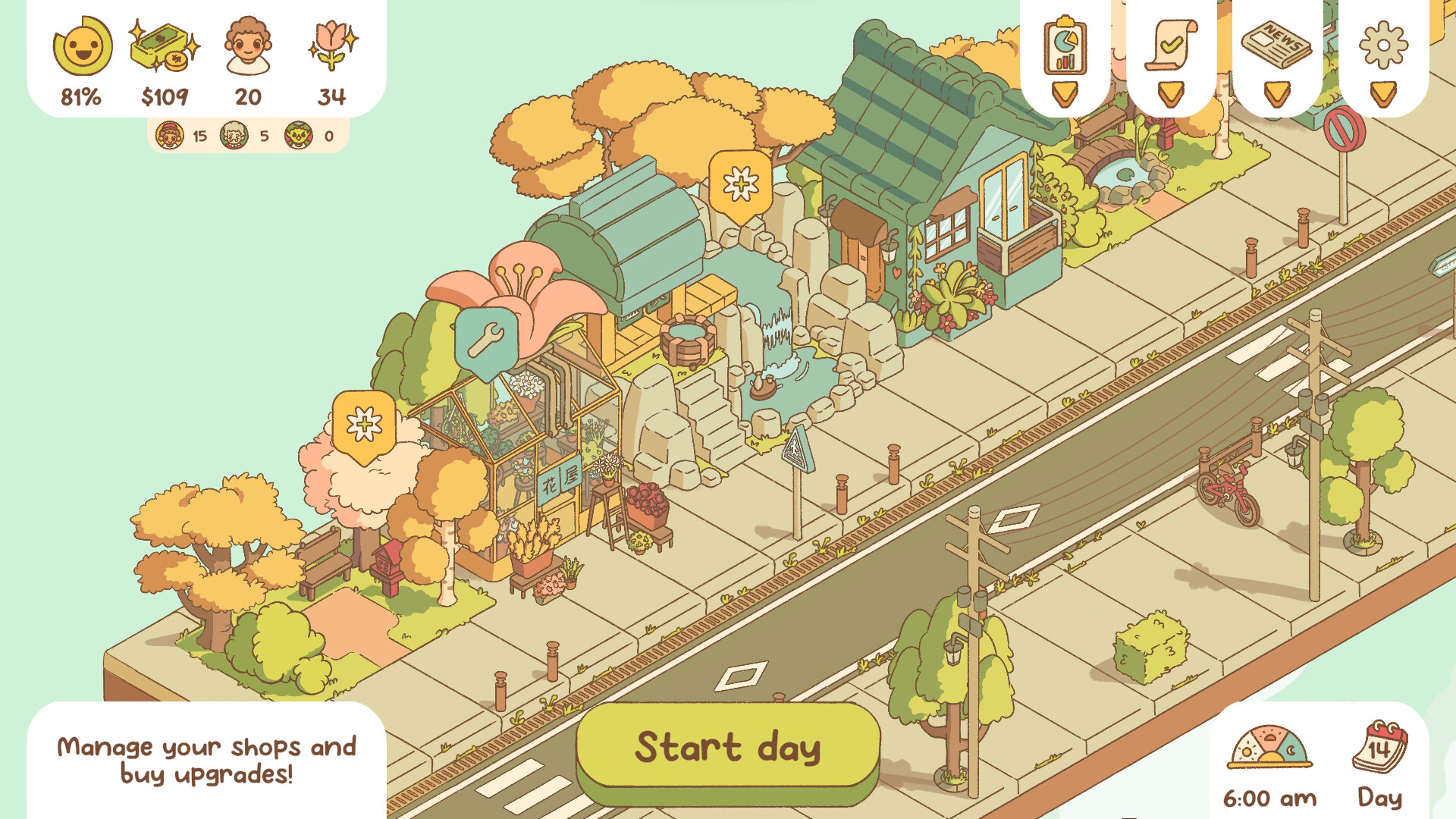
I pulled up Minami Lane expecting a purely decorative clicker, and what I actually got was a surprisingly readable management loop with real feedback mechanics underneath the pastel exterior. The premise is minimal: a tanuki guide named Ema sets you up on a single Japanese-inspired street, and each in-game day you place one new building, then watch villagers react to what you have built. That day-night cycle is the engine the whole game runs on, and it works. Each villager broadcasts their preferences in thought bubbles, telling you when ramen prices are too high, when the bookshop is stocking the wrong titles, or when the street lacks beauty. You then adjust before the next day starts. It is a feedback loop by design, and credit to the former data scientist behind the project: the systems are tighter than you would expect from something this small. Five missions structure the campaign, with each one introducing a new layer. Mission one is population growth via house construction and a ramen shop you can actually tune, adjusting recipe ingredients and pricing to hit satisfaction targets. Mission two splits your attention between elder and youth villager demographics, each with different shop preferences, which forces you to balance a bookshop's inventory alongside two ramen stalls. Mission three unlocks recycling, letting you clear redundant buildings to make room for higher-value structures, and adds cats attracted by street beauty as a measurable metric. By mission four, daily news events start randomizing conditions before each morning, such as a day where no one litters or a demographic suddenly tolerating premium pricing. It is thin by grand-strategy standards, but each layer lands clearly rather than piling on without explanation. The sandbox is where the game extends its value, modestly. Planner Mode starts you at $400 with building unlock requirements, which adds genuine resource constraint for anyone who wants to optimize. Creative Mode gives you a near-unlimited budget and all buildings at once, purely for aesthetic freeform play. Neither mode changes the fact that there are fewer than twenty buildings in the total roster, and the complete mission run clocks in somewhere between two and five hours depending on pace. That is the real number to sit with before purchasing. This is not a game with late-game spirals or compounding complexity. The loop stays shallow by design, and critics who called it repetitive after the missions are not wrong. The day timer runs between forty seconds and about three and a half minutes in later stages, and once the day starts you can only watch, not intervene. For strategy-focused players, Minami Lane is something I would call a valid mental-palate cleanser rather than a primary diet. The satisfaction math is simple enough to solve in your head within two missions, and the absence of any loss condition means the tension ceiling is low. That said, the hand-drawn, Studio Ghibli-inspired isometric art is genuinely good, the ambient soundtrack does not grate after repeated sessions, and the achievement list is short, non-missable, and completable in a single run. If you have a newcomer in your household who bounces off anything resembling a spreadsheet, this is one of the more painless genre introductions available. The tutorial does not lecture; it just puts Ema in front of you and lets the feedback bubbles do the teaching. The one design complaint worth flagging from a systems perspective: you cannot interact with villagers once the day has started without pausing time manually, and clicking individuals before they walk off-screen becomes slightly fiddly in the later, busier missions. It is a minor friction point, but it is the moment the game shows its scope limits. A deeper upgrade tree, additional building archetypes, or variable street layouts in sandbox would have bought it another tier of replayability. Diego, Scout Team

Minami Lane

Minami Lane

28 feb 2024BlibloopDoot Tiny Games
GamerScout opina

Pocket-sized street management that respects your lunch break. Five missions, a sandbox, and enough villager feedback loops to scratch that optimization itch without demanding a weekend.

PCMacLinux
Steam Deck VerifiedProtonDB Platinum
Mejor precio disponible
€0.00
en N/A
Mínimo histórico: €0.51

Comparar precios(0 tiendas)

Cargando precios...

We may earn a commission when you buy games through links on this page — at no extra cost to you. It never affects our rankings or verdicts.

Historial de precios

Historical low
€0.5126 Jun 2026
Keyshops
€0.49€0.56€0.63€0.708 Jun13 Jun18 Jun23 Jun28 Jun
Tracking prices since 8 Jun 2026
Create alert

Capturas y multimedia

Captura

Acerca de Minami Lane

I pulled up Minami Lane expecting a purely decorative clicker, and what I actually got was a surprisingly readable management loop with real feedback mechanics underneath the pastel exterior. The premise is minimal: a tanuki guide named Ema sets you up on a single Japanese-inspired street, and each in-game day you place one new building, then watch villagers react to what you have built. That day-night cycle is the engine the whole game runs on, and it works. Each villager broadcasts their preferences in thought bubbles, telling you when ramen prices are too high, when the bookshop is stocking the wrong titles, or when the street lacks beauty. You then adjust before the next day starts. It is a feedback loop by design, and credit to the former data scientist behind the project: the systems are tighter than you would expect from something this small. Five missions structure the campaign, with each one introducing a new layer. Mission one is population growth via house construction and a ramen shop you can actually tune, adjusting recipe ingredients and pricing to hit satisfaction targets. Mission two splits your attention between elder and youth villager demographics, each with different shop preferences, which forces you to balance a bookshop's inventory alongside two ramen stalls. Mission three unlocks recycling, letting you clear redundant buildings to make room for higher-value structures, and adds cats attracted by street beauty as a measurable metric. By mission four, daily news events start randomizing conditions before each morning, such as a day where no one litters or a demographic suddenly tolerating premium pricing. It is thin by grand-strategy standards, but each layer lands clearly rather than piling on without explanation. The sandbox is where the game extends its value, modestly. Planner Mode starts you at $400 with building unlock requirements, which adds genuine resource constraint for anyone who wants to optimize. Creative Mode gives you a near-unlimited budget and all buildings at once, purely for aesthetic freeform play. Neither mode changes the fact that there are fewer than twenty buildings in the total roster, and the complete mission run clocks in somewhere between two and five hours depending on pace. That is the real number to sit with before purchasing. This is not a game with late-game spirals or compounding complexity. The loop stays shallow by design, and critics who called it repetitive after the missions are not wrong. The day timer runs between forty seconds and about three and a half minutes in later stages, and once the day starts you can only watch, not intervene. For strategy-focused players, Minami Lane is something I would call a valid mental-palate cleanser rather than a primary diet. The satisfaction math is simple enough to solve in your head within two missions, and the absence of any loss condition means the tension ceiling is low. That said, the hand-drawn, Studio Ghibli-inspired isometric art is genuinely good, the ambient soundtrack does not grate after repeated sessions, and the achievement list is short, non-missable, and completable in a single run. If you have a newcomer in your household who bounces off anything resembling a spreadsheet, this is one of the more painless genre introductions available. The tutorial does not lecture; it just puts Ema in front of you and lets the feedback bubbles do the teaching. The one design complaint worth flagging from a systems perspective: you cannot interact with villagers once the day has started without pausing time manually, and clicking individuals before they walk off-screen becomes slightly fiddly in the later, busier missions. It is a minor friction point, but it is the moment the game shows its scope limits. A deeper upgrade tree, additional building archetypes, or variable street layouts in sandbox would have bought it another tier of replayability.

Diego
Diego · Scout Team

Strategy & simulation

Etiquetas

singleplayerachievementscontroller-supporttrading-cardscloud-savestier:sub-5Cozy ManagementDay-Cycle LoopVillager FeedbackSandbox ModeIsometric Street BuilderBite-Sized CampaignResource OptimizationCompletionist-Friendly

Requisitos del sistema

Mínimos

OS
Windows 7 (SP1+), 10 or 11
Memory
2 GB RAM
Storage
250 MB available space
Graphics
Integrated graphics should be enough
Processor
x86, x64 architecture

Sigue explorando

Community Discussion

Be the first to comment on Minami Lane.

Reseñas y valoraciones

No hay valoraciones disponibles

Información del juego

Desarrolladora
Blibloop
Distribuidora
Doot Tiny Games
Fecha de lanzamiento
28 feb 2024

Alerta de precio

¡Recibe un aviso cuando el precio baje de tu objetivo!

Crear alerta

Compra mejor: guías útiles

¿Buscas más? Mira juegos como Minami Lane →

Preguntas frecuentes sobre Minami Lane

¿Cuánto cuesta Minami Lane?

El precio de Minami Lane cambia a menudo y varía según la tienda, la edición y la región. La tabla de precios en vivo de esta página compara las ofertas más baratas en stock de tiendas de claves de confianza como Eneba y Kinguin, para que siempre veas el precio más bajo actual antes de comprar.

¿Dónde puedo comprar Minami Lane más barato?

Compara los precios de Minami Lane en todas las tiendas verificadas en la tabla de precios de esta página. Listamos las ofertas de claves y tiendas más baratas en stock, actualizadas con frecuencia, para que siempre veas la mejor oferta actual antes de comprar.

¿En qué plataformas está disponible Minami Lane?

Minami Lane está disponible en PC, Mac, Linux.

¿Cuándo se lanzó Minami Lane?

Minami Lane se lanzó el 28 de febrero de 2024.

¿Quién desarrolló Minami Lane?

Minami Lane fue desarrollado por Blibloop y publicado por Doot Tiny Games.