Compara los precios de Memoranda en tiendas de claves de confianza y encuentra la mejor oferta. Desarrollado por Bit Byterz. Publicado por Digital Dragon. Lanzado el 25/1/2017. Disponible en PC, Mac, Linux. Géneros: Adventure, Indie. Puntuación Metacritic: 58/100.

Gorgeous hand-drawn atmosphere lifted wholesale from Murakami, then quietly strangled by puzzle logic that asks you to read the developer's mind. Worth it if you keep a walkthrough tab open.

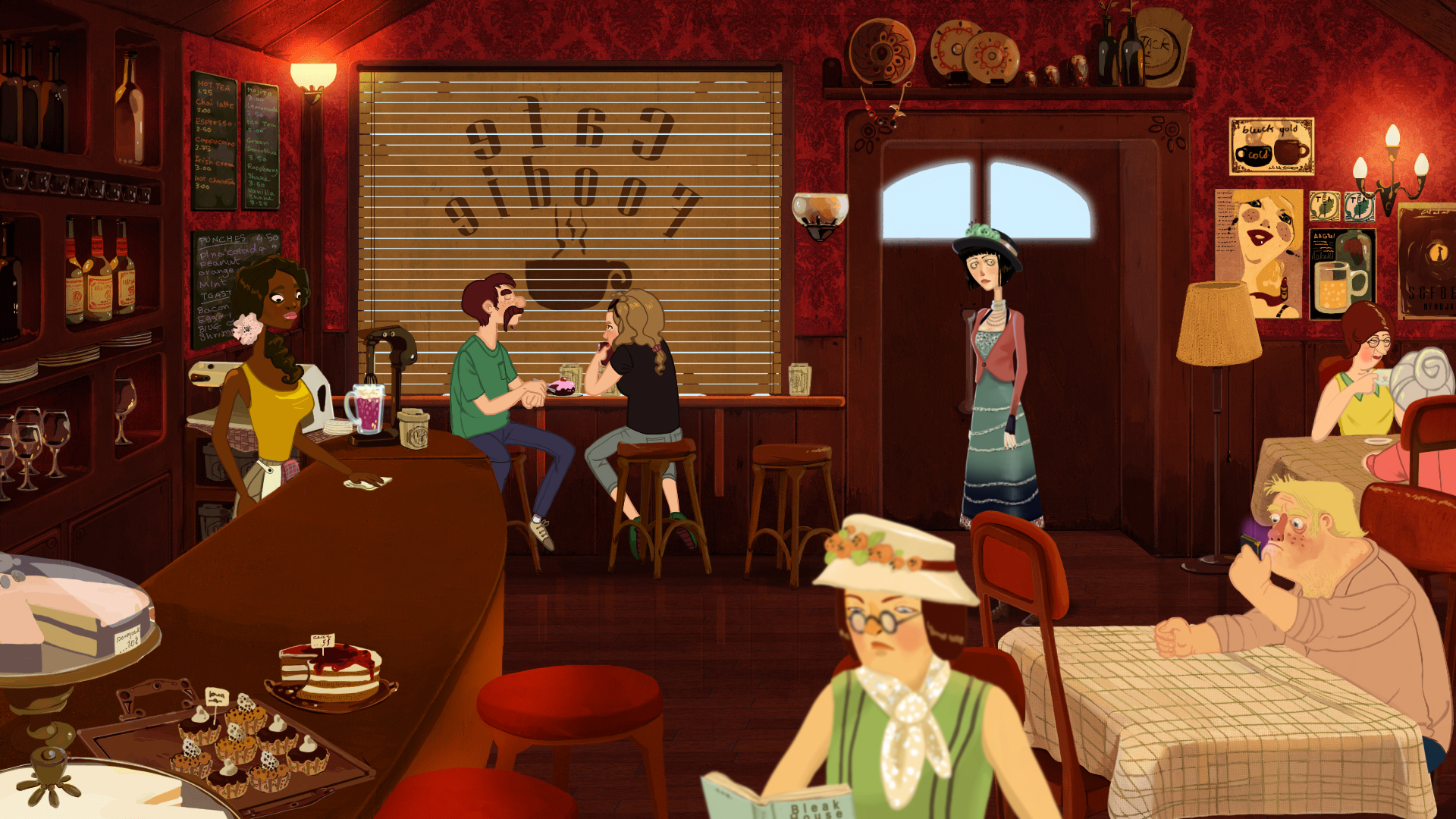
My first few minutes with Memoranda felt like someone had finally done the impossible: handed Haruki Murakami's short-story world to a point-and-click team that actually understood his loneliness. The hand-drawn art lands immediately. Locations carry that gloomy-pretty quality, run-down seaside buildings sitting alongside fully furnished ratholes, a world that feels like fairytale pages left out in the rain. The original soundtrack shifts between calm and quietly eerie depending on where Mizuki wanders, and it does that work with real intention. Bit Byterz clearly cared about craft here, and that care is visible in almost every scene you look at rather than interact with. The premise is quietly affecting. Mizuki, an insomniac in her mid-twenties, has somehow lost her own name. She keeps photos around the apartment, chronicles her days in a journal that doubles as a quest log (the in-game "memoranda" of the title), and cannot leave home without a map that also serves as the fast-travel system. The cast she meets across the game's roughly 40 locations is genuinely strange in the right ways: a WWII-surviving soldier who hasn't stood down, an elephant sheltering in a man's cottage while hoping to become human, an opera-singing cat whose range of notes you will need to collect for a later puzzle. There are over 35 characters, all fully voiced in English. The voice work is uneven in spots, but the eccentricity of the cast mostly papers over the rougher line readings. Here is where I have to be honest with you. The puzzle design is the game's central wound and everyone who reviewed it agrees. Solutions routinely abandon internal logic, even the kind of dream-logic Murakami himself always maintained in his prose. Item combinations feel arbitrary rather than intuitive. Hidden hotspots blend into backgrounds in ways that are less atmospheric obscurity and more missed QA pass. Multiple reviewers, myself included in spirit, found three or four puzzles that required an external guide not because the riddle was cleverly hard but because the answer had no discernible connection to the clues provided. Mizuki's journal-memoranda is supposed to hint at next steps, but some entries are red herrings and others are simply vague. There is also no way to skip or speed up interactions, so when you are stuck and cycling back through dialogue for the fourth time, the pacing that felt meditative an hour ago starts to feel punishing. The story itself has a similarly unfinished texture. Plot threads open around interesting side characters and then simply close without resolution, not in a Murakami-intentional-ambiguity way but in a we-ran-out-of-room way. That said, the game's second half does open up more locations and more writing, and the moment a camera appears that reveals the true nature of whoever it photographs is a genuinely lovely piece of design. The overall runtime sits somewhere between three and five hours depending on your puzzle tolerance, and the game does know when it wants to end, which I will always credit. For Murakami readers specifically: the atmosphere is there, the loneliness is there, but the puzzle frustration may sour what should be a warm recognition. For genre veterans who keep a walkthrough tab open by instinct: the art and soundscape justify the time. For anyone expecting Broken Age-level puzzle cohesion: look elsewhere. Kai, Scout Team

Memoranda

Memoranda

25 ene 2017Bit ByterzDigital Dragon
GamerScout opina

Gorgeous hand-drawn atmosphere lifted wholesale from Murakami, then quietly strangled by puzzle logic that asks you to read the developer's mind. Worth it if you keep a walkthrough tab open.

PCMacLinux
Mejor precio disponible
€0.00
en N/A
Mínimo histórico: €1.44

Comparar precios(0 tiendas)

Cargando precios...

We may earn a commission when you buy games through links on this page — at no extra cost to you. It never affects our rankings or verdicts.

Historial de precios

Historical low
€1.4423 Jun 2026
Keyshops
€1.37€1.62€1.88€2.137 Jun12 Jun18 Jun23 Jun28 Jun
Tracking prices since 7 Jun 2026
Create alert

Capturas y multimedia

Captura

Acerca de Memoranda

My first few minutes with Memoranda felt like someone had finally done the impossible: handed Haruki Murakami's short-story world to a point-and-click team that actually understood his loneliness. The hand-drawn art lands immediately. Locations carry that gloomy-pretty quality, run-down seaside buildings sitting alongside fully furnished ratholes, a world that feels like fairytale pages left out in the rain. The original soundtrack shifts between calm and quietly eerie depending on where Mizuki wanders, and it does that work with real intention. Bit Byterz clearly cared about craft here, and that care is visible in almost every scene you look at rather than interact with. The premise is quietly affecting. Mizuki, an insomniac in her mid-twenties, has somehow lost her own name. She keeps photos around the apartment, chronicles her days in a journal that doubles as a quest log (the in-game "memoranda" of the title), and cannot leave home without a map that also serves as the fast-travel system. The cast she meets across the game's roughly 40 locations is genuinely strange in the right ways: a WWII-surviving soldier who hasn't stood down, an elephant sheltering in a man's cottage while hoping to become human, an opera-singing cat whose range of notes you will need to collect for a later puzzle. There are over 35 characters, all fully voiced in English. The voice work is uneven in spots, but the eccentricity of the cast mostly papers over the rougher line readings. Here is where I have to be honest with you. The puzzle design is the game's central wound and everyone who reviewed it agrees. Solutions routinely abandon internal logic, even the kind of dream-logic Murakami himself always maintained in his prose. Item combinations feel arbitrary rather than intuitive. Hidden hotspots blend into backgrounds in ways that are less atmospheric obscurity and more missed QA pass. Multiple reviewers, myself included in spirit, found three or four puzzles that required an external guide not because the riddle was cleverly hard but because the answer had no discernible connection to the clues provided. Mizuki's journal-memoranda is supposed to hint at next steps, but some entries are red herrings and others are simply vague. There is also no way to skip or speed up interactions, so when you are stuck and cycling back through dialogue for the fourth time, the pacing that felt meditative an hour ago starts to feel punishing. The story itself has a similarly unfinished texture. Plot threads open around interesting side characters and then simply close without resolution, not in a Murakami-intentional-ambiguity way but in a we-ran-out-of-room way. That said, the game's second half does open up more locations and more writing, and the moment a camera appears that reveals the true nature of whoever it photographs is a genuinely lovely piece of design. The overall runtime sits somewhere between three and five hours depending on your puzzle tolerance, and the game does know when it wants to end, which I will always credit. For Murakami readers specifically: the atmosphere is there, the loneliness is there, but the puzzle frustration may sour what should be a warm recognition. For genre veterans who keep a walkthrough tab open by instinct: the art and soundscape justify the time. For anyone expecting Broken Age-level puzzle cohesion: look elsewhere.

Kai
Kai · Scout Team

Indie & narrative

Etiquetas

singleplayerachievementstrading-cardscloud-savestier:sub-5Magic RealismHand-Drawn ArtAtmospheric SoundtrackObtuse PuzzlesFully VoicedJournal Quest LogShort PlaythroughMurakami-InspiredSeaside Setting

Requisitos del sistema

Mínimos

OS
7+
Memory
2 GB RAM
DirectX
Version 9.0c
Storage
800 MB available space
Graphics
NVIDIA GeForce GTX 260, ATI Radeon 4870 HD, or equivalent card with at least 512 MB VRAM
Processor
1.7 GHz Dual Core
Sound Card
DirectX Compatible Sound Card

Sigue explorando

Community Discussion

Be the first to comment on Memoranda.

Reseñas y valoraciones

Metacritic
58

Información del juego

Desarrolladora
Bit Byterz
Distribuidora
Digital Dragon
Fecha de lanzamiento
25 ene 2017

Alerta de precio

¡Recibe un aviso cuando el precio baje de tu objetivo!

Crear alerta

Compra mejor: guías útiles

¿Buscas más? Mira juegos como Memoranda →

Preguntas frecuentes sobre Memoranda

¿Cuánto cuesta Memoranda?

El precio de Memoranda cambia a menudo y varía según la tienda, la edición y la región. La tabla de precios en vivo de esta página compara las ofertas más baratas en stock de tiendas de claves de confianza como Eneba y Kinguin, para que siempre veas el precio más bajo actual antes de comprar.

¿Dónde puedo comprar Memoranda más barato?

Compara los precios de Memoranda en todas las tiendas verificadas en la tabla de precios de esta página. Listamos las ofertas de claves y tiendas más baratas en stock, actualizadas con frecuencia, para que siempre veas la mejor oferta actual antes de comprar.

¿En qué plataformas está disponible Memoranda?

Memoranda está disponible en PC, Mac, Linux.

¿Cuándo se lanzó Memoranda?

Memoranda se lanzó el 25 de enero de 2017.

¿Quién desarrolló Memoranda?

Memoranda fue desarrollado por Bit Byterz y publicado por Digital Dragon.

¿Merece la pena comprar Memoranda?

Memoranda tiene una puntuación Metacritic de 58/100, lo que lo convierte en uno de los títulos destacados de Adventure. Mira las reseñas completas, las valoraciones y los tiempos de duración en esta página para decidir.