Compara los precios de Master of Orion 3 en tiendas de claves de confianza y encuentra la mejor oferta. Desarrollado por Quicksilver Software. Publicado por Wargaming Labs. Lanzado el 25/8/2016. Disponible en PC. Géneros: Strategy. Puntuación Metacritic: 64/100.

A space 4X that bet its entire identity on macro-management and AI governors, then shipped with AI too broken to carry the weight. Worth it only if you show up already knowing what you're walking into.

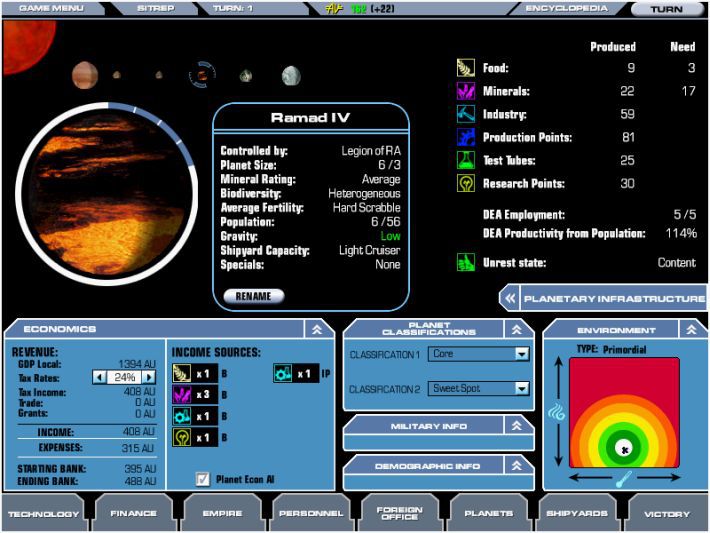
I've spent enough hours with turn-based 4X games to immediately recognize when a design philosophy is interesting versus when it's unfinished, and Master of Orion 3 is a painful case of both at the same time. The central concept is genuinely unusual: rather than micromanaging every colony individually, you are supposed to govern at the policy level, setting spending priorities, assigning planetary roles, and letting AI governors handle the routine queue-filling. Tax sliders, planetary development profiles, military budget allocations, research field priorities, diplomatic stances across 16 distinct races with their own strengths and weaknesses, task force composition for fleet operations. On paper, this is the Paradox-before-Paradox approach to galactic empire management, and the scale of the galaxy maps, spanning clusters of 50 to 100 stars even on smaller settings, gives it a real sense of weight. The problem is that the governors are bad at their jobs. Critically, irredeemably bad. They mismanage production queues, ignore your overarching strategic plans, and routinely replace your construction orders with their own preferences the moment a build slot opens. Research is partially randomised per save, so you cannot reliably target specific tech paths within a field, and the enemy AI at the diplomatic and military level is equally passive. Getting enemy factions to apply real pressure is difficult even on higher difficulty settings. For a game that asks you to trust your subordinate AI systems with so much of the moment-to-moment work, having those systems perform so poorly pulls the entire macro-management premise out from under itself. The interface compounds everything. Eight major reference screens covering finance, diplomacy, espionage, shipbuilding, and more, each split across multiple sub-views, with no meaningful contextual help and a learning curve that defeated veteran fans of the first two games on launch. The documentation runs to over 160 pages and still leaves core interactions unexplained. Players regularly report restarting multiple times before understanding how to properly set tech priorities or configure planetary development plans, not because the depth is rewarding, but because the game communicates its own systems poorly. Combat, which used to be a tactical subgame in the earlier entries, is now largely hands-off, with task force layout mattering but individual ship engagement feeling like a formality. That said, there is a small community that never gave up on it. Fan patches, notably the Brhuic and Gerra fixes, address a meaningful portion of the worst bugs. On top of that, the game uses Excel-style spreadsheets as its data layer, which makes it unusually easy to mod, and community mod packs have reshaped balance in ways the base release never achieved. If you are the kind of player who approaches a broken sandbox as a restoration project and enjoys tuning the numbers directly, there is arguably more raw material here than in many tidier competitors. The 16 races do offer meaningfully different starting strategies, from the Psilons' research advantage to the Klackons' population growth efficiency to the Ithkul's bioharvesting focus, and the victory conditions spanning Orion Senate elections, sole survivor, and ancient Antaran secret discovery give legitimate strategic variety to the endgame. Without the fan patches and at least one community mod, though, this is a frustrating experience by any standard. The Steam player score sits at mixed and the Metacritic sits at 64, and both feel about right for a game with real ideas underneath a nearly impenetrable exterior. If you loved MOO2 and want a direct continuation of that feel, this will disappoint you at almost every turn. If you are genuinely curious about the macro-governance experiment and willing to install patches and do some reading before your first session, there is something here, just not something comfortable. Diego, Scout Team

Master of Orion 3

Master of Orion 3

25 ago 2016Quicksilver SoftwareWargaming Labs
GamerScout opina

A space 4X that bet its entire identity on macro-management and AI governors, then shipped with AI too broken to carry the weight. Worth it only if you show up already knowing what you're walking into.

PC
ProtonDB Platinum
Mejor precio disponible
€0.00
en N/A
Mínimo histórico: €3.94

Comparar precios(0 tiendas)

Cargando precios...

We may earn a commission when you buy games through links on this page — at no extra cost to you. It never affects our rankings or verdicts.

Historial de precios

Historical low
€3.9412 Jun 2026
Keyshops
€3.88€4.10€4.32€4.548 Jun13 Jun18 Jun23 Jun28 Jun
Tracking prices since 8 Jun 2026
Create alert

Capturas y multimedia

Captura

Acerca de Master of Orion 3

I've spent enough hours with turn-based 4X games to immediately recognize when a design philosophy is interesting versus when it's unfinished, and Master of Orion 3 is a painful case of both at the same time. The central concept is genuinely unusual: rather than micromanaging every colony individually, you are supposed to govern at the policy level, setting spending priorities, assigning planetary roles, and letting AI governors handle the routine queue-filling. Tax sliders, planetary development profiles, military budget allocations, research field priorities, diplomatic stances across 16 distinct races with their own strengths and weaknesses, task force composition for fleet operations. On paper, this is the Paradox-before-Paradox approach to galactic empire management, and the scale of the galaxy maps, spanning clusters of 50 to 100 stars even on smaller settings, gives it a real sense of weight. The problem is that the governors are bad at their jobs. Critically, irredeemably bad. They mismanage production queues, ignore your overarching strategic plans, and routinely replace your construction orders with their own preferences the moment a build slot opens. Research is partially randomised per save, so you cannot reliably target specific tech paths within a field, and the enemy AI at the diplomatic and military level is equally passive. Getting enemy factions to apply real pressure is difficult even on higher difficulty settings. For a game that asks you to trust your subordinate AI systems with so much of the moment-to-moment work, having those systems perform so poorly pulls the entire macro-management premise out from under itself. The interface compounds everything. Eight major reference screens covering finance, diplomacy, espionage, shipbuilding, and more, each split across multiple sub-views, with no meaningful contextual help and a learning curve that defeated veteran fans of the first two games on launch. The documentation runs to over 160 pages and still leaves core interactions unexplained. Players regularly report restarting multiple times before understanding how to properly set tech priorities or configure planetary development plans, not because the depth is rewarding, but because the game communicates its own systems poorly. Combat, which used to be a tactical subgame in the earlier entries, is now largely hands-off, with task force layout mattering but individual ship engagement feeling like a formality. That said, there is a small community that never gave up on it. Fan patches, notably the Brhuic and Gerra fixes, address a meaningful portion of the worst bugs. On top of that, the game uses Excel-style spreadsheets as its data layer, which makes it unusually easy to mod, and community mod packs have reshaped balance in ways the base release never achieved. If you are the kind of player who approaches a broken sandbox as a restoration project and enjoys tuning the numbers directly, there is arguably more raw material here than in many tidier competitors. The 16 races do offer meaningfully different starting strategies, from the Psilons' research advantage to the Klackons' population growth efficiency to the Ithkul's bioharvesting focus, and the victory conditions spanning Orion Senate elections, sole survivor, and ancient Antaran secret discovery give legitimate strategic variety to the endgame. Without the fan patches and at least one community mod, though, this is a frustrating experience by any standard. The Steam player score sits at mixed and the Metacritic sits at 64, and both feel about right for a game with real ideas underneath a nearly impenetrable exterior. If you loved MOO2 and want a direct continuation of that feel, this will disappoint you at almost every turn. If you are genuinely curious about the macro-governance experiment and willing to install patches and do some reading before your first session, there is something here, just not something comfortable.

Diego
Diego · Scout Team

Strategy & simulation

Etiquetas

singleplayertier:sub-5Macro-ManagementAI Governor SystemGalaxy-Scale 4XFan Patch RequiredTask Force CombatRace AsymmetrySpreadsheet ModdableSenate Victory ConditionTurn-Based Space Strategy

Requisitos del sistema

Mínimos

OS
Windows (XP, Vista, 7, 8, 10)
Memory
512 MB RAM
DirectX
Version 7.0
Storage
2 GB available space
Graphics
3D graphics card compatible with DirectX 7
Processor
1.8 GHz
Sound Card
DirectX 7 Compatible

Recomendados

OS
Windows (XP, Vista, 7, 8, 10)
Memory
1 GB RAM
DirectX
Version 9.0
Storage
2 GB available space
Graphics
3D graphics card compatible with DirectX 9
Processor
1.8 GHz
Sound Card
DirectX 9 Compatible

Sigue explorando

Community Discussion

Be the first to comment on Master of Orion 3.

Reseñas y valoraciones

Metacritic
64

Información del juego

Desarrolladora
Quicksilver Software
Distribuidora
Wargaming Labs
Fecha de lanzamiento
25 ago 2016

Alerta de precio

¡Recibe un aviso cuando el precio baje de tu objetivo!

Crear alerta

Compra mejor: guías útiles

¿Buscas más? Mira juegos como Master of Orion 3 →

Preguntas frecuentes sobre Master of Orion 3

¿Cuánto cuesta Master of Orion 3?

El precio de Master of Orion 3 cambia a menudo y varía según la tienda, la edición y la región. La tabla de precios en vivo de esta página compara las ofertas más baratas en stock de tiendas de claves de confianza como Eneba y Kinguin, para que siempre veas el precio más bajo actual antes de comprar.

¿Dónde puedo comprar Master of Orion 3 más barato?

Compara los precios de Master of Orion 3 en todas las tiendas verificadas en la tabla de precios de esta página. Listamos las ofertas de claves y tiendas más baratas en stock, actualizadas con frecuencia, para que siempre veas la mejor oferta actual antes de comprar.

¿En qué plataformas está disponible Master of Orion 3?

Master of Orion 3 está disponible en PC.

¿Cuándo se lanzó Master of Orion 3?

Master of Orion 3 se lanzó el 25 de agosto de 2016.

¿Quién desarrolló Master of Orion 3?

Master of Orion 3 fue desarrollado por Quicksilver Software y publicado por Wargaming Labs.

¿Merece la pena comprar Master of Orion 3?

Master of Orion 3 tiene una puntuación Metacritic de 64/100, lo que lo convierte en uno de los títulos destacados de Strategy. Mira las reseñas completas, las valoraciones y los tiempos de duración en esta página para decidir.