
Compara los precios de LONESTAR en tiendas de claves de confianza y encuentra la mejor oferta. Desarrollado por Math Tide. Publicado por Thermite Games. Lanzado el 3/4/2025. Disponible en PC, Mac. Géneros: Adventure, Indie, RPG, Strategy.

FTL's spiritual heir, dressed up in deckbuilder math: satisfying if you can tolerate some rough tutorial edges and a steep early difficulty wall.

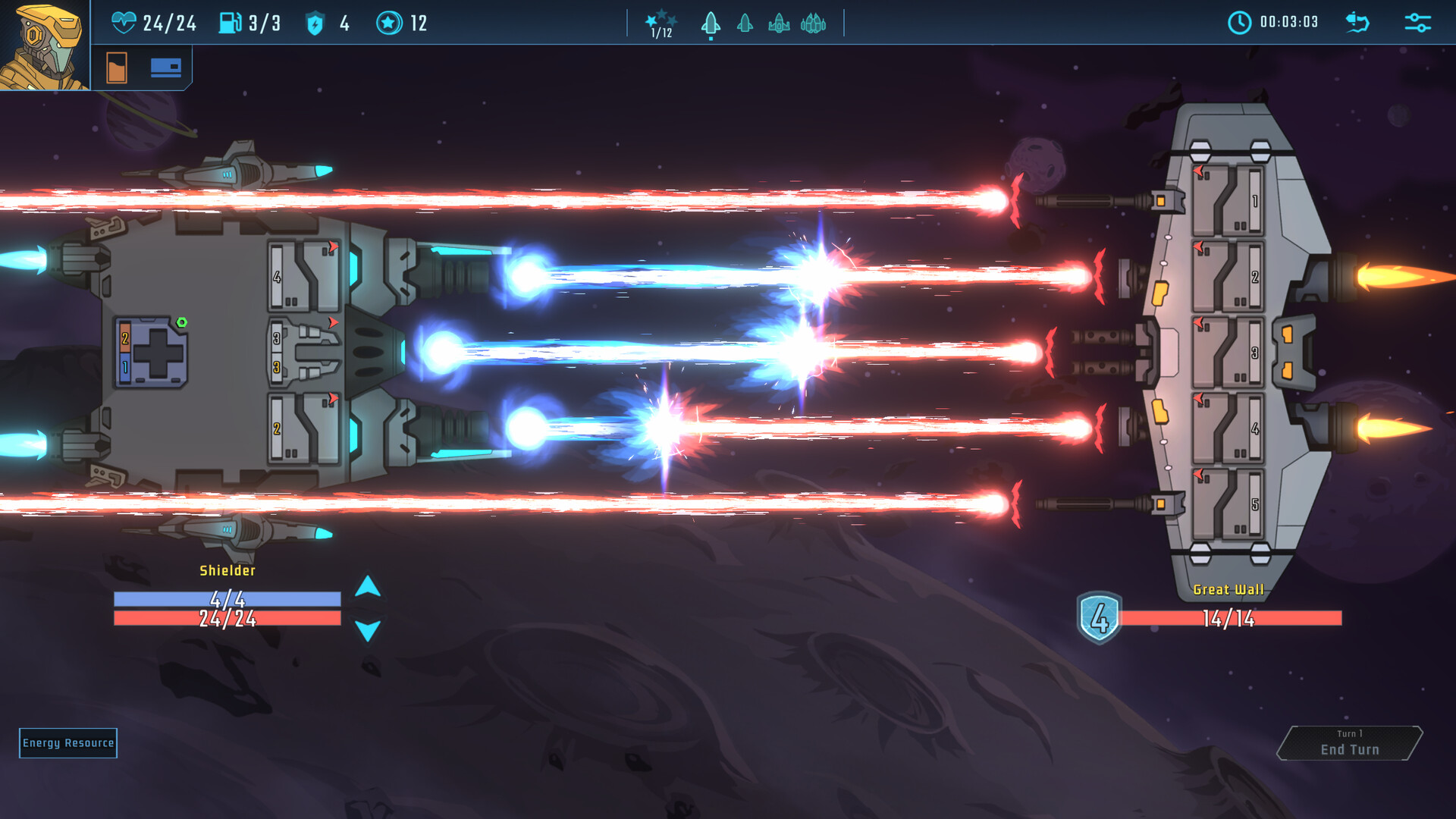
My first instinct when I see a roguelike deckbuilder pitched as an FTL successor is skepticism, because that comparison gets slapped on anything with a spaceship sprite. LONESTAR earns it more than most. The core combat loop is genuinely novel: rather than playing cards from a hand, you slot attack and support modules directly onto your ship's grid, each one consuming energy that regenerates randomly each turn from a pool of colored, numbered tiles. Orange energy outranks blue, blue outranks white, and higher-ranked energy can slot downward but not up. That one rule creates a cascade of micro-decisions every round: do you activate the weight-two heavy cannon now, or split the energy across two cheaper modules and keep pressure up? The shockwave battle system, where both sides accumulate power simultaneously and the larger total wins the exchange, keeps fights feeling like math puzzles rather than attrition slogs. The three ships at 1.0 launch each bend the formula in a distinct direction. Shielder lets you burn defensive resources for survival margin in tight spots. Spacewalker lets you reposition modules mid-battle, which is the kind of mid-run adaptability build-crafters live for. Spectra, the newest addition, runs a multi-colored pigment system that effectively lets you reconfigure your deck on the fly between engagements. Fifty-two pilots layer on passive talents that synergize differently with each hull, so the combinatorial space is legitimate. Hundreds of treasures and a roster of nearly a hundred bounty targets, including fifteen boss-tier felons whose intel you can review before each mission, give runs enough texture to stay interesting across a reasonable number of hours. That said, LONESTAR has friction points worth knowing before you commit. The tutorial is disorganized enough that several reviewers flagged confusion over how energy values interact with module slot requirements, and some upgrade descriptions are genuinely ambiguous, particularly around whether a buff applies to an individual energy tile or to the cumulative pool value. The difficulty curve between early bounties and the mid-game spike catches players off guard if they have not spent time theorycrafting module synergies. At its worst, losing a run can feel like the RNG handed you an incompatible energy pool rather than punishing a strategic error, which is the cardinal sin of the genre. Community reception on Steam sits firmly positive overall, but the critical voice in that sample consistently points to upgrade clarity and unlockable content depth as the places where the game underdelivers relative to its direct competitors. For genre veterans, the weight system alone is worth the admission. Deckbuilders usually give you a hand of cards and a mana budget; LONESTAR replaces both with a spatial loadout problem that changes shape every turn. If you have chewed through Slay the Spire's ascensions and want a combat model that forces genuinely different thinking, this scratches that itch. If you are newer to roguelikes, go in expecting to lose several runs before the energy-color logic clicks, and consult the in-game encyclopedia early because it is the actual tutorial the opening sequence forgot to be. The Boss Rush mode also gives returning players a high-difficulty pressure test once the standard bounty loop feels solved. Diego, Scout Team

LONESTAR

LONESTAR

3 abr 2025Math TideThermite Games
GamerScout opina

FTL's spiritual heir, dressed up in deckbuilder math: satisfying if you can tolerate some rough tutorial edges and a steep early difficulty wall.

PCMac
Steam Deck VerifiedProtonDB Gold
Mejor precio disponible
€0.00
en N/A
Mínimo histórico: €3.68

Comparar precios(0 tiendas)

Cargando precios...

We may earn a commission when you buy games through links on this page — at no extra cost to you. It never affects our rankings or verdicts.

Historial de precios

Historical low
€3.689 Jun 2026
Keyshops
€3.39€3.58€3.78€3.979 Jun14 Jun19 Jun23 Jun28 Jun
Tracking prices since 9 Jun 2026
Create alert

Capturas y multimedia

Captura

Acerca de LONESTAR

My first instinct when I see a roguelike deckbuilder pitched as an FTL successor is skepticism, because that comparison gets slapped on anything with a spaceship sprite. LONESTAR earns it more than most. The core combat loop is genuinely novel: rather than playing cards from a hand, you slot attack and support modules directly onto your ship's grid, each one consuming energy that regenerates randomly each turn from a pool of colored, numbered tiles. Orange energy outranks blue, blue outranks white, and higher-ranked energy can slot downward but not up. That one rule creates a cascade of micro-decisions every round: do you activate the weight-two heavy cannon now, or split the energy across two cheaper modules and keep pressure up? The shockwave battle system, where both sides accumulate power simultaneously and the larger total wins the exchange, keeps fights feeling like math puzzles rather than attrition slogs. The three ships at 1.0 launch each bend the formula in a distinct direction. Shielder lets you burn defensive resources for survival margin in tight spots. Spacewalker lets you reposition modules mid-battle, which is the kind of mid-run adaptability build-crafters live for. Spectra, the newest addition, runs a multi-colored pigment system that effectively lets you reconfigure your deck on the fly between engagements. Fifty-two pilots layer on passive talents that synergize differently with each hull, so the combinatorial space is legitimate. Hundreds of treasures and a roster of nearly a hundred bounty targets, including fifteen boss-tier felons whose intel you can review before each mission, give runs enough texture to stay interesting across a reasonable number of hours. That said, LONESTAR has friction points worth knowing before you commit. The tutorial is disorganized enough that several reviewers flagged confusion over how energy values interact with module slot requirements, and some upgrade descriptions are genuinely ambiguous, particularly around whether a buff applies to an individual energy tile or to the cumulative pool value. The difficulty curve between early bounties and the mid-game spike catches players off guard if they have not spent time theorycrafting module synergies. At its worst, losing a run can feel like the RNG handed you an incompatible energy pool rather than punishing a strategic error, which is the cardinal sin of the genre. Community reception on Steam sits firmly positive overall, but the critical voice in that sample consistently points to upgrade clarity and unlockable content depth as the places where the game underdelivers relative to its direct competitors. For genre veterans, the weight system alone is worth the admission. Deckbuilders usually give you a hand of cards and a mana budget; LONESTAR replaces both with a spatial loadout problem that changes shape every turn. If you have chewed through Slay the Spire's ascensions and want a combat model that forces genuinely different thinking, this scratches that itch. If you are newer to roguelikes, go in expecting to lose several runs before the energy-color logic clicks, and consult the in-game encyclopedia early because it is the actual tutorial the opening sequence forgot to be. The Boss Rush mode also gives returning players a high-difficulty pressure test once the standard bounty loop feels solved.

Diego
Diego · Scout Team

Strategy & simulation

Etiquetas

singleplayerachievementscontroller-supporttrading-cardsworkshopcloud-savestier:sub-5Energy-ManagementShip-Loadout BuilderShockwave CombatPilot TalentsBoss Rush ModeWeight-Limit DeckbuilderMastery Difficulty Scaling

Requisitos del sistema

Mínimos

OS
Windows 10
Memory
4 GB RAM
DirectX
Version 11
Storage
2 GB available space
Graphics
GeForce GT 730 OR Radeon HD 4830
Processor
Intel Core2 Duo E6400 @ 2.13GHz

Recomendados

OS
Windows 10
Memory
8 GB RAM
DirectX
Version 11
Storage
2 GB available space
Graphics
GeForce GTX 650 OR Radeon HD 7750
Processor
Intel Core i5-2300

Sigue explorando

Community Discussion

Be the first to comment on LONESTAR.

Reseñas y valoraciones

No hay valoraciones disponibles

Información del juego

Desarrolladora
Math Tide
Distribuidora
Thermite Games
Fecha de lanzamiento
3 abr 2025

Alerta de precio

¡Recibe un aviso cuando el precio baje de tu objetivo!

Crear alerta

Compra mejor: guías útiles

¿Buscas más? Mira juegos como LONESTAR →

Preguntas frecuentes sobre LONESTAR

¿Cuánto cuesta LONESTAR?

El precio de LONESTAR cambia a menudo y varía según la tienda, la edición y la región. La tabla de precios en vivo de esta página compara las ofertas más baratas en stock de tiendas de claves de confianza como Eneba y Kinguin, para que siempre veas el precio más bajo actual antes de comprar.

¿Dónde puedo comprar LONESTAR más barato?

Compara los precios de LONESTAR en todas las tiendas verificadas en la tabla de precios de esta página. Listamos las ofertas de claves y tiendas más baratas en stock, actualizadas con frecuencia, para que siempre veas la mejor oferta actual antes de comprar.

¿En qué plataformas está disponible LONESTAR?

LONESTAR está disponible en PC, Mac.

¿Cuándo se lanzó LONESTAR?

LONESTAR se lanzó el 3 de abril de 2025.

¿Quién desarrolló LONESTAR?

LONESTAR fue desarrollado por Math Tide y publicado por Thermite Games.