
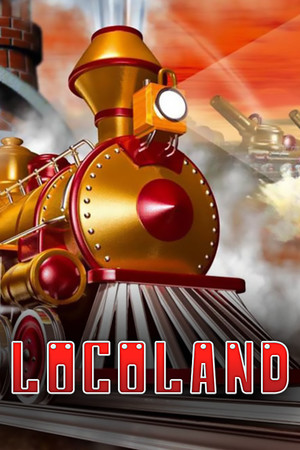
Compara los precios de Locoland en tiendas de claves de confianza y encuentra la mejor oferta. Desarrollado por Gromada. Publicado por ESDigital Games. Lanzado el 28/5/2015. Disponible en PC. Géneros: Indie, Strategy.

A rail-locked RTS from Russia's early 2000s that somehow still converts skeptics: if the idea of steam-robot train combat with base economics sounds absurd enough to work, it mostly does.

My spreadsheet instincts fired up the moment I realized Locoland's core constraint: every unit in the game is a locomotive, and every locomotive is permanently bound to the rail network. That single design decision turns what looks like a cartoonish kids' RTS into something genuinely tactical. You cannot blitz across open terrain. You cannot flank freely. Every attack route, every retreat, every patrol order is dictated by the geometry of the tracks on that map. For a strategy player who thinks in terms of chokepoints and supply lines, that framing is immediately interesting. The economic loop sits underneath all of it. You capture resource structures, including factories, oil wells, and repair depots, to fund your train fleet and keep it operational. Weapons can be attached to your locomotives to change their combat role, and you can combine multiple rail cars into longer, heavier trains or detach coaches mid-battle to adapt. The 20 mission campaign runs a difficulty curve that starts accessible and then spikes hard without warning, which is the game's most honest flaw. Some late missions have what players correctly describe as a single correct solution, and finding it means replaying the same opening sequence several times until the timing clicks. That is not strategic depth; that is a puzzle with one answer. Fans of twitchy trial-and-error will tolerate it. Players expecting the build-order freedom of a proper RTS will hit a wall. The tutorial situation is the other honest complaint I have to flag. There is not one, not in any meaningful sense. The control scheme is actually fairly compact: right-click to move or attack, Shift plus right-click to force-attack any tile, Ctrl to set a patrol route, and ram attacks executed by holding Shift during an attack order. None of that is explained in-game. Experienced RTS players will mouse around and figure it out within twenty minutes. Newcomers, especially younger players the colorful aesthetic might attract, will feel abandoned. The AI moves fast and commits hard, so the learning period has real consequences. What holds Locoland together across a play session is the atmosphere and the mechanical novelty. Dynamic weather, day-night cycles, meteor showers, and volcanoes all pass over the battlefield while your armored trains are exchanging fire. It does not affect gameplay in deep ways, but it gives the world a restless energy that keeps the maps from feeling static. The steampunk-robot setting is genuinely charming rather than cynically applied, and the enemy train AI, while not sophisticated by modern standards, moves with enough aggression to demand active attention rather than passive turtling. Capturing enemy factories and fending off zeppelin attacks adds variety to objectives that would otherwise reduce entirely to "destroy everything." The honest context here is that this game originally shipped as Steamland in the early 2000s and reached Steam years later. Its graphics, windowed-mode support, and interface design reflect that origin faithfully. For a strategy enthusiast who wants something compact and unusual to run through over a weekend, the 20-mission structure fits. For anyone expecting a deep mod ecosystem, multiplayer, or a tutorial that respects their time, those things are simply absent. It is a small, strange, mostly functional RTS with a rail-constraint mechanic that no mainstream game has really copied, which is either a missed opportunity or a sign that the idea is harder to scale than it looks. Diego, Scout Team

Locoland

Locoland

28 may 2015GromadaESDigital Games
GamerScout opina

A rail-locked RTS from Russia's early 2000s that somehow still converts skeptics: if the idea of steam-robot train combat with base economics sounds absurd enough to work, it mostly does.

PC
Steam Deck UnsupportedProtonDB Platinum
Mejor precio disponible
€0.00
en N/A
Mínimo histórico: €1.45

Comparar precios(0 tiendas)

Cargando precios...

We may earn a commission when you buy games through links on this page — at no extra cost to you. It never affects our rankings or verdicts.

Historial de precios

Historical low
€1.4526 Jun 2026
Keyshops
€1.10€2.30€3.50€4.708 Jun13 Jun18 Jun23 Jun28 Jun
Tracking prices since 8 Jun 2026
Create alert

Capturas y multimedia

Acerca de Locoland

My spreadsheet instincts fired up the moment I realized Locoland's core constraint: every unit in the game is a locomotive, and every locomotive is permanently bound to the rail network. That single design decision turns what looks like a cartoonish kids' RTS into something genuinely tactical. You cannot blitz across open terrain. You cannot flank freely. Every attack route, every retreat, every patrol order is dictated by the geometry of the tracks on that map. For a strategy player who thinks in terms of chokepoints and supply lines, that framing is immediately interesting. The economic loop sits underneath all of it. You capture resource structures, including factories, oil wells, and repair depots, to fund your train fleet and keep it operational. Weapons can be attached to your locomotives to change their combat role, and you can combine multiple rail cars into longer, heavier trains or detach coaches mid-battle to adapt. The 20 mission campaign runs a difficulty curve that starts accessible and then spikes hard without warning, which is the game's most honest flaw. Some late missions have what players correctly describe as a single correct solution, and finding it means replaying the same opening sequence several times until the timing clicks. That is not strategic depth; that is a puzzle with one answer. Fans of twitchy trial-and-error will tolerate it. Players expecting the build-order freedom of a proper RTS will hit a wall. The tutorial situation is the other honest complaint I have to flag. There is not one, not in any meaningful sense. The control scheme is actually fairly compact: right-click to move or attack, Shift plus right-click to force-attack any tile, Ctrl to set a patrol route, and ram attacks executed by holding Shift during an attack order. None of that is explained in-game. Experienced RTS players will mouse around and figure it out within twenty minutes. Newcomers, especially younger players the colorful aesthetic might attract, will feel abandoned. The AI moves fast and commits hard, so the learning period has real consequences. What holds Locoland together across a play session is the atmosphere and the mechanical novelty. Dynamic weather, day-night cycles, meteor showers, and volcanoes all pass over the battlefield while your armored trains are exchanging fire. It does not affect gameplay in deep ways, but it gives the world a restless energy that keeps the maps from feeling static. The steampunk-robot setting is genuinely charming rather than cynically applied, and the enemy train AI, while not sophisticated by modern standards, moves with enough aggression to demand active attention rather than passive turtling. Capturing enemy factories and fending off zeppelin attacks adds variety to objectives that would otherwise reduce entirely to "destroy everything." The honest context here is that this game originally shipped as Steamland in the early 2000s and reached Steam years later. Its graphics, windowed-mode support, and interface design reflect that origin faithfully. For a strategy enthusiast who wants something compact and unusual to run through over a weekend, the 20-mission structure fits. For anyone expecting a deep mod ecosystem, multiplayer, or a tutorial that respects their time, those things are simply absent. It is a small, strange, mostly functional RTS with a rail-constraint mechanic that no mainstream game has really copied, which is either a missed opportunity or a sign that the idea is harder to scale than it looks.

Diego
Diego · Scout Team

Strategy & simulation

Etiquetas

singleplayertrading-cardstier:indieRail-Bound RTSResource CaptureTrain CombatSteampunk SettingDifficulty SpikesRetro StrategyMission-Based CampaignOld-School Design

Requisitos del sistema

Mínimos

OS
Windows XP/7/8/8.1
Memory
100 MB RAM
DirectX
Version 9.0
Storage
600 MB available space
Graphics
16 MB VRAM
Processor
Pentium II 300 MHz

Sigue explorando

Community Discussion

Be the first to comment on Locoland.

Reseñas y valoraciones

No hay valoraciones disponibles

Información del juego

Desarrolladora
Gromada
Distribuidora
ESDigital Games
Fecha de lanzamiento
28 may 2015

Alerta de precio

¡Recibe un aviso cuando el precio baje de tu objetivo!

Crear alerta

Compra mejor: guías útiles

¿Buscas más? Mira juegos como Locoland →

Preguntas frecuentes sobre Locoland

¿Cuánto cuesta Locoland?

El precio de Locoland cambia a menudo y varía según la tienda, la edición y la región. La tabla de precios en vivo de esta página compara las ofertas más baratas en stock de tiendas de claves de confianza como Eneba y Kinguin, para que siempre veas el precio más bajo actual antes de comprar.

¿Dónde puedo comprar Locoland más barato?

Compara los precios de Locoland en todas las tiendas verificadas en la tabla de precios de esta página. Listamos las ofertas de claves y tiendas más baratas en stock, actualizadas con frecuencia, para que siempre veas la mejor oferta actual antes de comprar.

¿En qué plataformas está disponible Locoland?

Locoland está disponible en PC.

¿Cuándo se lanzó Locoland?

Locoland se lanzó el 28 de mayo de 2015.

¿Quién desarrolló Locoland?

Locoland fue desarrollado por Gromada y publicado por ESDigital Games.