
Compara los precios de Life Eater en tiendas de claves de confianza y encuentra la mejor oferta. Desarrollado por Strange Scaffold. Publicado por Strange Scaffold. Lanzado el 16/4/2024. Disponible en PC. Géneros: Indie, RPG, Simulation, Strategy. Puntuación Metacritic: 68/100.

Spreadsheet-brained players who thought they'd seen every resource-management hook should sit down with this one. Life Eater turns surveillance into a puzzle loop, then quietly makes you feel terrible about how good you got at it.

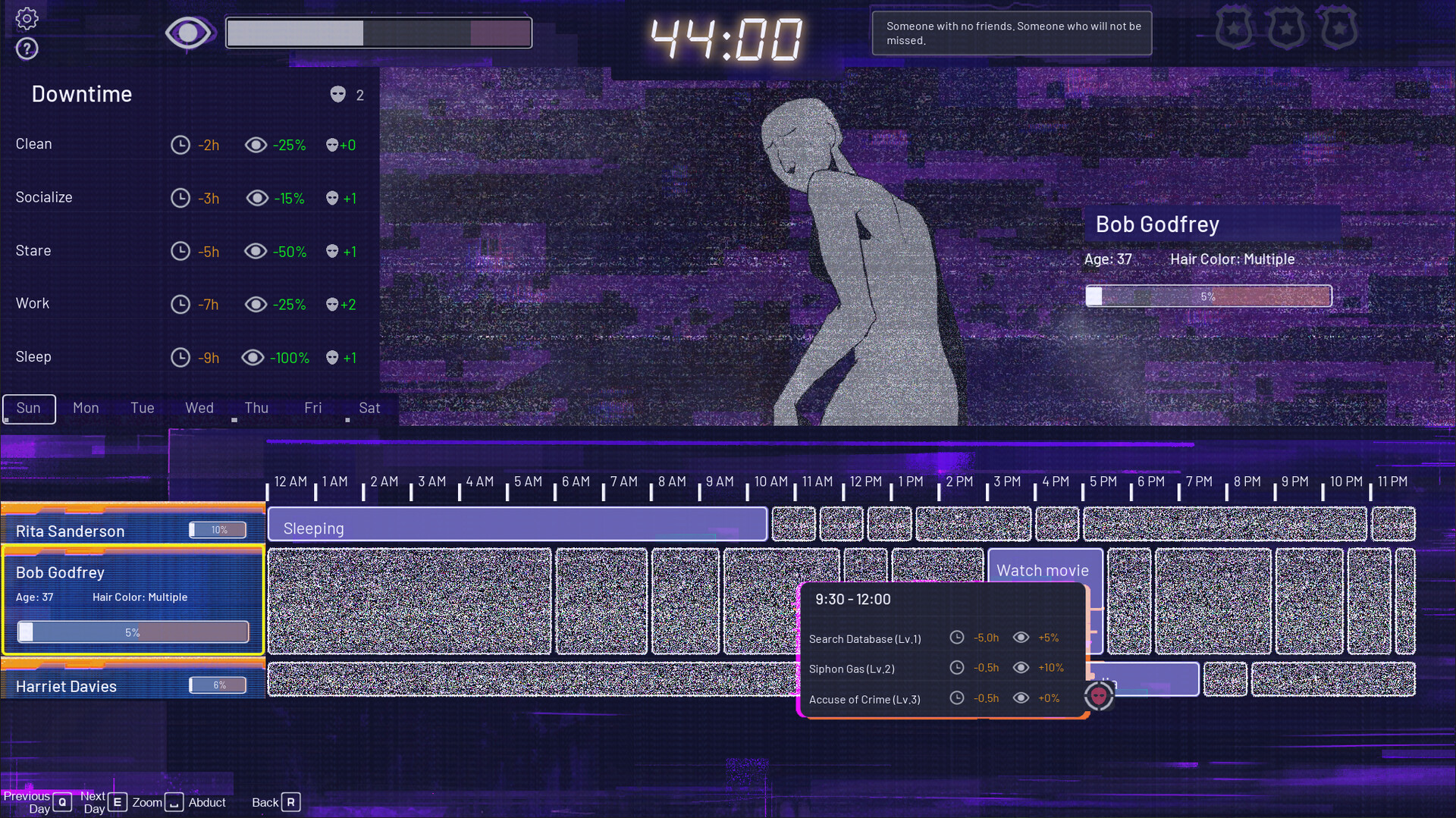
I spend a lot of time thinking about decision-making loops, and Life Eater handed me one I genuinely had not seen before. You play as Ralph, a modern-day druid named by the credits but never by the game itself, who must locate and abduct a specific sacrifice every year to placate the god Zimforth. The core interface is built to look like video editing software: a horizontal timeline carved into blocks representing each target's weekly activities, from commutes to sleep cycles to those small 30-minute gaps on a Thursday afternoon that are, you eventually realize, the window you need. Each action you take to reveal a block costs time off your clock and raises a suspicion meter. Hit the suspicion threshold three times or run out of time, and the run is over. On paper it reads like a stripped-down stealth-puzzle with one resource dial. In practice, the pressure of min-maxing which action to spend on which block, and when to deliberately bleed time to cool down suspicion, generates real tension in a way that surprised me for a game this compact. The ten-chapter campaign runs roughly three to four hours depending on how badly a particular puzzle catches you out. That is short, and the shortness is both Life Eater's smartest design call and its most obvious limitation. The loop is properly scoped: it introduces wrinkles at a reasonable pace, including levels where you must distinguish one target among a household of multiple people using only inferred behavioral differences, and gets out before the premise completely wears thin. But "before it wears thin" and "with room to breathe" are different things, and critics were right to flag that the mechanics never quite reach a second gear. Once you have internalized the rhythm of the stalking phase, the difficulty deflates noticeably. Levels that require you to cross-reference shared time blocks between multiple targets to figure out who is doing an activity together are clever; levels that reduce to clicking the cheapest available action until the threshold fills are less so. The tutorial problem is real and worth naming plainly. The game explains some of its color-coded timeline signals but leaves others unexplained, and vague mission descriptors, like being told to find "someone with no friends," can produce genuine uncertainty about whether you are reading the puzzle correctly or fighting a bug. Return of the Obra Dinn and Case of the Golden Idol deliver that satisfying locked-in deduction moment; Life Eater more often delivers a resigned "oh, that was it." If you are coming in expecting tight logical closure, manage expectations accordingly. What keeps the experience from being merely a curiosity is how deliberately the systems are weaponized against the player's comfort. Reducing a human being to an Outlook-style calendar of repeated movements, then routing you toward finding and exploiting the one gap in that calendar, is a genuinely uncomfortable design idea. The cutscenes, delivered as roughly 20 still images with strong voice performances, add a strand of humanity through Ralph's deteriorating mental state and his caged confidant Johnny. Those two elements working in parallel produce moments that land harder than the mechanical puzzle does on its own. Steam user reception sits at 85 percent positive across over 300 reviews, which suggests the people who connect with the premise tend to connect with it strongly, while the Metacritic score of 68 reflects critics who wanted more mechanical depth to match the ambition of the concept. An endless mode was added post-launch as a free update, which extends replayability past the campaign, though it does not address the structural thinness critics identified. If your threshold for a short, mechanically modest experience is calibrated by the price tag and the originality of the premise, Life Eater clears that bar with room to spare. If you need 20 hours of escalating systemic depth, look elsewhere. Strange Scaffold builds intentionally small games and this is one of their more divisive efforts, but divisive in the interesting direction: the people it works for tend to remember it. Diego, Scout Team

Life Eater

Life Eater

16 abr 2024Strange Scaffold
GamerScout opina

Spreadsheet-brained players who thought they'd seen every resource-management hook should sit down with this one. Life Eater turns surveillance into a puzzle loop, then quietly makes you feel terrible about how good you got at it.

PC
Steam Deck Playable
Mejor precio disponible
€0.00
en N/A
Mínimo histórico: €0.27

Comparar precios(0 tiendas)

Cargando precios...

We may earn a commission when you buy games through links on this page — at no extra cost to you. It never affects our rankings or verdicts.

Historial de precios

Historical low
€0.2718 Jun 2026
Keyshops
€0.25€0.27€0.28€0.308 Jun13 Jun18 Jun23 Jun28 Jun
Tracking prices since 8 Jun 2026
Create alert

Capturas y multimedia

Captura

Acerca de Life Eater

I spend a lot of time thinking about decision-making loops, and Life Eater handed me one I genuinely had not seen before. You play as Ralph, a modern-day druid named by the credits but never by the game itself, who must locate and abduct a specific sacrifice every year to placate the god Zimforth. The core interface is built to look like video editing software: a horizontal timeline carved into blocks representing each target's weekly activities, from commutes to sleep cycles to those small 30-minute gaps on a Thursday afternoon that are, you eventually realize, the window you need. Each action you take to reveal a block costs time off your clock and raises a suspicion meter. Hit the suspicion threshold three times or run out of time, and the run is over. On paper it reads like a stripped-down stealth-puzzle with one resource dial. In practice, the pressure of min-maxing which action to spend on which block, and when to deliberately bleed time to cool down suspicion, generates real tension in a way that surprised me for a game this compact. The ten-chapter campaign runs roughly three to four hours depending on how badly a particular puzzle catches you out. That is short, and the shortness is both Life Eater's smartest design call and its most obvious limitation. The loop is properly scoped: it introduces wrinkles at a reasonable pace, including levels where you must distinguish one target among a household of multiple people using only inferred behavioral differences, and gets out before the premise completely wears thin. But "before it wears thin" and "with room to breathe" are different things, and critics were right to flag that the mechanics never quite reach a second gear. Once you have internalized the rhythm of the stalking phase, the difficulty deflates noticeably. Levels that require you to cross-reference shared time blocks between multiple targets to figure out who is doing an activity together are clever; levels that reduce to clicking the cheapest available action until the threshold fills are less so. The tutorial problem is real and worth naming plainly. The game explains some of its color-coded timeline signals but leaves others unexplained, and vague mission descriptors, like being told to find "someone with no friends," can produce genuine uncertainty about whether you are reading the puzzle correctly or fighting a bug. Return of the Obra Dinn and Case of the Golden Idol deliver that satisfying locked-in deduction moment; Life Eater more often delivers a resigned "oh, that was it." If you are coming in expecting tight logical closure, manage expectations accordingly. What keeps the experience from being merely a curiosity is how deliberately the systems are weaponized against the player's comfort. Reducing a human being to an Outlook-style calendar of repeated movements, then routing you toward finding and exploiting the one gap in that calendar, is a genuinely uncomfortable design idea. The cutscenes, delivered as roughly 20 still images with strong voice performances, add a strand of humanity through Ralph's deteriorating mental state and his caged confidant Johnny. Those two elements working in parallel produce moments that land harder than the mechanical puzzle does on its own. Steam user reception sits at 85 percent positive across over 300 reviews, which suggests the people who connect with the premise tend to connect with it strongly, while the Metacritic score of 68 reflects critics who wanted more mechanical depth to match the ambition of the concept. An endless mode was added post-launch as a free update, which extends replayability past the campaign, though it does not address the structural thinness critics identified. If your threshold for a short, mechanically modest experience is calibrated by the price tag and the originality of the premise, Life Eater clears that bar with room to spare. If you need 20 hours of escalating systemic depth, look elsewhere. Strange Scaffold builds intentionally small games and this is one of their more divisive efforts, but divisive in the interesting direction: the people it works for tend to remember it.

Diego
Diego · Scout Team

Strategy & simulation

Etiquetas

singleplayerachievementscloud-savestier:sub-5Analog HorrorTimeline PuzzleSuspicion ManagementDark NarrativeSingle PlaythroughLogic DeductionCult HorrorShort-Form SimUnreliable Narrator

Requisitos del sistema

Mínimos

OS
Windows 10 64-bit
Memory
8 GB RAM
Storage
2 GB available space
Graphics
Any DirectX 11 or 12 compatible card
Processor
Quad-core Intel or AMD 2.5 GHz or superior

Sigue explorando

Community Discussion

Be the first to comment on Life Eater.

Reseñas y valoraciones

Metacritic
68

Información del juego

Desarrolladora
Strange Scaffold
Distribuidora
Strange Scaffold
Fecha de lanzamiento
16 abr 2024

Alerta de precio

¡Recibe un aviso cuando el precio baje de tu objetivo!

Crear alerta

Más de Strange Scaffold

Compra mejor: guías útiles

¿Buscas más? Mira juegos como Life Eater →

Preguntas frecuentes sobre Life Eater

¿Cuánto cuesta Life Eater?

El precio de Life Eater cambia a menudo y varía según la tienda, la edición y la región. La tabla de precios en vivo de esta página compara las ofertas más baratas en stock de tiendas de claves de confianza como Eneba y Kinguin, para que siempre veas el precio más bajo actual antes de comprar.

¿Dónde puedo comprar Life Eater más barato?

Compara los precios de Life Eater en todas las tiendas verificadas en la tabla de precios de esta página. Listamos las ofertas de claves y tiendas más baratas en stock, actualizadas con frecuencia, para que siempre veas la mejor oferta actual antes de comprar.

¿En qué plataformas está disponible Life Eater?

Life Eater está disponible en PC.

¿Cuándo se lanzó Life Eater?

Life Eater se lanzó el 16 de abril de 2024.

¿Quién desarrolló Life Eater?

Life Eater fue desarrollado por Strange Scaffold.

¿Merece la pena comprar Life Eater?

Life Eater tiene una puntuación Metacritic de 68/100, lo que lo convierte en uno de los títulos destacados de Indie. Mira las reseñas completas, las valoraciones y los tiempos de duración en esta página para decidir.