Compara los precios de Kana Quest en tiendas de claves de confianza y encuentra la mejor oferta. Desarrollado por Not Dead Design. Publicado por Whitethorn Games. Lanzado el 12/3/2020. Disponible en PC. Géneros: Casual, Indie, Strategy.

Puzzle-first, flashcard-never: Kana Quest hides a surprisingly deep tile-chain puzzler inside its language-learning wrapper, and the logic holds up even if Japanese isn't your goal.

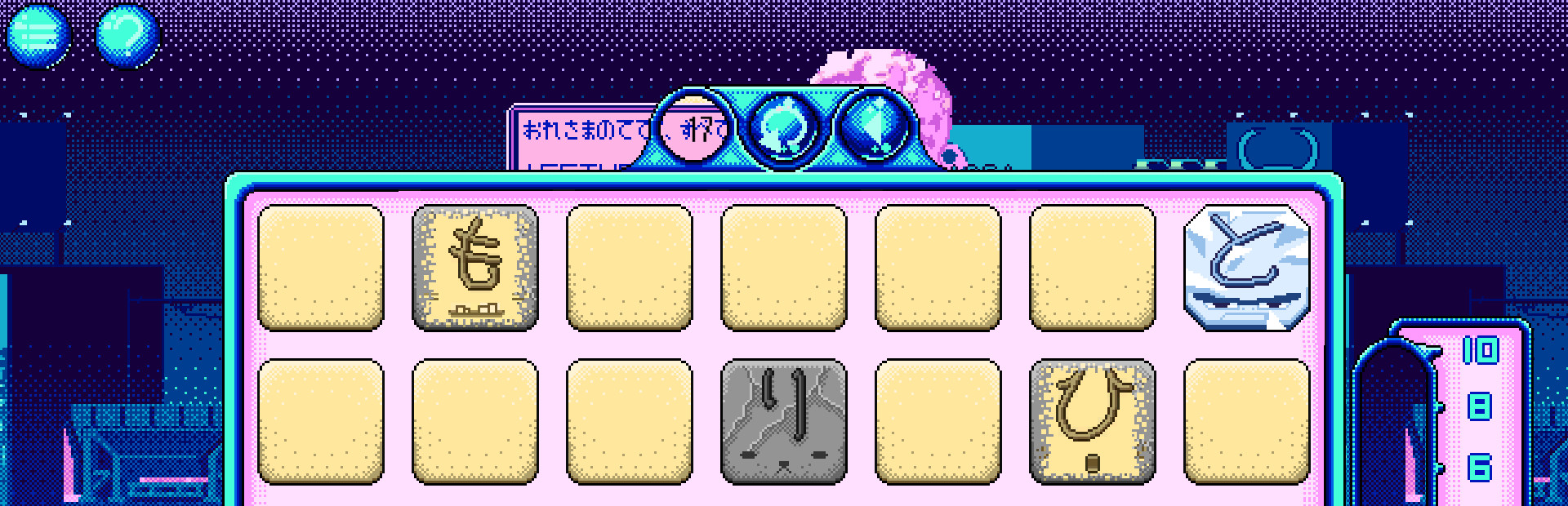
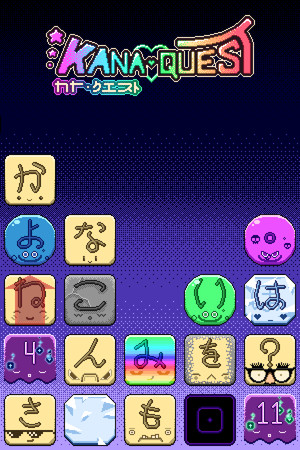
My first instinct with Kana Quest was to slot it under 'educational software' and move on, but the puzzle engine underneath kept pulling me back. The core mechanic is deceptively clean: slide kana tiles on a grid so that every tile touches at least one neighbour that shares either its consonant or its vowel sound. Ka can sit next to na (shared 'a') or next to ki (shared 'k'), but ka and ki cannot both be next to na. That consonant-vowel dominoes logic, which the developer apparently hit on while playtesting with Japanese students, turns out to generate genuinely interesting spatial puzzles that have nothing to do with whether you can read Japanese. Spread across 13 worlds and more than 300 levels, the puzzle design escalates well. Early stages introduce the matching rule with a handful of tiles. Later worlds layer in stone tiles that are immovable and must have friends slid up to them, ice tiles that keep sliding until they hit a wall, mystery tiles where you have to infer the hidden kana from its neighbours before spending a move to guess it, slime tiles that mutate a kana's value, and one-directional tiles that can only travel a single axis. Each world front-loads its new mechanic with gentler levels, then starts combining modifiers from previous worlds so the late-game boards become genuine move-order problems you need to pre-solve mentally before touching a tile. For players who care about optimisation, a gold-silver-bronze medal system rewards fewest-move solutions, and the undo button is generous enough that experimenting never feels punishing. The tension in the design is that the game bills itself as a Japanese learning tool but functions primarily as symbol recognition through repetition. You can tap any tile to hear its romanised pronunciation spoken aloud, and swapping the entire game to Katakana mode from the main menu effectively doubles your practice surface, since the puzzles replay with the alternate alphabet. That said, reviewers across the board note the same caveat: Kana Quest will not teach you vocabulary, grammar, or stroke order. It is a study supplement, not a curriculum. If you pair it with something like Anki or a structured course, the forced repetition of seeing and matching the same characters across hundreds of puzzles does build recognition speed. If you come in expecting conversational Japanese, you will leave disappointed. A separate concern flagged by multiple players is the difficulty spike mid-world, where new mechanics get combined before earlier ones feel fully internalised, which can create a momentary wall that feels out of step with the otherwise measured pacing. Visually, the pixel-art worlds shift from cherry-blossom spring festivals in the early game to distinctly urban and cyberpunk aesthetics in later worlds, which stops the colour palette from going stale. Each tile has a small animated face, and the hearts that appear when two kana successfully pair up are a nice tactile reward. The soundtrack is relaxed and world-specific. On PC with mouse control the slide-swap interface is workable but clearly designed with touchscreens in mind, and the lack of physical feedback is occasionally felt when you are trying to execute a precise multi-tile chain. The Steam version carries a 90% positive rating from a small sample of reviews, which lines up with the general cross-platform reception: appreciated by language learners, viable as a pure puzzler for anyone else, and best played in short sessions. Diego, Scout Team

Kana Quest

Kana Quest

12 mar 2020Not Dead DesignWhitethorn Games
GamerScout opina

Puzzle-first, flashcard-never: Kana Quest hides a surprisingly deep tile-chain puzzler inside its language-learning wrapper, and the logic holds up even if Japanese isn't your goal.

PC
Mejor precio disponible
€0.00
en N/A
Mínimo histórico: €1.08

Comparar precios(0 tiendas)

Cargando precios...

We may earn a commission when you buy games through links on this page — at no extra cost to you. It never affects our rankings or verdicts.

Historial de precios

Historical low
€1.0810 Jun 2026
Keyshops
€0.99€1.05€1.11€1.1710 Jun15 Jun19 Jun24 Jun28 Jun
Tracking prices since 10 Jun 2026
Create alert

Capturas y multimedia

Acerca de Kana Quest

My first instinct with Kana Quest was to slot it under 'educational software' and move on, but the puzzle engine underneath kept pulling me back. The core mechanic is deceptively clean: slide kana tiles on a grid so that every tile touches at least one neighbour that shares either its consonant or its vowel sound. Ka can sit next to na (shared 'a') or next to ki (shared 'k'), but ka and ki cannot both be next to na. That consonant-vowel dominoes logic, which the developer apparently hit on while playtesting with Japanese students, turns out to generate genuinely interesting spatial puzzles that have nothing to do with whether you can read Japanese. Spread across 13 worlds and more than 300 levels, the puzzle design escalates well. Early stages introduce the matching rule with a handful of tiles. Later worlds layer in stone tiles that are immovable and must have friends slid up to them, ice tiles that keep sliding until they hit a wall, mystery tiles where you have to infer the hidden kana from its neighbours before spending a move to guess it, slime tiles that mutate a kana's value, and one-directional tiles that can only travel a single axis. Each world front-loads its new mechanic with gentler levels, then starts combining modifiers from previous worlds so the late-game boards become genuine move-order problems you need to pre-solve mentally before touching a tile. For players who care about optimisation, a gold-silver-bronze medal system rewards fewest-move solutions, and the undo button is generous enough that experimenting never feels punishing. The tension in the design is that the game bills itself as a Japanese learning tool but functions primarily as symbol recognition through repetition. You can tap any tile to hear its romanised pronunciation spoken aloud, and swapping the entire game to Katakana mode from the main menu effectively doubles your practice surface, since the puzzles replay with the alternate alphabet. That said, reviewers across the board note the same caveat: Kana Quest will not teach you vocabulary, grammar, or stroke order. It is a study supplement, not a curriculum. If you pair it with something like Anki or a structured course, the forced repetition of seeing and matching the same characters across hundreds of puzzles does build recognition speed. If you come in expecting conversational Japanese, you will leave disappointed. A separate concern flagged by multiple players is the difficulty spike mid-world, where new mechanics get combined before earlier ones feel fully internalised, which can create a momentary wall that feels out of step with the otherwise measured pacing. Visually, the pixel-art worlds shift from cherry-blossom spring festivals in the early game to distinctly urban and cyberpunk aesthetics in later worlds, which stops the colour palette from going stale. Each tile has a small animated face, and the hearts that appear when two kana successfully pair up are a nice tactile reward. The soundtrack is relaxed and world-specific. On PC with mouse control the slide-swap interface is workable but clearly designed with touchscreens in mind, and the lack of physical feedback is occasionally felt when you are trying to execute a precise multi-tile chain. The Steam version carries a 90% positive rating from a small sample of reviews, which lines up with the general cross-platform reception: appreciated by language learners, viable as a pure puzzler for anyone else, and best played in short sessions.

Diego
Diego · Scout Team

Strategy & simulation

Etiquetas

singleplayerachievementstier:sub-5Tile-Sliding PuzzlesEducational SupplementMove-OptimisationKatakana ModeDomino LogicRelaxing Difficulty CurveShort Sessions

Requisitos del sistema

Mínimos

OS
Windows 7
Memory
1 GB RAM
Storage
130 MB available space
Graphics
265 MB of Graphic Memory
Processor
1.5GHz Dual Core
Sound Card
Any Sound Card

Recomendados

OS
Windows 7
Memory
2 GB RAM
Storage
130 MB available space
Graphics
NVIDIA GeForce 920M
Processor
2.7GHz Quad Core
Sound Card
Any Sound Card

Sigue explorando

Community Discussion

Be the first to comment on Kana Quest.

Reseñas y valoraciones

No hay valoraciones disponibles

Información del juego

Desarrolladora
Not Dead Design
Distribuidora
Whitethorn Games
Fecha de lanzamiento
12 mar 2020

Alerta de precio

¡Recibe un aviso cuando el precio baje de tu objetivo!

Crear alerta

Compra mejor: guías útiles

Preguntas frecuentes sobre Kana Quest

¿Cuánto cuesta Kana Quest?

El precio de Kana Quest cambia a menudo y varía según la tienda, la edición y la región. La tabla de precios en vivo de esta página compara las ofertas más baratas en stock de tiendas de claves de confianza como Eneba y Kinguin, para que siempre veas el precio más bajo actual antes de comprar.

¿Dónde puedo comprar Kana Quest más barato?

Compara los precios de Kana Quest en todas las tiendas verificadas en la tabla de precios de esta página. Listamos las ofertas de claves y tiendas más baratas en stock, actualizadas con frecuencia, para que siempre veas la mejor oferta actual antes de comprar.

¿En qué plataformas está disponible Kana Quest?

Kana Quest está disponible en PC.

¿Cuándo se lanzó Kana Quest?

Kana Quest se lanzó el 12 de marzo de 2020.

¿Quién desarrolló Kana Quest?

Kana Quest fue desarrollado por Not Dead Design y publicado por Whitethorn Games.