
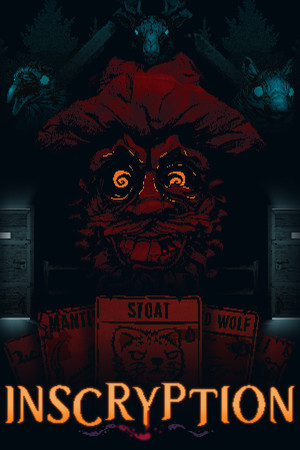
Inscryption
Few card games will make you question whether the software itself is haunted. Inscryption pulls that trick off, then dismantles the whole table and rebuilds it twice before you finish.
Comparar precios(0 tiendas)
Cargando precios...
We may earn a commission when you buy games through links on this page — at no extra cost to you. It never affects our rankings or verdicts.
Historial de precios
Capturas y multimedia
Acerca de Inscryption
My first hours with Inscryption felt like cracking open a tightly designed roguelite deckbuilder and finding a fever dream hidden inside. You start in a dark cabin, face-to-face with a masked gamemaster called Leshy, building a creature deck from scratch and sacrificing cards to pay the blood cost of stronger ones. The scale mechanic at the center of combat creates a genuine tug-of-war: tip the damage five points in your favor and you win the fight, which means every card placement, every sacrifice of a Stoat or a Wolf Cub, carries real weight. Between fights you move a figurine along a map, hit nodes that let you fuse abilities between cards, barter with a trapper for pelts, and stand up from the table to wander the cabin solving escape-room puzzles that reward you with powerful items and deeper lore. The loop is tight, the difficulty is honest, and losing early runs teaches you mechanics in a way that feels intentional rather than punishing. The game is split into three distinct acts, each of which overhauls the card system almost completely. Act One uses blood sacrifice and bone tokens earned from defeated creatures. Act Two shifts to an energy-per-turn model closer to a traditional CCG. Act Three introduces gem-based costs where specific gem cards must remain in play or your entire suite of Magnificus cards collapses. That structural ambition is both the game's greatest achievement and its most debated flaw. Act One is, by near-universal agreement among players, the peak. The atmosphere is oppressive in the best way, the secrets are dense, and the roguelite loop is polished enough to carry the whole runtime on its own. Acts Two and Three are shorter, mechanically looser, and carry a different tonal register that some players find jarring. If you go in expecting Act One to keep delivering forever, you will hit a wall around the midpoint. What carries you through that wall is the meta-narrative, and saying much more than that risks destroying the game's best trick. Inscryption operates on several layers simultaneously: there is the card game, the escape room, a mystery narrative built from found-footage framing and cryptic environmental detail, and occasional fourth-wall intrusions that pull directly from your Steam account or local file system. Daniel Mullins did the same genre of meta-horror in Pony Island and The Hex, so fans of those titles will recognize the fingerprints, but the card mechanics here are substantive enough to stand without the tricks. The modding community has extended the game well past its base runtime, with community-built card sets and challenge modes available through Steam Workshop. Kaycee's Mod, a free mini-expansion included with the game, strips out the narrative and lets you run the Act One roguelite endlessly with unlockable starting abilities and escalating challenge tiers, which is a genuine gift for the deck-optimization crowd. From a strategy-depth standpoint, the game respects intelligent play without demanding mastery. Experienced deckbuilders will find the blood-sacrifice synergies breakable in satisfying ways, stacking abilities through permanent transfers at specific map nodes and building combinations that spiral well beyond what the game seems to intend. Newcomers are handled with care: mechanics arrive one at a time, runs that end in defeat nudge the design open rather than slamming it shut, and the cabin puzzles provide useful items that smooth out rough early runs. The AI opponent is scripted rather than adaptive, which means very experienced players may find the card combat itself underchallenging once the systems click, but the encounter design keeps things interesting through boss-phase rule changes and environmental modifiers. If you have any tolerance for psychological horror aesthetics, a non-linear mystery that withholds information aggressively, and a deckbuilder that refuses to stay the same game for more than a few hours, Inscryption earns its overwhelmingly positive reputation. Go in knowing that Act One is the apex, treat everything after as a deliberate shift in register rather than a decline, and leave time to search every corner of that cabin.

Strategy & simulation
Etiquetas
Requisitos del sistema
Mínimos
- OS
- Windows 7
- Processor
- Intel Core i5-760 (4 * 2800); AMD Athlon II X4 645 AM3 (4 * 3100)
- Memory
- 4 GB RAM
- Graphics
- GeForce GTX 550 Ti (3072 VRAM); Radeon HD 6850 (1024 VRAM)
- Storage
- 2 GB available space
Recomendados
- OS
- Windows 10
- Processor
- Intel Core i5-3470 (4 * 3200); AMD FX-4350 (4 * 4200)
- Memory
- 8 GB RAM
- Graphics
- GeForce GTX 1050 2048 VRAM; Radeon RX 460 4096 VRAM
- Storage
- 3 GB available space
Sigue explorando
Community Discussion
Be the first to comment on Inscryption.
Reseñas y valoraciones
Información del juego
- Desarrolladora
- Daniel Mullins Games
- Distribuidora
- Devolver Digital
- Fecha de lanzamiento
- 19 oct 2021


