
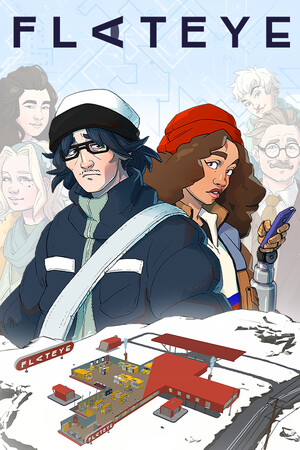
Compara los precios de Flat Eye en tiendas de claves de confianza y encuentra la mejor oferta. Desarrollado por Monkey Moon. Publicado por Raw Fury. Lanzado el 14/11/2022. Disponible en PC, Mac. Géneros: Indie, Simulation. Puntuación Metacritic: 74/100.

Managing a dystopian gas station sounds boring until your clerk dies and corporate sends a cheerful pop-up about hiring a replacement. About 10 hours, narrative-first, thin on sim depth.

My spreadsheet brain went in expecting a tight resource loop and came out having genuinely thought about data privacy and labour exploitation, which is not a sentence I write often. Flat Eye puts you behind a diegetic desktop interface, watching a single clerk run a futuristic Icelandic convenience store on behalf of an all-seeing AI corporation. You build out modules, manage a power grid, hit daily quotas, and watch cash accumulate. That last part is both the design intent and the design problem, and we will get to it. The sim layer is deliberately light. Monkey Moon stated openly that they felt modern management games had grown too complex, so the quota system, power management, and module placement are all tuned toward accessibility rather than depth. Early days carry genuine tension: your one clerk has to manually staff the register, repair breaking machines, and restock shelves simultaneously, and watching them spiral into exhaustion while customer satisfaction tanks is a sharp little loop. The moment you unlock self-checkout from the tech tree, though, most of that pressure evaporates. From there the management becomes a passive income machine you click on occasionally, and progress is gated mainly by waiting for cash to build up. If you want the complexity of a proper sim, this is not your game. If you want a narrative vehicle with sim dressing, keep reading. The real payload is the Premium Customer system. These characters unlock when specific modules are installed, arrive with fully voiced storylines, and present you with dialogue choices that can nudge endings in different directions. The tech tree functions less as an optimisation puzzle and more as a key ring for unlocking those character encounters. The modules themselves are a dark-comedy highlight: biometric-harvesting smart toilets, memory alteration booths, AI-run micro-clinics that quietly sell health data upstream. Each new installation comments on something real, and the game earns points for letting the systemic design do the satirical heavy lifting rather than lecturing you directly. The content warning system, which lets you configure sensitivity flags per topic before you even start playing, is also genuinely well-considered and rare in the genre. Where the writing stumbles is consistency. Some Premium Customer arcs are pointed and funny; others feel underdeveloped or veer into the blunt messaging that reviewers across the board flagged. The dialogue choices are meaningful enough to affect which of the multiple endings you reach, but the branching is shallower than the visual-novel format implies. You will also run into the pacing wall that PC Gamer and others noted: quotas refresh daily but new ideas arrive slowly, and the middle section of a roughly 10-hour campaign can feel like watching a progress bar. There is no hard game-over state, which reduces stakes further once you understand the systems. For strategy and sim players specifically: treat this as a narrative experience with a management wrapper, not the other way around. Approach it the way you would a short walking sim or a visual novel with interactive interludes, and the runtime feels appropriately tight. If your benchmark is Rimworld or even a mid-weight Kairosoft title, the management will feel undercooked. The art direction, a cel-shaded retro-futurist palette designed by independent illustrator Owen Pomery, is consistently excellent and holds visual interest throughout. There is no mod support and no sandbox mode to speak of, so replay value lives almost entirely in the branching ending structure. Diego, Scout Team

Flat Eye

Flat Eye

14 nov 2022Monkey MoonRaw Fury
GamerScout opina

Managing a dystopian gas station sounds boring until your clerk dies and corporate sends a cheerful pop-up about hiring a replacement. About 10 hours, narrative-first, thin on sim depth.

PCMac
Steam Deck UnsupportedProtonDB Borked
Mejor precio disponible
€0.00
en N/A
Mínimo histórico: €7.51

Comparar precios(0 tiendas)

Cargando precios...

We may earn a commission when you buy games through links on this page — at no extra cost to you. It never affects our rankings or verdicts.

Historial de precios

Historical low
€7.5123 Jun 2026
Keyshops
€6.94€8.89€10.84€12.798 Jun13 Jun18 Jun23 Jun28 Jun
Tracking prices since 8 Jun 2026
Create alert

Capturas y multimedia

Acerca de Flat Eye

My spreadsheet brain went in expecting a tight resource loop and came out having genuinely thought about data privacy and labour exploitation, which is not a sentence I write often. Flat Eye puts you behind a diegetic desktop interface, watching a single clerk run a futuristic Icelandic convenience store on behalf of an all-seeing AI corporation. You build out modules, manage a power grid, hit daily quotas, and watch cash accumulate. That last part is both the design intent and the design problem, and we will get to it. The sim layer is deliberately light. Monkey Moon stated openly that they felt modern management games had grown too complex, so the quota system, power management, and module placement are all tuned toward accessibility rather than depth. Early days carry genuine tension: your one clerk has to manually staff the register, repair breaking machines, and restock shelves simultaneously, and watching them spiral into exhaustion while customer satisfaction tanks is a sharp little loop. The moment you unlock self-checkout from the tech tree, though, most of that pressure evaporates. From there the management becomes a passive income machine you click on occasionally, and progress is gated mainly by waiting for cash to build up. If you want the complexity of a proper sim, this is not your game. If you want a narrative vehicle with sim dressing, keep reading. The real payload is the Premium Customer system. These characters unlock when specific modules are installed, arrive with fully voiced storylines, and present you with dialogue choices that can nudge endings in different directions. The tech tree functions less as an optimisation puzzle and more as a key ring for unlocking those character encounters. The modules themselves are a dark-comedy highlight: biometric-harvesting smart toilets, memory alteration booths, AI-run micro-clinics that quietly sell health data upstream. Each new installation comments on something real, and the game earns points for letting the systemic design do the satirical heavy lifting rather than lecturing you directly. The content warning system, which lets you configure sensitivity flags per topic before you even start playing, is also genuinely well-considered and rare in the genre. Where the writing stumbles is consistency. Some Premium Customer arcs are pointed and funny; others feel underdeveloped or veer into the blunt messaging that reviewers across the board flagged. The dialogue choices are meaningful enough to affect which of the multiple endings you reach, but the branching is shallower than the visual-novel format implies. You will also run into the pacing wall that PC Gamer and others noted: quotas refresh daily but new ideas arrive slowly, and the middle section of a roughly 10-hour campaign can feel like watching a progress bar. There is no hard game-over state, which reduces stakes further once you understand the systems. For strategy and sim players specifically: treat this as a narrative experience with a management wrapper, not the other way around. Approach it the way you would a short walking sim or a visual novel with interactive interludes, and the runtime feels appropriately tight. If your benchmark is Rimworld or even a mid-weight Kairosoft title, the management will feel undercooked. The art direction, a cel-shaded retro-futurist palette designed by independent illustrator Owen Pomery, is consistently excellent and holds visual interest throughout. There is no mod support and no sandbox mode to speak of, so replay value lives almost entirely in the branching ending structure.

Diego
Diego · Scout Team

Strategy & simulation

Etiquetas

singleplayerachievementscloud-savestier:aaaNarrative-DrivenDark SatireDiegetic UIMultiple EndingsTech TreeShort CampaignAnti-Capitalist ThemesVisual Novel Hybrid

Requisitos del sistema

Mínimos

OS
Windows 10+
Memory
8 GB RAM
DirectX
Version 11
Storage
5 GB available space
Graphics
NVIDIA GeForce GTX 1050ti / AMD Radeon RX 570
Processor
Intel Core i5-7400 / AMD Ryzen 3 1200

Sigue explorando

Community Discussion

Be the first to comment on Flat Eye.

Reseñas y valoraciones

Metacritic
74

Información del juego

Desarrolladora
Monkey Moon
Distribuidora
Raw Fury
Fecha de lanzamiento
14 nov 2022

Alerta de precio

¡Recibe un aviso cuando el precio baje de tu objetivo!

Crear alerta

Más de Monkey Moon

Compra mejor: guías útiles

¿Buscas más? Mira juegos como Flat Eye →

Preguntas frecuentes sobre Flat Eye

¿Cuánto cuesta Flat Eye?

El precio de Flat Eye cambia a menudo y varía según la tienda, la edición y la región. La tabla de precios en vivo de esta página compara las ofertas más baratas en stock de tiendas de claves de confianza como Eneba y Kinguin, para que siempre veas el precio más bajo actual antes de comprar.

¿Dónde puedo comprar Flat Eye más barato?

Compara los precios de Flat Eye en todas las tiendas verificadas en la tabla de precios de esta página. Listamos las ofertas de claves y tiendas más baratas en stock, actualizadas con frecuencia, para que siempre veas la mejor oferta actual antes de comprar.

¿En qué plataformas está disponible Flat Eye?

Flat Eye está disponible en PC, Mac.

¿Cuándo se lanzó Flat Eye?

Flat Eye se lanzó el 14 de noviembre de 2022.

¿Quién desarrolló Flat Eye?

Flat Eye fue desarrollado por Monkey Moon y publicado por Raw Fury.

¿Merece la pena comprar Flat Eye?

Flat Eye tiene una puntuación Metacritic de 74/100, lo que lo convierte en uno de los títulos destacados de Indie. Mira las reseñas completas, las valoraciones y los tiempos de duración en esta página para decidir.