Compara los precios de Eschalon: Book III en tiendas de claves de confianza y encuentra la mejor oferta. Desarrollado por Basilisk Games. Publicado por Basilisk Games. Lanzado el 14/2/2014. Disponible en PC, Mac, Linux. Géneros: Adventure, Indie, RPG. Puntuación Metacritic: 67/100.

A solo-dev old-school RPG closer that demands patience and punishes impatience, but quietly delivers for anyone who loves pen-and-paper systems and handcrafted wilderness maps.

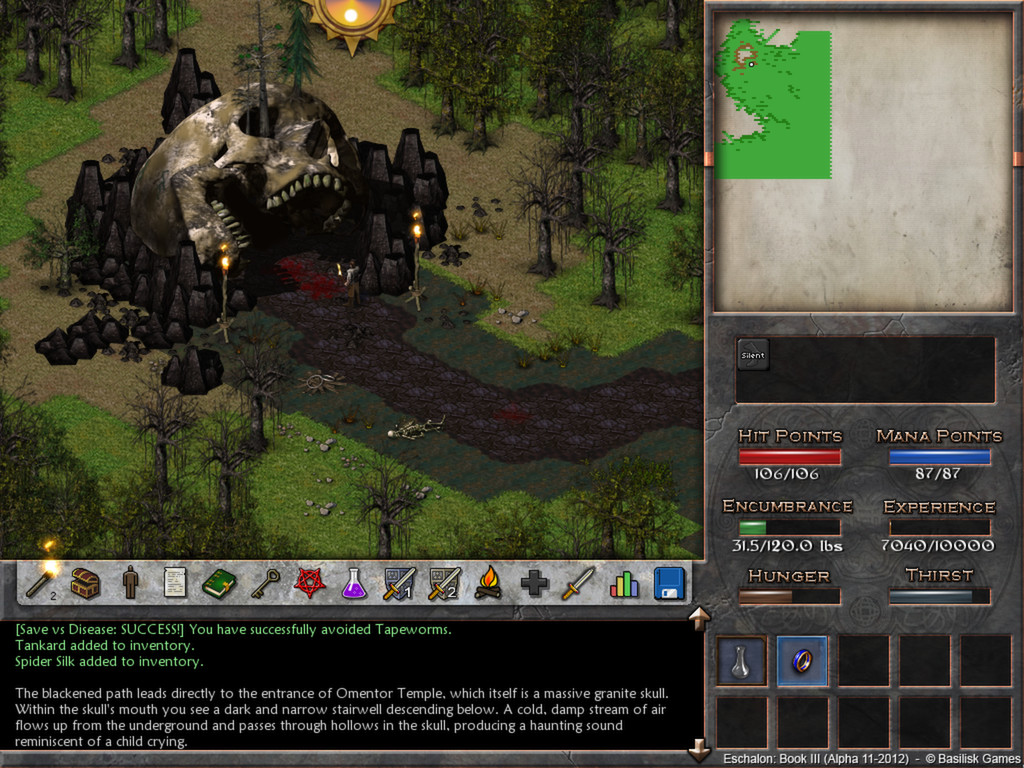
I have a soft spot for small studios that finish what they start, and Basilisk Games did exactly that with Book III. One developer, one trilogy, seven years. That kind of stubborn craft earns attention before you even load the game. What you find inside is a turn-based isometric RPG that plays like something excavated from 1993 and polished just enough to run on a modern machine without drama. The bird's-eye view, the tiled wilderness, the creaking dungeon corridors, the gentle soundtrack that shifts tone almost without you noticing. It is unapologetically old, and it knows it. Character creation sets the tempo immediately. You pick a class from the fighter, mage, and thief archetype trio, then start shaping something more personal through a freeform skill system that has no prerequisites and no locked branches. Want a bow-wielding healer who moonlights in Divination spells? Viable. An unarmed brawler with Alchemy and Hide in Shadows? The game added brass-knuckle-style unarmed weapons specifically to support that fantasy. You earn three Skill Points per level alongside four Attribute points, and you cap around level 20, which is not enough time to master everything. That scarcity keeps builds meaningful. The Mapmaking skill is a small masterpiece of philosophy: invest nothing in it and you have no minimap at all, forcing you to navigate by memory and observation. Skills like Foraging keep food pressure manageable, while the day-night cycle punishes characters without a light source in combat and rewards stealthy builds who prefer the dark. There are 47 learnable spells across Elemental and Divination schools, and fast travel via scattered Travelstones prevents the world from feeling purely punitive to cross. The early game is the wall. The first quests ask you to clear bugs from a mine and scorpions from a field, and the difficulty does not scale to your character level. Weapons degrade, armor wears down, food and hunger meters tick quietly in the background, and resting in the wilderness can get you killed mid-sleep. These survival systems can be toggled off, and honestly, for a first playthrough, turning off equipment degradation is not a betrayal of the experience. The later dungeons are where the game earns back goodwill. They vary in scale and complexity, the largest ones feeling genuinely labyrinthine, and they contain puzzles beyond simple lever sequences. Secret passages are embedded in the environment almost invisibly, hinted at by a small gap in a treeline or an oddly placed shadow. The world rewards paying attention rather than rushing. The story is weaker than its systems. Book III is more linear than Book II, with fewer optional paths and a main quest that does not give you as much connective tissue about the world as the earlier entries did. The narrative wraps the Crux stone plot and answers questions about the Orakur, but some long-time players found the conclusion thinner than expected. The soundtrack, on the other hand, is the trilogy's most consistent strength across all three entries: calm, atmospheric, with environmental audio that shifts when you wade through swamp or push through undergrowth, a level of textural detail that most games twice this budget skip entirely. Book III is the right ending for series veterans, a flawed but committed send-off. New players who jump in cold and push through the opening hours tend to find a more rewarding RPG underneath the difficulty wall than the early sessions suggest. Those who expect modern quality-of-life or an expansive open world will collide hard with its constraints. But if you like the idea of a handcrafted world where every skill point matters and the music knows how to be quiet, this trilogy closer deserves a fair run. Kai, Scout Team

Eschalon: Book III

Eschalon: Book III

14 feb 2014Basilisk Games
GamerScout opina

A solo-dev old-school RPG closer that demands patience and punishes impatience, but quietly delivers for anyone who loves pen-and-paper systems and handcrafted wilderness maps.

PCMacLinux
Mejor precio disponible
€0.00
en N/A
Mínimo histórico: €3.19

Comparar precios(0 tiendas)

Cargando precios...

We may earn a commission when you buy games through links on this page — at no extra cost to you. It never affects our rankings or verdicts.

Historial de precios

Historical low
€3.1925 Jun 2026
Keyshops
€3.15€3.28€3.42€3.556 Jun12 Jun17 Jun23 Jun28 Jun
Tracking prices since 6 Jun 2026
Create alert

Capturas y multimedia

Captura

Acerca de Eschalon: Book III

I have a soft spot for small studios that finish what they start, and Basilisk Games did exactly that with Book III. One developer, one trilogy, seven years. That kind of stubborn craft earns attention before you even load the game. What you find inside is a turn-based isometric RPG that plays like something excavated from 1993 and polished just enough to run on a modern machine without drama. The bird's-eye view, the tiled wilderness, the creaking dungeon corridors, the gentle soundtrack that shifts tone almost without you noticing. It is unapologetically old, and it knows it. Character creation sets the tempo immediately. You pick a class from the fighter, mage, and thief archetype trio, then start shaping something more personal through a freeform skill system that has no prerequisites and no locked branches. Want a bow-wielding healer who moonlights in Divination spells? Viable. An unarmed brawler with Alchemy and Hide in Shadows? The game added brass-knuckle-style unarmed weapons specifically to support that fantasy. You earn three Skill Points per level alongside four Attribute points, and you cap around level 20, which is not enough time to master everything. That scarcity keeps builds meaningful. The Mapmaking skill is a small masterpiece of philosophy: invest nothing in it and you have no minimap at all, forcing you to navigate by memory and observation. Skills like Foraging keep food pressure manageable, while the day-night cycle punishes characters without a light source in combat and rewards stealthy builds who prefer the dark. There are 47 learnable spells across Elemental and Divination schools, and fast travel via scattered Travelstones prevents the world from feeling purely punitive to cross. The early game is the wall. The first quests ask you to clear bugs from a mine and scorpions from a field, and the difficulty does not scale to your character level. Weapons degrade, armor wears down, food and hunger meters tick quietly in the background, and resting in the wilderness can get you killed mid-sleep. These survival systems can be toggled off, and honestly, for a first playthrough, turning off equipment degradation is not a betrayal of the experience. The later dungeons are where the game earns back goodwill. They vary in scale and complexity, the largest ones feeling genuinely labyrinthine, and they contain puzzles beyond simple lever sequences. Secret passages are embedded in the environment almost invisibly, hinted at by a small gap in a treeline or an oddly placed shadow. The world rewards paying attention rather than rushing. The story is weaker than its systems. Book III is more linear than Book II, with fewer optional paths and a main quest that does not give you as much connective tissue about the world as the earlier entries did. The narrative wraps the Crux stone plot and answers questions about the Orakur, but some long-time players found the conclusion thinner than expected. The soundtrack, on the other hand, is the trilogy's most consistent strength across all three entries: calm, atmospheric, with environmental audio that shifts when you wade through swamp or push through undergrowth, a level of textural detail that most games twice this budget skip entirely. Book III is the right ending for series veterans, a flawed but committed send-off. New players who jump in cold and push through the opening hours tend to find a more rewarding RPG underneath the difficulty wall than the early sessions suggest. Those who expect modern quality-of-life or an expansive open world will collide hard with its constraints. But if you like the idea of a handcrafted world where every skill point matters and the music knows how to be quiet, this trilogy closer deserves a fair run.

Kai
Kai · Scout Team

Indie & narrative

Etiquetas

singleplayertier:sub-5Turn-Based CombatOld-School RPGFreeform Skill SystemSurvival MechanicsDay-Night CycleDungeon PuzzlesPen-and-Paper InspiredNo Level Scaling

Requisitos del sistema

Mínimos

OS
Windows XP
Memory
512 MB RAM
DirectX
Version 7.0
Storage
500 MB available space

Recomendados

OS
Windows 7
Memory
1 GB RAM
DirectX
Version 9.0c
Storage
1 GB available space

Sigue explorando

Community Discussion

Be the first to comment on Eschalon: Book III.

Reseñas y valoraciones

Metacritic
67

Información del juego

Desarrolladora
Basilisk Games
Distribuidora
Basilisk Games
Fecha de lanzamiento
14 feb 2014

Alerta de precio

¡Recibe un aviso cuando el precio baje de tu objetivo!

Crear alerta

Compra mejor: guías útiles

¿Buscas más? Mira juegos como Eschalon: Book III →

Preguntas frecuentes sobre Eschalon: Book III

¿Cuánto cuesta Eschalon: Book III?

El precio de Eschalon: Book III cambia a menudo y varía según la tienda, la edición y la región. La tabla de precios en vivo de esta página compara las ofertas más baratas en stock de tiendas de claves de confianza como Eneba y Kinguin, para que siempre veas el precio más bajo actual antes de comprar.

¿Dónde puedo comprar Eschalon: Book III más barato?

Compara los precios de Eschalon: Book III en todas las tiendas verificadas en la tabla de precios de esta página. Listamos las ofertas de claves y tiendas más baratas en stock, actualizadas con frecuencia, para que siempre veas la mejor oferta actual antes de comprar.

¿En qué plataformas está disponible Eschalon: Book III?

Eschalon: Book III está disponible en PC, Mac, Linux.

¿Cuándo se lanzó Eschalon: Book III?

Eschalon: Book III se lanzó el 14 de febrero de 2014.

¿Quién desarrolló Eschalon: Book III?

Eschalon: Book III fue desarrollado por Basilisk Games.

¿Merece la pena comprar Eschalon: Book III?

Eschalon: Book III tiene una puntuación Metacritic de 67/100, lo que lo convierte en uno de los títulos destacados de Adventure. Mira las reseñas completas, las valoraciones y los tiempos de duración en esta página para decidir.