Compara los precios de Else Heart.Break() en tiendas de claves de confianza y encuentra la mejor oferta. Desarrollado por Erik Svedäng. Publicado por Erik Svedäng AB. Lanzado el 24/9/2015. Disponible en PC, Mac, Linux. Géneros: Adventure, Indie, RPG. Puntuación Metacritic: 79/100.

Probably the only game that'll teach you to write actual loops and conditionals while breaking your heart about a girl named Pixie in a city where everything runs on hackable code.

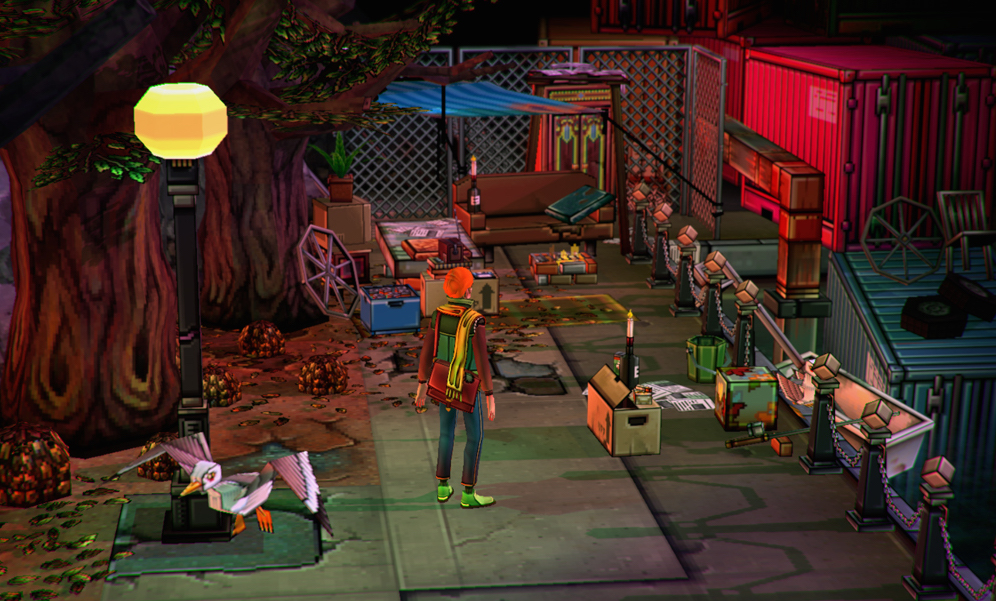
I keep thinking about Dorisburg the way you think about a city you visited once and never fully understood. You arrive as Sebastian, a soda salesman with a ferry ticket and no plan, and the game drops you into a living isometric town with its own clocks, its own parties, its own rhythms. NPCs wake up, go to work, drift to bars, and fall asleep without waiting for you. That simulation has a warmth to it, something close to the Majora's Mask clockwork but without the loop, without the reset. Days pass and they don't come back. That detail alone does more emotional work than most games manage with hours of cutscenes. The hacking is the real reason you're here, though, and it's unlike anything else in the genre. Once you get your hands on a modifier, almost every object in the world opens up: hover over a beer can and you'll see the actual Språk code governing how tired it makes you. Change a positive sleepiness value to a negative one and you've got an energy drink. Want through a locked door? Hack a key's code to loop through combinations, or connect to the door over the city's internal internet from a terminal across town. Språk is a custom language built on BASIC principles, with if-else conditionals, looping, and syntax that matters, but the game is gentle enough about it that people with zero coding background consistently find themselves writing working scripts and feeling genuinely surprised by themselves. The modifier interface shows you the available functions in its bottom panel, so you're never guessing at thin air. When your code is wrong, objects emit a little puff of smoke. It's a forgiving metaphor for a real technical system, and that balance is the game's quiet achievement. Here is where honesty matters: the first several hours are genuinely hard to love. The open-world structure is aimless by design, and if you miss the social cues that pull the plot forward, you'll spend real time wandering a harbor town waiting for a party to start. The story doesn't hold your hand, which is mostly good, but in the early stretch it can feel like the game is withholding rather than trusting you. Some players never push through, and that's a fair outcome. The camera also has a habit of burying your view behind walls at inconvenient moments, and the writing, while charming and idiosyncratic, is sometimes stiff in ways that feel less stylized and more unpolished. Bugs have been present since launch and the community still exchanges workarounds a decade on. But if you do push through, what the game becomes is genuinely singular. The community of players who made it past the opening hasn't shrunk down to silence. They write SPRAK manuals, catalog every floppy disk in Dorisburg, build scripts that let you teleport anything to anywhere. The game quietly spawned people who learned to think like programmers inside a world that treated code as something close to magic, a colorful halo appearing around Sebastian's head when the modifier is active, hacking framed as a kind of secular sainthood. That's a specific and unusual thing to pull off. The soundtrack, credited partly to El Huervo and Oscar Rydelius, carries the whole atmosphere on its back in the way only small, intentional games manage. Else Heart.Break() is not for players who need a clear objective every fifteen minutes. It's for people who want to sit inside a city that feels real, learn a scripting language by necessity, and find out whose heart actually breaks at the end. Go in with a notebook, talk to everyone twice, and don't look up walkthroughs for at least the first few hours. The payoff, when it arrives, earns all the wandering. Kai, Scout Team

Else Heart.Break()

Else Heart.Break()

24 sept 2015Erik SvedängErik Svedäng AB
GamerScout opina

Probably the only game that'll teach you to write actual loops and conditionals while breaking your heart about a girl named Pixie in a city where everything runs on hackable code.

PCMacLinux
Steam Deck Playable
Mejor precio disponible
€0.00
en N/A
Mínimo histórico: €0.59

Comparar precios(0 tiendas)

Cargando precios...

We may earn a commission when you buy games through links on this page — at no extra cost to you. It never affects our rankings or verdicts.

Historial de precios

Historical low
€0.597 Jun 2026
Keyshops
€0.56€0.65€0.75€0.847 Jun12 Jun18 Jun23 Jun28 Jun
Tracking prices since 7 Jun 2026
Create alert

Capturas y multimedia

Captura

Acerca de Else Heart.Break()

I keep thinking about Dorisburg the way you think about a city you visited once and never fully understood. You arrive as Sebastian, a soda salesman with a ferry ticket and no plan, and the game drops you into a living isometric town with its own clocks, its own parties, its own rhythms. NPCs wake up, go to work, drift to bars, and fall asleep without waiting for you. That simulation has a warmth to it, something close to the Majora's Mask clockwork but without the loop, without the reset. Days pass and they don't come back. That detail alone does more emotional work than most games manage with hours of cutscenes. The hacking is the real reason you're here, though, and it's unlike anything else in the genre. Once you get your hands on a modifier, almost every object in the world opens up: hover over a beer can and you'll see the actual Språk code governing how tired it makes you. Change a positive sleepiness value to a negative one and you've got an energy drink. Want through a locked door? Hack a key's code to loop through combinations, or connect to the door over the city's internal internet from a terminal across town. Språk is a custom language built on BASIC principles, with if-else conditionals, looping, and syntax that matters, but the game is gentle enough about it that people with zero coding background consistently find themselves writing working scripts and feeling genuinely surprised by themselves. The modifier interface shows you the available functions in its bottom panel, so you're never guessing at thin air. When your code is wrong, objects emit a little puff of smoke. It's a forgiving metaphor for a real technical system, and that balance is the game's quiet achievement. Here is where honesty matters: the first several hours are genuinely hard to love. The open-world structure is aimless by design, and if you miss the social cues that pull the plot forward, you'll spend real time wandering a harbor town waiting for a party to start. The story doesn't hold your hand, which is mostly good, but in the early stretch it can feel like the game is withholding rather than trusting you. Some players never push through, and that's a fair outcome. The camera also has a habit of burying your view behind walls at inconvenient moments, and the writing, while charming and idiosyncratic, is sometimes stiff in ways that feel less stylized and more unpolished. Bugs have been present since launch and the community still exchanges workarounds a decade on. But if you do push through, what the game becomes is genuinely singular. The community of players who made it past the opening hasn't shrunk down to silence. They write SPRAK manuals, catalog every floppy disk in Dorisburg, build scripts that let you teleport anything to anywhere. The game quietly spawned people who learned to think like programmers inside a world that treated code as something close to magic, a colorful halo appearing around Sebastian's head when the modifier is active, hacking framed as a kind of secular sainthood. That's a specific and unusual thing to pull off. The soundtrack, credited partly to El Huervo and Oscar Rydelius, carries the whole atmosphere on its back in the way only small, intentional games manage. Else Heart.Break() is not for players who need a clear objective every fifteen minutes. It's for people who want to sit inside a city that feels real, learn a scripting language by necessity, and find out whose heart actually breaks at the end. Go in with a notebook, talk to everyone twice, and don't look up walkthroughs for at least the first few hours. The payoff, when it arrives, earns all the wandering.

Kai
Kai · Scout Team

Indie & narrative

Etiquetas

singleplayertier:aaaReal Coding MechanicsLiving City SimulationNarrative HackingBASIC-Inspired ScriptingSlow BurnDay-Night NPC SchedulesUnderground ResistanceFloppy Disk CollectiblesAnti-Tutorial Design

Requisitos del sistema

Mínimos

OS
7
Memory
2 GB RAM
DirectX
Version 9.0
Storage
1500 MB available space
Graphics
Dedicated graphics card
Processor
Core 2 Duo 2.4 GHz

Recomendados

OS
7
Memory
4 GB RAM
DirectX
Version 9.0
Storage
1500 MB available space
Graphics
NVIDIA GeForce GT 650M or equivalent
Processor
Intel Core i3 2.4 GHz

Sigue explorando

Community Discussion

Be the first to comment on Else Heart.Break().

Reseñas y valoraciones

Metacritic
79

Información del juego

Desarrolladora
Erik Svedäng
Distribuidora
Erik Svedäng AB
Fecha de lanzamiento
24 sept 2015

Alerta de precio

¡Recibe un aviso cuando el precio baje de tu objetivo!

Crear alerta

Más de Erik Svedäng

Compra mejor: guías útiles

¿Buscas más? Mira juegos como Else Heart.Break() →

Preguntas frecuentes sobre Else Heart.Break()

¿Cuánto cuesta Else Heart.Break()?

El precio de Else Heart.Break() cambia a menudo y varía según la tienda, la edición y la región. La tabla de precios en vivo de esta página compara las ofertas más baratas en stock de tiendas de claves de confianza como Eneba y Kinguin, para que siempre veas el precio más bajo actual antes de comprar.

¿Dónde puedo comprar Else Heart.Break() más barato?

Compara los precios de Else Heart.Break() en todas las tiendas verificadas en la tabla de precios de esta página. Listamos las ofertas de claves y tiendas más baratas en stock, actualizadas con frecuencia, para que siempre veas la mejor oferta actual antes de comprar.

¿En qué plataformas está disponible Else Heart.Break()?

Else Heart.Break() está disponible en PC, Mac, Linux.

¿Cuándo se lanzó Else Heart.Break()?

Else Heart.Break() se lanzó el 24 de septiembre de 2015.

¿Quién desarrolló Else Heart.Break()?

Else Heart.Break() fue desarrollado por Erik Svedäng y publicado por Erik Svedäng AB.

¿Merece la pena comprar Else Heart.Break()?

Else Heart.Break() tiene una puntuación Metacritic de 79/100, lo que lo convierte en uno de los títulos destacados de Adventure. Mira las reseñas completas, las valoraciones y los tiempos de duración en esta página para decidir.