Compara los precios de Dragonero en tiendas de claves de confianza y encuentra la mejor oferta. Desarrollado por Operaludica. Publicado por Operaludica. Lanzado el 26/9/2024. Disponible en PC, Mac, Linux. Géneros: Action, Adventure, Indie, RPG, Simulation, Strategy.

Five distinct champions, a fully explorable open world, and turn-based tactics rooted in an Italian comic series you have almost certainly never read. Worth your attention if party-based dungeon crawling is already in your wheelhouse.

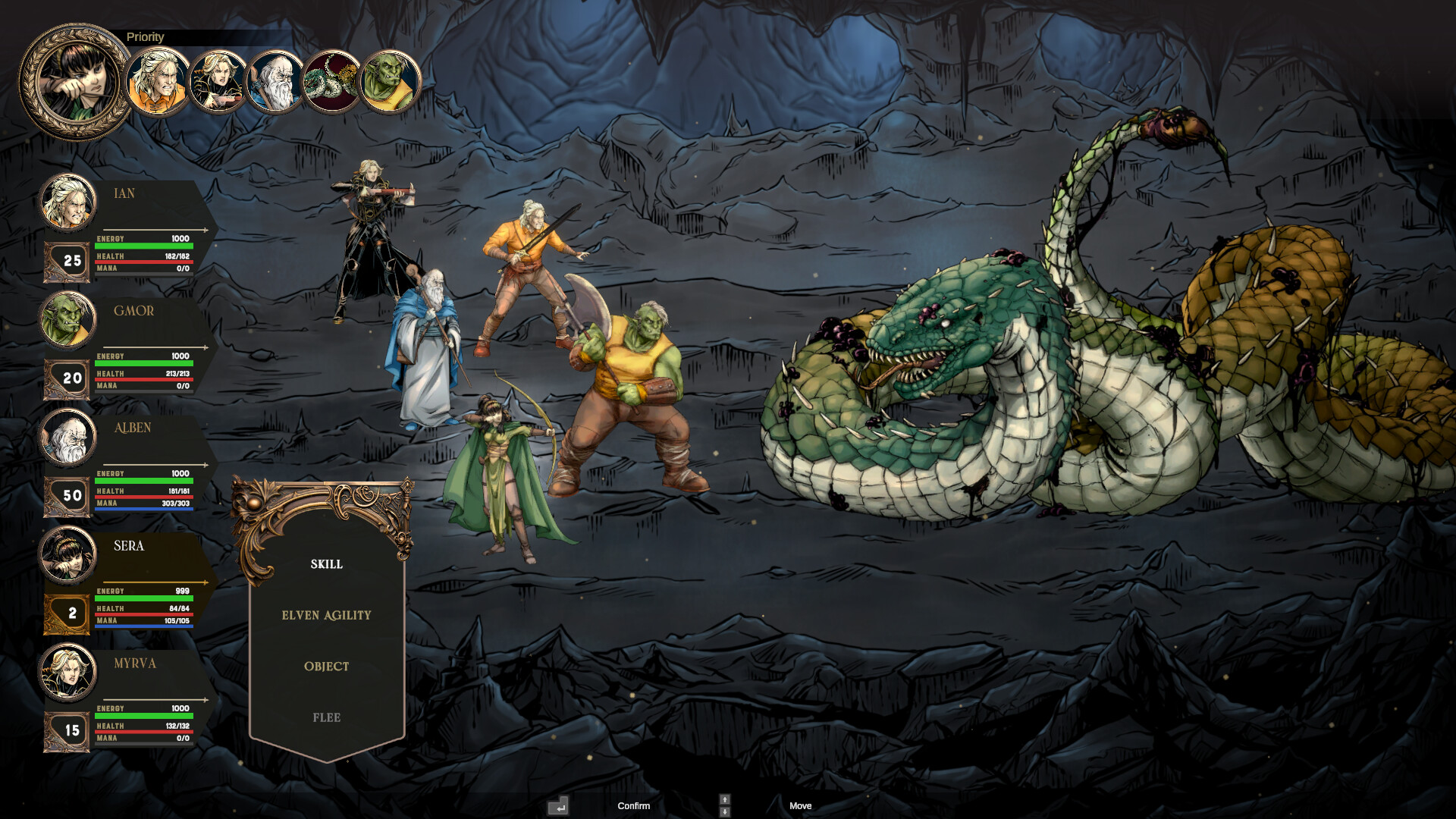
I have a soft spot for strategy-adjacent RPGs that force you to think before every move, so when Dragonero crossed my desk I went in with cautious optimism. Italian developer Operaludica has adapted the Dragonero comic series created by Luca Enoch and Stefano Vietti for Sergio Bonelli Editore into a grid-based, party-driven RPG set across the open world of Erondàr, and the translation from panel to pixel is more faithful in spirit than most licensed games manage. The comic book aesthetic runs through the UI and character art in ways that feel deliberate rather than cheap. The structure is the most interesting design decision here. You begin by playing each of the five heroes separately: Ian Aranill the Scout, Gmor Burpen the Orc, Myrva Aranille the Technocrat, Alben the Luresindo, and Sera of Rômelinwe each carry their own storyline before the party converges for the main campaign. From a strategy standpoint, this means you spend genuine time learning each character's skill set and role before you ever have to manage them as a unit. That is a smarter onboarding loop than it first appears. Combat is grid-based and turn-by-turn, with character-specific abilities and item coordination driving the tactical layer. Fatigue is a real resource: heroes tire from fighting and exploring, so knowing when to rest, when to hunt for food, when to camp, and when to push into the next dungeon floor becomes a genuine planning question rather than an afterthought. The open world of Erondàr mixes procedurally generated dungeons with hand-crafted areas, and the overworld travel layer adds a logistical dimension that strategy players will find satisfying. You can rent horses to conserve supplies on long routes, book passage on ships, and manage provisions before departing for distant objectives. Community posts flag some navigation rough edges, including reported pathing quirks that can leave your party stuck at certain map boundaries, and quest tracking that is not always as clear as it should be. Dungeon interiors draw criticism for reusing assets heavily, and combat animations are utilitarian rather than expressive. A Master Mode lets players build and share custom dungeons and creatures, which is an unusual inclusion for a title at this scale and hints at longer-term community potential, though the player base is still small enough that user-created content is sparse. The honest verdict for strategy-minded players: Dragonero is an indie production with a modest budget and a visible roughness around the edges, but the core decision loop is functional and the multi-character structure gives it more replay texture than a single-protagonist dungeon crawler would. Steam user sentiment sits in mostly positive territory, which for a niche licensed RPG with no major press coverage is a reasonable signal. If you have ever bounced off games like this because the opening hours were too punishing or opaque, the solo-character prologue design actually earns Dragonero a bit of credit as an accessible entry point. Come in knowing what it is: a mid-budget tactics RPG built around a beloved Italian comic property, not a challenger to the genre's heavy hitters. Fans of Dragonero the comic will find the most to love; everyone else is buying a competent party-tactics game with a story that rewards patience. Diego, Scout Team

Dragonero

Dragonero

26 sept 2024Operaludica
GamerScout opina

Five distinct champions, a fully explorable open world, and turn-based tactics rooted in an Italian comic series you have almost certainly never read. Worth your attention if party-based dungeon crawling is already in your wheelhouse.

PCMacLinux
Mejor precio disponible
€0.00
en N/A
Mínimo histórico: €10.08

Comparar precios(0 tiendas)

Cargando precios...

We may earn a commission when you buy games through links on this page — at no extra cost to you. It never affects our rankings or verdicts.

Historial de precios

Historical low
€10.088 Jun 2026
Keyshops
€9.27€9.81€10.35€10.898 Jun13 Jun18 Jun23 Jun28 Jun
Tracking prices since 8 Jun 2026
Create alert

Capturas y multimedia

Captura

Acerca de Dragonero

I have a soft spot for strategy-adjacent RPGs that force you to think before every move, so when Dragonero crossed my desk I went in with cautious optimism. Italian developer Operaludica has adapted the Dragonero comic series created by Luca Enoch and Stefano Vietti for Sergio Bonelli Editore into a grid-based, party-driven RPG set across the open world of Erondàr, and the translation from panel to pixel is more faithful in spirit than most licensed games manage. The comic book aesthetic runs through the UI and character art in ways that feel deliberate rather than cheap. The structure is the most interesting design decision here. You begin by playing each of the five heroes separately: Ian Aranill the Scout, Gmor Burpen the Orc, Myrva Aranille the Technocrat, Alben the Luresindo, and Sera of Rômelinwe each carry their own storyline before the party converges for the main campaign. From a strategy standpoint, this means you spend genuine time learning each character's skill set and role before you ever have to manage them as a unit. That is a smarter onboarding loop than it first appears. Combat is grid-based and turn-by-turn, with character-specific abilities and item coordination driving the tactical layer. Fatigue is a real resource: heroes tire from fighting and exploring, so knowing when to rest, when to hunt for food, when to camp, and when to push into the next dungeon floor becomes a genuine planning question rather than an afterthought. The open world of Erondàr mixes procedurally generated dungeons with hand-crafted areas, and the overworld travel layer adds a logistical dimension that strategy players will find satisfying. You can rent horses to conserve supplies on long routes, book passage on ships, and manage provisions before departing for distant objectives. Community posts flag some navigation rough edges, including reported pathing quirks that can leave your party stuck at certain map boundaries, and quest tracking that is not always as clear as it should be. Dungeon interiors draw criticism for reusing assets heavily, and combat animations are utilitarian rather than expressive. A Master Mode lets players build and share custom dungeons and creatures, which is an unusual inclusion for a title at this scale and hints at longer-term community potential, though the player base is still small enough that user-created content is sparse. The honest verdict for strategy-minded players: Dragonero is an indie production with a modest budget and a visible roughness around the edges, but the core decision loop is functional and the multi-character structure gives it more replay texture than a single-protagonist dungeon crawler would. Steam user sentiment sits in mostly positive territory, which for a niche licensed RPG with no major press coverage is a reasonable signal. If you have ever bounced off games like this because the opening hours were too punishing or opaque, the solo-character prologue design actually earns Dragonero a bit of credit as an accessible entry point. Come in knowing what it is: a mid-budget tactics RPG built around a beloved Italian comic property, not a challenger to the genre's heavy hitters. Fans of Dragonero the comic will find the most to love; everyone else is buying a competent party-tactics game with a story that rewards patience.

Diego
Diego · Scout Team

Strategy & simulation

Etiquetas

singleplayerachievementscloud-savestier:indieComic Book AdaptationFatigue SystemMulti-Character PrologueOverworld Travel ManagementMaster ModeCamp CraftingLicensed IPFive-Character RosterGrid-Based Tactics

Requisitos del sistema

Mínimos

OS
Windows® 10 64-bit
Memory
8 GB RAM
Storage
10 GB available space
Graphics
GTX 750
Processor
i3 8th gen

Recomendados

OS
Windows® 10 64-bit/ Windows® 11
Memory
16 GB RAM
Storage
12 MB available space
Graphics
Nvidia GeForce 1060 or Radeon RX 570 and higher
Processor
Intel Core i5 or Ryzen 5 3600 and higher

Sigue explorando

Community Discussion

Be the first to comment on Dragonero.

Reseñas y valoraciones

No hay valoraciones disponibles

Información del juego

Desarrolladora
Operaludica
Distribuidora
Operaludica
Fecha de lanzamiento
26 sept 2024

Alerta de precio

¡Recibe un aviso cuando el precio baje de tu objetivo!

Crear alerta

Compra mejor: guías útiles

Preguntas frecuentes sobre Dragonero

¿Cuánto cuesta Dragonero?

El precio de Dragonero cambia a menudo y varía según la tienda, la edición y la región. La tabla de precios en vivo de esta página compara las ofertas más baratas en stock de tiendas de claves de confianza como Eneba y Kinguin, para que siempre veas el precio más bajo actual antes de comprar.

¿Dónde puedo comprar Dragonero más barato?

Compara los precios de Dragonero en todas las tiendas verificadas en la tabla de precios de esta página. Listamos las ofertas de claves y tiendas más baratas en stock, actualizadas con frecuencia, para que siempre veas la mejor oferta actual antes de comprar.

¿En qué plataformas está disponible Dragonero?

Dragonero está disponible en PC, Mac, Linux.

¿Cuándo se lanzó Dragonero?

Dragonero se lanzó el 26 de septiembre de 2024.

¿Quién desarrolló Dragonero?

Dragonero fue desarrollado por Operaludica.