Compara los precios de Clinically Dead en tiendas de claves de confianza y encuentra la mejor oferta. Desarrollado por Mogila Games. Publicado por Ultimate Games S.A.. Lanzado el 6/12/2018. Disponible en PC. Géneros: Action, Adventure, Indie.

A one-person four-year labor that turns the color spectrum into a time axis inside a dying man's mind. Puzzle fans with patience for rough edges will find something genuinely singular here.

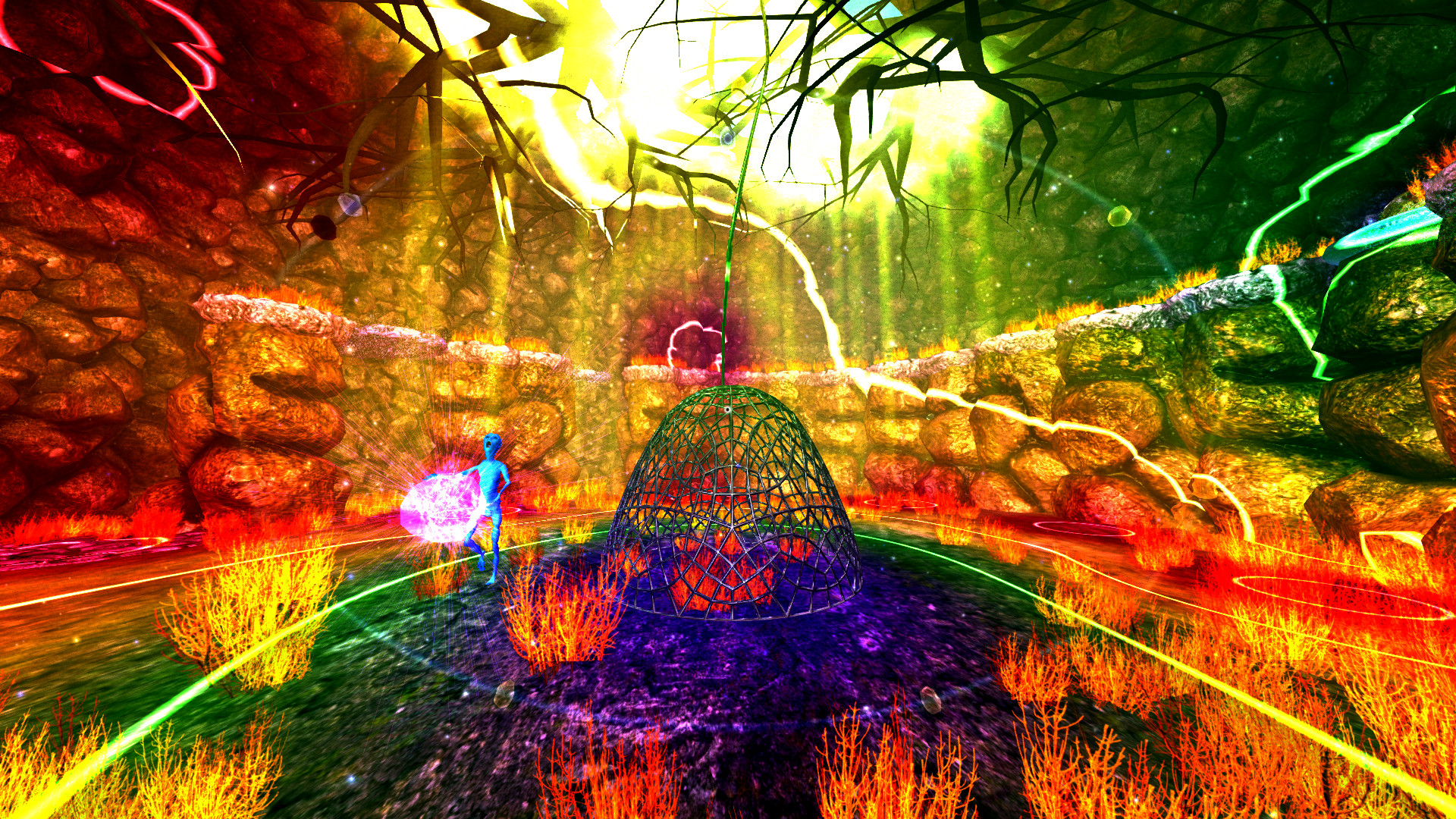
I keep a mental shelf for games that arrive with almost no fanfare and quietly do something nobody else is doing. Clinically Dead earns a spot on that shelf, not because everything works, but because its central idea is so committed that I kept playing long after the translation started making my eyebrow twitch. Solo developer Pawel Mogila spent four years building this first-person puzzle game around a concept that sounds like a student thesis and somehow became a playable world: space and time are the same axis, and color is how you read it. Blue zones are low time, red zones are high time, and moving your body through a level physically scrubs the timeline forward or backward. Platforms rise and fall, doors open, hazards shift. Your position is your time dial. The premise frames all of this inside the final 30 seconds of a man named Samson dying in a hospital bed. His subconsciousness separates from him as a floating narrator, and together you work through a series of psychedelic cavern levels to collect time crystals and let him pass in peace. It sounds melancholy, but the game reads as strangely hopeful. The neon-cave environments glow with an almost bioluminescent beauty, and the soundtrack oscillates between eerie calm and low dread in exactly the way a near-death dreamscape should. Platforms resemble bones, the walls could pass for grey matter, and the yellowish fluid below the walkways does not invite a closer look. The atmosphere is doing real work here, even when the underlying geometry is rough by modern standards. The puzzles themselves are the honest heart of the experience. Some levels give you direct Q and E hotkey control to scrub time forward and backward manually. Others lock your timeline to your physical position, so navigation becomes a spatial-temporal logic problem rather than a movement challenge. The best levels layer both systems and throw in pressure plates, marble-run elements, and the occasional stealth section where alien-gray creatures stalk you through the shadows. Difficulty swings hard between the approachable and the genuinely stumping, but reviewers broadly agreed the challenge stays fair throughout, and you should not need a guide. The non-linear layout, with Metroidvania-style connected paths between areas, gives exploration a quiet reward when a shortcut suddenly clicks open. Now for the honest accounting of rough spots, because this is a one-person project and it shows in specific places. The English localization is noticeably unpolished, with instructions that use terms like 'high time' and 'low time' where clearer phrasing would have helped considerably. The voice acting in the hospital intro sits in a strange uncanny valley, stilted enough to be distracting. Controls feel slightly imprecise, with a janky quality that never fully disappears. The visuals are vibrant but technically unpolished, and a small subset of players flagged genuine headache risk from the relentless chromatic intensity. Go in knowing the epilepsy warning on the store page is not boilerplate. These are real friction points, not incidental ones. But here is the thing: once the game leaves the intro behind and drops you fully into its mind-world, almost all of those weaknesses either fade or become contextually strange in a way that serves the atmosphere. Clinically Dead is the kind of game where the idea is so specific that I find it hard to dismiss even the parts that frustrate me. The color-as-time system is not a metaphor slapped onto a normal puzzle game. It is the entire architecture. When you genuinely internalize it and start reading a level's color gradient the way you read a map's elevation lines, there is a quiet click of comprehension that feels earned. For fans of Antichamber-style conceptual puzzles or anyone who appreciates small games built with unusual conviction, this one deserves a look. Kai, Scout Team

Clinically Dead

Clinically Dead

6 dic 2018Mogila GamesUltimate Games S.A.
GamerScout opina

A one-person four-year labor that turns the color spectrum into a time axis inside a dying man's mind. Puzzle fans with patience for rough edges will find something genuinely singular here.

PC
Steam Deck Playable
Mejor precio disponible
€0.00
en N/A
Mínimo histórico: €0.27

Comparar precios(0 tiendas)

Cargando precios...

We may earn a commission when you buy games through links on this page — at no extra cost to you. It never affects our rankings or verdicts.

Historial de precios

Historical low
€0.2728 Jun 2026
Keyshops
€0.24€0.34€0.45€0.557 Jun12 Jun18 Jun23 Jun28 Jun
Tracking prices since 7 Jun 2026
Create alert

Capturas y multimedia

Captura

Acerca de Clinically Dead

I keep a mental shelf for games that arrive with almost no fanfare and quietly do something nobody else is doing. Clinically Dead earns a spot on that shelf, not because everything works, but because its central idea is so committed that I kept playing long after the translation started making my eyebrow twitch. Solo developer Pawel Mogila spent four years building this first-person puzzle game around a concept that sounds like a student thesis and somehow became a playable world: space and time are the same axis, and color is how you read it. Blue zones are low time, red zones are high time, and moving your body through a level physically scrubs the timeline forward or backward. Platforms rise and fall, doors open, hazards shift. Your position is your time dial. The premise frames all of this inside the final 30 seconds of a man named Samson dying in a hospital bed. His subconsciousness separates from him as a floating narrator, and together you work through a series of psychedelic cavern levels to collect time crystals and let him pass in peace. It sounds melancholy, but the game reads as strangely hopeful. The neon-cave environments glow with an almost bioluminescent beauty, and the soundtrack oscillates between eerie calm and low dread in exactly the way a near-death dreamscape should. Platforms resemble bones, the walls could pass for grey matter, and the yellowish fluid below the walkways does not invite a closer look. The atmosphere is doing real work here, even when the underlying geometry is rough by modern standards. The puzzles themselves are the honest heart of the experience. Some levels give you direct Q and E hotkey control to scrub time forward and backward manually. Others lock your timeline to your physical position, so navigation becomes a spatial-temporal logic problem rather than a movement challenge. The best levels layer both systems and throw in pressure plates, marble-run elements, and the occasional stealth section where alien-gray creatures stalk you through the shadows. Difficulty swings hard between the approachable and the genuinely stumping, but reviewers broadly agreed the challenge stays fair throughout, and you should not need a guide. The non-linear layout, with Metroidvania-style connected paths between areas, gives exploration a quiet reward when a shortcut suddenly clicks open. Now for the honest accounting of rough spots, because this is a one-person project and it shows in specific places. The English localization is noticeably unpolished, with instructions that use terms like 'high time' and 'low time' where clearer phrasing would have helped considerably. The voice acting in the hospital intro sits in a strange uncanny valley, stilted enough to be distracting. Controls feel slightly imprecise, with a janky quality that never fully disappears. The visuals are vibrant but technically unpolished, and a small subset of players flagged genuine headache risk from the relentless chromatic intensity. Go in knowing the epilepsy warning on the store page is not boilerplate. These are real friction points, not incidental ones. But here is the thing: once the game leaves the intro behind and drops you fully into its mind-world, almost all of those weaknesses either fade or become contextually strange in a way that serves the atmosphere. Clinically Dead is the kind of game where the idea is so specific that I find it hard to dismiss even the parts that frustrate me. The color-as-time system is not a metaphor slapped onto a normal puzzle game. It is the entire architecture. When you genuinely internalize it and start reading a level's color gradient the way you read a map's elevation lines, there is a quiet click of comprehension that feels earned. For fans of Antichamber-style conceptual puzzles or anyone who appreciates small games built with unusual conviction, this one deserves a look.

Kai
Kai · Scout Team

Indie & narrative

Etiquetas

singleplayerachievementscontroller-supporttier:sub-5Time-as-Space MechanicFirst-Person PuzzlerSubconsciousness NarrativeStealth ElementsMetroidvania LayoutTime Crystal CollectiblesMultiple EndingsChromatic Hazard WarningSolo Dev Project

Requisitos del sistema

Mínimos

OS
32bit or 64bit, Windows 7, Windows 8, Windows 10
Memory
8 GB RAM
Storage
1600 MB available space
Graphics
GeForce GTX 660M
Processor
Intel Core i3
Sound Card
Windows compatible

Recomendados

OS
32bit or 64bit, Windows 7, Windows 8, Windows 10
Memory
8 GB RAM
Storage
1600 MB available space
Graphics
GeForce GTX 1060
Processor
Intel Core i7
Sound Card
Windows compatible

Sigue explorando

Community Discussion

Be the first to comment on Clinically Dead.

Reseñas y valoraciones

No hay valoraciones disponibles

Información del juego

Desarrolladora
Mogila Games
Distribuidora
Ultimate Games S.A.
Fecha de lanzamiento
6 dic 2018

Alerta de precio

¡Recibe un aviso cuando el precio baje de tu objetivo!

Crear alerta

Compra mejor: guías útiles

Preguntas frecuentes sobre Clinically Dead

¿Cuánto cuesta Clinically Dead?

El precio de Clinically Dead cambia a menudo y varía según la tienda, la edición y la región. La tabla de precios en vivo de esta página compara las ofertas más baratas en stock de tiendas de claves de confianza como Eneba y Kinguin, para que siempre veas el precio más bajo actual antes de comprar.

¿Dónde puedo comprar Clinically Dead más barato?

Compara los precios de Clinically Dead en todas las tiendas verificadas en la tabla de precios de esta página. Listamos las ofertas de claves y tiendas más baratas en stock, actualizadas con frecuencia, para que siempre veas la mejor oferta actual antes de comprar.

¿En qué plataformas está disponible Clinically Dead?

Clinically Dead está disponible en PC.

¿Cuándo se lanzó Clinically Dead?

Clinically Dead se lanzó el 6 de diciembre de 2018.

¿Quién desarrolló Clinically Dead?

Clinically Dead fue desarrollado por Mogila Games y publicado por Ultimate Games S.A..