Compara los precios de Bartender VR Simulator en tiendas de claves de confianza y encuentra la mejor oferta. Desarrollado por VR Factory Games Sp. z o.o.. Publicado por VR Factory Games Sp. z o.o.. Lanzado el 9/2/2018. Disponible en PC. Géneros: Casual, Indie, Simulation.

Consulted a six-time world bartending champion, built real liquid physics, then shipped a 57% 'Mixed' rating on Steam. There is a good game buried in here, but you will fight the controls to reach it.

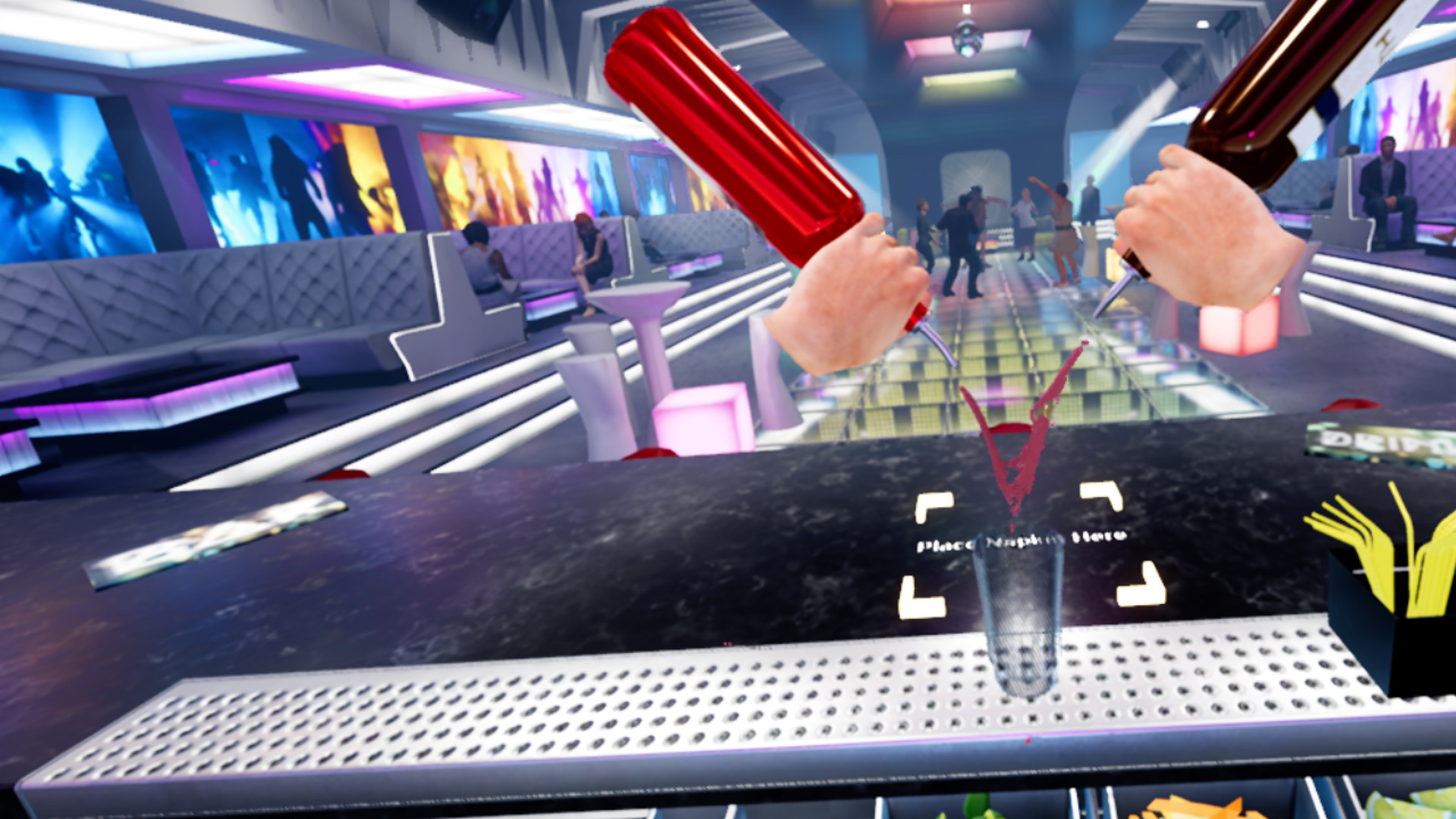
My first hour with Bartender VR Simulator went something like this: I poured ice, watched it scatter across the counter, failed the drink, tried to toss a bottle between hands for a flair bonus, watched it fly into a wall, and failed the drink again. That loop, frustrating as it sounds, is actually the core tension this game is selling. The ambition is real. VR Factory Games collaborated closely with six-time Bartending World Champion Tomasz Malek, who motion-captured his actual movements and consulted on pour speeds, shaking times, and ingredient order. The fluid tech reportedly uses physics simulation to model pour volume based on wrist angle, and shaking a cocktail requires you to actually hit a power threshold before the drink is ready to strain. That kind of fidelity is not something you find in casual VR fare. The concept deserved better execution. Structurally, the game sends you through four venue types: a nightclub, a beach bar, a rooftop lounge, and a high-end cocktail bar. Each venue has three modes: Practice (step-by-step guided prep), Regular (orders without a safety net, with costly hints available), and Challenge (make as many drinks as possible inside ten minutes for a leaderboard score). A Pro Mode unlocks after you clear the challenge gauntlet. The progression of cocktails mirrors that arc, starting with Gin and Tonic and Cuba Libre and climbing to Martinis, Old-Fashioneds, and Daiquiris. On paper this is a solid design: build muscle memory in Practice, stress-test it in Challenge, chase scores. In reality, the game's unforgiving fail states, where dropping anything, pouring slightly too much, or doing one step out of order immediately voids the drink, undercut the fun before the learning can kick in. Recipe memory is not the hard part; wrestling the physics engine into cooperating is. The physics are where the community's complaints concentrate, and after spending time with the game I cannot disagree. Liquid simulation behaves reasonably at low pour speeds, but the grab detection is inconsistent enough that flair moves, bottle juggling, mid-air catches, the tricks that earn bonus tips, feel like luck rather than skill. Ice scooping is a repeated offender, with the scoop catching awkwardly and scattering cubes in ways that feel punishing rather than challenging. Visually, the PC Steam build shows its 2018 origins: textures read as washed out in a VR headset, and NPC models in the background repeat animations on short loops. The Steam review aggregate sits at 57% positive across 170 reviews, which honestly reflects a split audience: bar industry people and cocktail hobbyists who appreciate the recipe accuracy versus casual VR shoppers who bounce off the janky controls. Where the game earns partial credit is in its seated-play comfort (no locomotion, minimal motion sickness risk), the genuine educational angle around real drink recipes, and the score-attack structure that creates short-session replay value if you commit to memorizing the recipe set. The Meta Quest version has seen significantly more active development, with multiple major updates, improved tracking, and hand-tracking support added post-launch, meaning the PC Steam build is not where this title is at its best. If VR bartending appeals to you and you have a Quest headset, go there instead. On PC via Steam, you are running older code, older physics tuning, and a content set that has not kept pace with what the Quest version received. For strategy-minded players who enjoy systems mastery, the scoring loop in Challenge Mode does have something to it: minimizing wasted motion, optimizing pour sequence, timing flair insertions for tip bonuses. It is thin compared to what a proper skill-expression game could be, but it is there. The ceiling is low, and the physics friction means you will hit a wall where improvement stalls not because you lack skill but because the engine stops cooperating. That is a design failure, not a difficulty curve. Diego, Scout Team

Bartender VR Simulator

Bartender VR Simulator

9 feb 2018VR Factory Games Sp. z o.o.
GamerScout opina

Consulted a six-time world bartending champion, built real liquid physics, then shipped a 57% 'Mixed' rating on Steam. There is a good game buried in here, but you will fight the controls to reach it.

PC
Mejor precio disponible
€0.00
en N/A
Mínimo histórico: €17.55

Comparar precios(0 tiendas)

Cargando precios...

We may earn a commission when you buy games through links on this page — at no extra cost to you. It never affects our rankings or verdicts.

Historial de precios

Historical low
€17.558 Jun 2026
Keyshops
€16.15€17.08€18.02€18.958 Jun13 Jun18 Jun23 Jun28 Jun
Tracking prices since 8 Jun 2026
Create alert

Capturas y multimedia

Captura

Acerca de Bartender VR Simulator

My first hour with Bartender VR Simulator went something like this: I poured ice, watched it scatter across the counter, failed the drink, tried to toss a bottle between hands for a flair bonus, watched it fly into a wall, and failed the drink again. That loop, frustrating as it sounds, is actually the core tension this game is selling. The ambition is real. VR Factory Games collaborated closely with six-time Bartending World Champion Tomasz Malek, who motion-captured his actual movements and consulted on pour speeds, shaking times, and ingredient order. The fluid tech reportedly uses physics simulation to model pour volume based on wrist angle, and shaking a cocktail requires you to actually hit a power threshold before the drink is ready to strain. That kind of fidelity is not something you find in casual VR fare. The concept deserved better execution. Structurally, the game sends you through four venue types: a nightclub, a beach bar, a rooftop lounge, and a high-end cocktail bar. Each venue has three modes: Practice (step-by-step guided prep), Regular (orders without a safety net, with costly hints available), and Challenge (make as many drinks as possible inside ten minutes for a leaderboard score). A Pro Mode unlocks after you clear the challenge gauntlet. The progression of cocktails mirrors that arc, starting with Gin and Tonic and Cuba Libre and climbing to Martinis, Old-Fashioneds, and Daiquiris. On paper this is a solid design: build muscle memory in Practice, stress-test it in Challenge, chase scores. In reality, the game's unforgiving fail states, where dropping anything, pouring slightly too much, or doing one step out of order immediately voids the drink, undercut the fun before the learning can kick in. Recipe memory is not the hard part; wrestling the physics engine into cooperating is. The physics are where the community's complaints concentrate, and after spending time with the game I cannot disagree. Liquid simulation behaves reasonably at low pour speeds, but the grab detection is inconsistent enough that flair moves, bottle juggling, mid-air catches, the tricks that earn bonus tips, feel like luck rather than skill. Ice scooping is a repeated offender, with the scoop catching awkwardly and scattering cubes in ways that feel punishing rather than challenging. Visually, the PC Steam build shows its 2018 origins: textures read as washed out in a VR headset, and NPC models in the background repeat animations on short loops. The Steam review aggregate sits at 57% positive across 170 reviews, which honestly reflects a split audience: bar industry people and cocktail hobbyists who appreciate the recipe accuracy versus casual VR shoppers who bounce off the janky controls. Where the game earns partial credit is in its seated-play comfort (no locomotion, minimal motion sickness risk), the genuine educational angle around real drink recipes, and the score-attack structure that creates short-session replay value if you commit to memorizing the recipe set. The Meta Quest version has seen significantly more active development, with multiple major updates, improved tracking, and hand-tracking support added post-launch, meaning the PC Steam build is not where this title is at its best. If VR bartending appeals to you and you have a Quest headset, go there instead. On PC via Steam, you are running older code, older physics tuning, and a content set that has not kept pace with what the Quest version received. For strategy-minded players who enjoy systems mastery, the scoring loop in Challenge Mode does have something to it: minimizing wasted motion, optimizing pour sequence, timing flair insertions for tip bonuses. It is thin compared to what a proper skill-expression game could be, but it is there. The ceiling is low, and the physics friction means you will hit a wall where improvement stalls not because you lack skill but because the engine stops cooperating. That is a design failure, not a difficulty curve.

Diego
Diego · Scout Team

Strategy & simulation

Etiquetas

singleplayertier:aaaFlair BartendingScore AttackVR RequiredSeated PlayRecipe MemoryChallenge ModeLeaderboard

Requisitos del sistema

Mínimos

OS
Windows 7/8.1/10 (64-bit)
Memory
8 GB RAM
Storage
2000 MB available space
Graphics
Nvidia GeForce GTX 970
Processor
CPU: Intel i5-4590 equivalent or better
Sound Card
N/A
VR Support
SteamVR

Recomendados

16 GB RAM

Sigue explorando

Community Discussion

Be the first to comment on Bartender VR Simulator.

Reseñas y valoraciones

No hay valoraciones disponibles

Información del juego

Desarrolladora
VR Factory Games Sp. z o.o.
Distribuidora
VR Factory Games Sp. z o.o.
Fecha de lanzamiento
9 feb 2018

Alerta de precio

¡Recibe un aviso cuando el precio baje de tu objetivo!

Crear alerta

Compra mejor: guías útiles

¿Buscas más? Mira juegos como Bartender VR Simulator →

Preguntas frecuentes sobre Bartender VR Simulator

¿Cuánto cuesta Bartender VR Simulator?

El precio de Bartender VR Simulator cambia a menudo y varía según la tienda, la edición y la región. La tabla de precios en vivo de esta página compara las ofertas más baratas en stock de tiendas de claves de confianza como Eneba y Kinguin, para que siempre veas el precio más bajo actual antes de comprar.

¿Dónde puedo comprar Bartender VR Simulator más barato?

Compara los precios de Bartender VR Simulator en todas las tiendas verificadas en la tabla de precios de esta página. Listamos las ofertas de claves y tiendas más baratas en stock, actualizadas con frecuencia, para que siempre veas la mejor oferta actual antes de comprar.

¿En qué plataformas está disponible Bartender VR Simulator?

Bartender VR Simulator está disponible en PC.

¿Cuándo se lanzó Bartender VR Simulator?

Bartender VR Simulator se lanzó el 9 de febrero de 2018.

¿Quién desarrolló Bartender VR Simulator?

Bartender VR Simulator fue desarrollado por VR Factory Games Sp. z o.o..