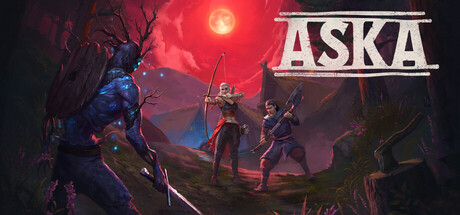
Compara los precios de ASKA en tiendas de claves de confianza y encuentra la mejor oferta. Desarrollado por Sand Sailor Studio. Publicado por Thunderful Publishing. Lanzado el 20/6/2024. Disponible en PC. Géneros: Adventure, Simulation, Strategy, Early Access.

Colony management with a Norse mythology skin: if micromanaging woodcutters, blacksmiths, and Blood Moon raid defenses sounds like a good Saturday, ASKA is built for you.

I went into ASKA expecting a Valheim-adjacent romp and got a production-chain puzzle wrapped in a fur cloak instead. That gap between expectation and reality is the single biggest thing you need to know before purchasing. Sand Sailor Studio built something far closer to a colony sim than an exploration survival game, and the entire experience hinges on whether you find joy in setting up supply lines, assigning villager roles, and watching your settlement's resource economy tick over while you are away fighting Draugr. If that sentence excited you, keep reading. If it made you want to play Valheim instead, that is also a valid conclusion. The core mechanics work as follows. You arrive on a procedurally generated island as a shipwrecked Viking, gather Jotun Blood from cursed stones and defeated enemies, and use it via the Eye of Odin to summon new villagers. Each recruit comes with individual traits and skill affinities: a naturally gifted hunter will range further as they level up and bring back rarer materials; a well-fed, rested blacksmith produces better equipment. Unemployed villagers default to construction work, but real efficiency only comes when you build the right structures and assign roles deliberately. You will need a woodcutter pit, a stonecutter pit, a gatherer pit, a storage system with correctly configured whitelists, a rain collector to unlock wells, farms that fail completely in winter, and cottages with fireplaces to keep people from freezing. The UI for wiring all of this together is the game's honest weak point: menus are buried, dependencies are rarely spelled out, and a single skipped step will leave your specialist standing idle while the village falls apart. Plan for a learning-curve session of two to four hours before anything clicks. Once the colony automation does click, the payoff is real. Seasonal pressure is the engine that keeps decisions meaningful: winter freezes water sources, kills crops, and is precisely when enemy factions mount coordinated Blood Moon raids on your walls. Preparing defenses during warmer months is not a nice-to-have. Walls, guard towers, and combat-trained villagers who fight alongside you are required infrastructure, not cosmetics. The post-launch Seaborne Raiders update meaningfully expanded the end-game by adding naval exploration, raiding mechanics, two new biomes including the Salt Flats, a flying boss called Ravendrake, and Golem villagers that never hunger or tire. There is also a beekeeping and mead-brewing production chain via the Hearth and Honey update, which feeds into the morale system through taverns. The development cadence has been consistent, which is a meaningful data point for an Early Access game. Combat is the weakest pillar. It is skill-based rather than stat-gated, so positioning and timing matter, but dodging feels unreliable and enemy variety remains thin. Fending off a horde during a Blood Moon with your trained militia is genuinely tense, but solo boss fights are underwhelming in their current form. Building on slopes is also a persistent headache: the terrain system does not forgive uneven ground easily, which forces either tedious land-flattening or awkward terraced layouts. Performance can degrade as the settlement scales, so keep that in mind if your machine is mid-range. On the positive side, the visual presentation is strong, the dynamic weather transitions from autumn colour to snow convincingly, and the audio does a solid job of shifting between atmospheric building ambience and combat urgency. For the strategy-and-sim crowd, ASKA is a more interesting proposition than its surface marketing suggests. Think of it as a village management game where you are also the sheriff, the general, and occasionally the person who has to go mine iron ore because nobody else can reach the cave. The four-player co-op splits the management load into something genuinely comfortable: one player handles resource logistics while another runs combat patrols, and the whole colony sim stops feeling overwhelming. Solo is viable but demands patience and a tolerance for menu archaeology. Dedicated server support arrived post-launch, which helps co-op groups stay persistent without a host tethering the session. At roughly 79 percent positive across over five thousand Steam reviews, the community reception is cautiously warm rather than enthusiastic, which tracks: this is a game that rewards the right player type rather than broadly satisfying everyone. Diego, Scout Team

ASKA

ASKA

20 jun 2024Sand Sailor StudioThunderful Publishing
GamerScout opina

Colony management with a Norse mythology skin: if micromanaging woodcutters, blacksmiths, and Blood Moon raid defenses sounds like a good Saturday, ASKA is built for you.

PC
Steam Deck PlayableProtonDB Gold
Mejor precio disponible
€0.00
en N/A
Mínimo histórico: €6.29

Comparar precios(0 tiendas)

Cargando precios...

We may earn a commission when you buy games through links on this page — at no extra cost to you. It never affects our rankings or verdicts.

Historial de precios

Historical low
€6.2926 Jun 2026
Keyshops
€5.88€6.22€6.56€6.908 Jun13 Jun18 Jun23 Jun28 Jun
Tracking prices since 8 Jun 2026
Create alert

Capturas y multimedia

Acerca de ASKA

I went into ASKA expecting a Valheim-adjacent romp and got a production-chain puzzle wrapped in a fur cloak instead. That gap between expectation and reality is the single biggest thing you need to know before purchasing. Sand Sailor Studio built something far closer to a colony sim than an exploration survival game, and the entire experience hinges on whether you find joy in setting up supply lines, assigning villager roles, and watching your settlement's resource economy tick over while you are away fighting Draugr. If that sentence excited you, keep reading. If it made you want to play Valheim instead, that is also a valid conclusion. The core mechanics work as follows. You arrive on a procedurally generated island as a shipwrecked Viking, gather Jotun Blood from cursed stones and defeated enemies, and use it via the Eye of Odin to summon new villagers. Each recruit comes with individual traits and skill affinities: a naturally gifted hunter will range further as they level up and bring back rarer materials; a well-fed, rested blacksmith produces better equipment. Unemployed villagers default to construction work, but real efficiency only comes when you build the right structures and assign roles deliberately. You will need a woodcutter pit, a stonecutter pit, a gatherer pit, a storage system with correctly configured whitelists, a rain collector to unlock wells, farms that fail completely in winter, and cottages with fireplaces to keep people from freezing. The UI for wiring all of this together is the game's honest weak point: menus are buried, dependencies are rarely spelled out, and a single skipped step will leave your specialist standing idle while the village falls apart. Plan for a learning-curve session of two to four hours before anything clicks. Once the colony automation does click, the payoff is real. Seasonal pressure is the engine that keeps decisions meaningful: winter freezes water sources, kills crops, and is precisely when enemy factions mount coordinated Blood Moon raids on your walls. Preparing defenses during warmer months is not a nice-to-have. Walls, guard towers, and combat-trained villagers who fight alongside you are required infrastructure, not cosmetics. The post-launch Seaborne Raiders update meaningfully expanded the end-game by adding naval exploration, raiding mechanics, two new biomes including the Salt Flats, a flying boss called Ravendrake, and Golem villagers that never hunger or tire. There is also a beekeeping and mead-brewing production chain via the Hearth and Honey update, which feeds into the morale system through taverns. The development cadence has been consistent, which is a meaningful data point for an Early Access game. Combat is the weakest pillar. It is skill-based rather than stat-gated, so positioning and timing matter, but dodging feels unreliable and enemy variety remains thin. Fending off a horde during a Blood Moon with your trained militia is genuinely tense, but solo boss fights are underwhelming in their current form. Building on slopes is also a persistent headache: the terrain system does not forgive uneven ground easily, which forces either tedious land-flattening or awkward terraced layouts. Performance can degrade as the settlement scales, so keep that in mind if your machine is mid-range. On the positive side, the visual presentation is strong, the dynamic weather transitions from autumn colour to snow convincingly, and the audio does a solid job of shifting between atmospheric building ambience and combat urgency. For the strategy-and-sim crowd, ASKA is a more interesting proposition than its surface marketing suggests. Think of it as a village management game where you are also the sheriff, the general, and occasionally the person who has to go mine iron ore because nobody else can reach the cave. The four-player co-op splits the management load into something genuinely comfortable: one player handles resource logistics while another runs combat patrols, and the whole colony sim stops feeling overwhelming. Solo is viable but demands patience and a tolerance for menu archaeology. Dedicated server support arrived post-launch, which helps co-op groups stay persistent without a host tethering the session. At roughly 79 percent positive across over five thousand Steam reviews, the community reception is cautiously warm rather than enthusiastic, which tracks: this is a game that rewards the right player type rather than broadly satisfying everyone.

Diego
Diego · Scout Team

Strategy & simulation

Etiquetas

singleplayermultiplayercooponline-coopcontroller-supportcloud-savestier:indieColony SimVillager ManagementBlood Moon RaidsSeasonal SurvivalProduction ChainsNaval ExplorationNorse MythologyDedicated Server SupportEarly Access Worth Watching

Requisitos del sistema

Mínimos

OS
Windows 10 64-bit
Memory
16GB GB RAM
Network
Broadband Internet connection
Storage
6 GB available space
Graphics
Nvidia GeForce GTX 1660 (6GB) or AMD RX 590
Processor
Intel Core i5 6600 or AMD Ryzen 5 1600

Recomendados

Requires a 64-bit processor and operating system

Sigue explorando

Community Discussion

Be the first to comment on ASKA.

Reseñas y valoraciones

No hay valoraciones disponibles

Información del juego

Desarrolladora
Sand Sailor Studio
Distribuidora
Thunderful Publishing
Fecha de lanzamiento
20 jun 2024

Alerta de precio

¡Recibe un aviso cuando el precio baje de tu objetivo!

Crear alerta

Más de Sand Sailor Studio

Compra mejor: guías útiles

ASKA en directo en Twitch

¿Buscas más? Mira juegos como ASKA →

Preguntas frecuentes sobre ASKA

¿Cuánto cuesta ASKA?

El precio de ASKA cambia a menudo y varía según la tienda, la edición y la región. La tabla de precios en vivo de esta página compara las ofertas más baratas en stock de tiendas de claves de confianza como Eneba y Kinguin, para que siempre veas el precio más bajo actual antes de comprar.

¿Dónde puedo comprar ASKA más barato?

Compara los precios de ASKA en todas las tiendas verificadas en la tabla de precios de esta página. Listamos las ofertas de claves y tiendas más baratas en stock, actualizadas con frecuencia, para que siempre veas la mejor oferta actual antes de comprar.

¿En qué plataformas está disponible ASKA?

ASKA está disponible en PC.

¿Cuándo se lanzó ASKA?

ASKA se lanzó el 20 de junio de 2024.

¿Quién desarrolló ASKA?

ASKA fue desarrollado por Sand Sailor Studio y publicado por Thunderful Publishing.