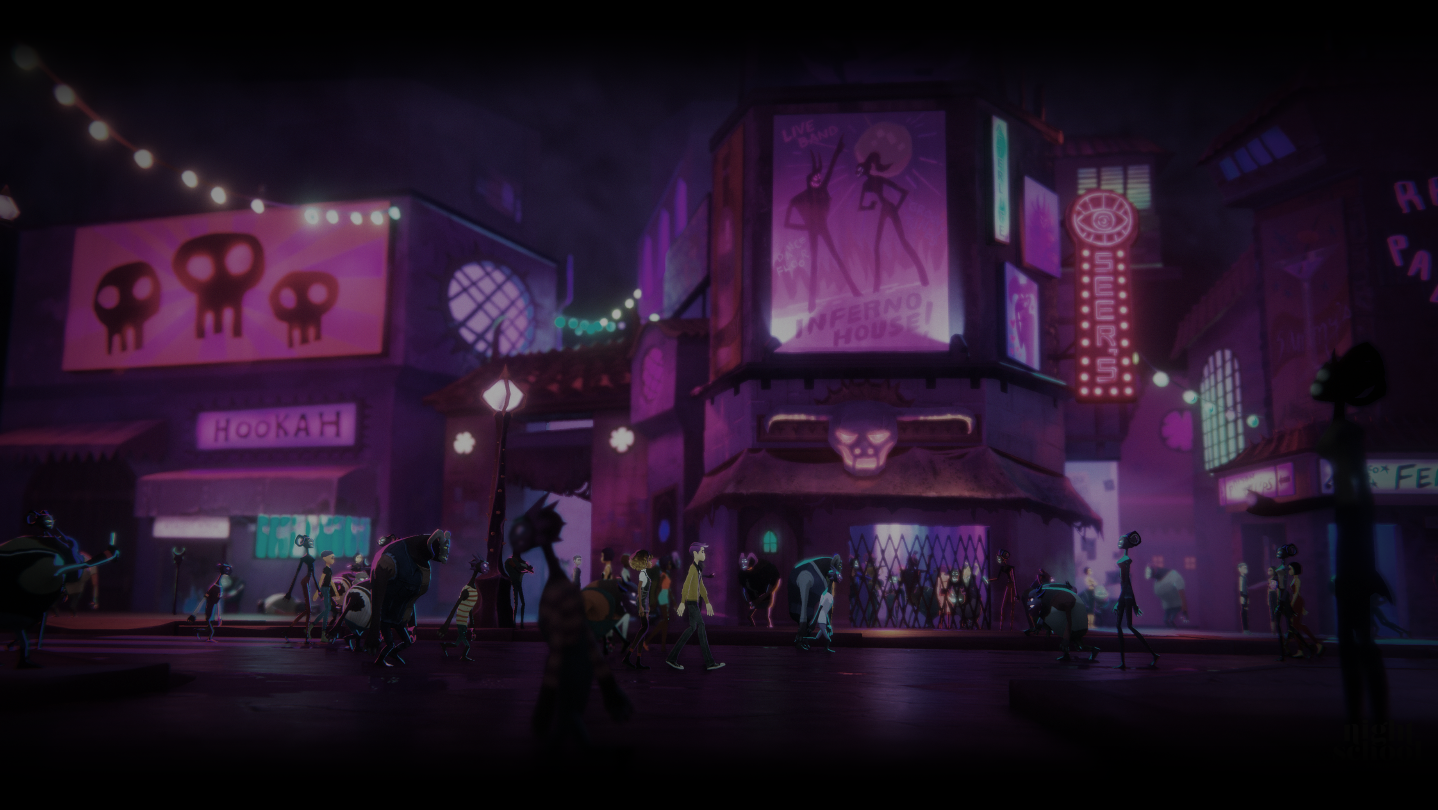
Afterparty
Two dead best friends try to out-drink Satan to escape Hell. It's a dialogue-heavy adventure with sharp writing and a genuinely weird sense of humor.
Comparar precios(0 tiendas)
Cargando precios...
We may earn a commission when you buy games through links on this page — at no extra cost to you. It never affects our rankings or verdicts.
Historial de precios
Capturas y multimedia
Acerca de Afterparty
Afterparty is a narrative adventure from Night School Studio, the team behind Oxenfree, and it wears that lineage openly. You control Milo and Lola, two college friends who die on the same night and land in Hell with no explanation. The twist - and it's a good one - is that Hell has a loophole: if you can out-drink Satan himself, he'll send you back. What follows is essentially a bar crawl through the underworld, a road trip comedy set in a place that looks like a neon-drenched nightclub district designed by someone who read too much Dante and listened to too much synthpop. It suits the mood perfectly. The core loop is conversation. You move between locations, order drinks that unlock new dialogue options (a mechanic that is both thematically clever and mechanically light), and talk. A lot. Milo and Lola feel like real friends - their banter has the rhythm of people who genuinely know each other's worst habits, and the writing earns laughs without resorting to easy irony. The supporting cast of demons, hellish bureaucrats, and tortured souls is inventive, and some of the side characters leave a stronger impression than the main story beats. The voice acting is consistently excellent. The soundtrack is low-key one of the game's strongest assets - ambient, slightly liturgical, then punchy when it needs to be. Night School understands that sound design is half the atmosphere in a game like this. Where it stumbles is in its second half. The pacing loses confidence around the midpoint, and certain narrative threads feel like they were set up with more ambition than the runtime could support. The relationship between Milo and Lola - which is clearly meant to be the emotional core - gets crowded out by plot mechanics, and the ending lands softly when it should land hard. For a game that runs roughly four to five hours, that's a meaningful gap. Oxenfree had a similar length and felt complete. Afterparty feels like it needed one more pass at the structure. The mixed Steam reviews are not entirely unfair, but they undersell what works. If you are someone who values voice performance, atmospheric design, and jokes that actually land, those things are genuinely present here. If you want meaningful player agency or branching consequences, you will be disappointed - the drink mechanic adds flavor to scenes without fundamentally changing outcomes. This is a game you watch as much as you play, and it knows that about itself. Whether that's a problem depends entirely on what you came for. For fans of Oxenfree, Disco Elysium's lighter moments, or any narrative game that treats its world as something worth lingering in, Afterparty has real value. It doesn't reach everything it aims for, but the craft in its smaller moments - a throwaway demon character with a believable grievance, a piece of environmental detail in a background bar, a line reading that lands exactly right - reminds you that Night School builds these worlds with genuine care. Sometimes that's enough.

Indie & narrative
Etiquetas
Requisitos del sistema
Mínimos
- Processor
- Intel Core i3 2.5GHz
- Memory
- 4 GB RAM
- Graphics
- Radeon HD 6850 or equivalent
- DirectX
- Version 11
- Storage
- 5 GB available space
Recomendados
- OS
- Windows 10
- Processor
- Intel Core i5 3.0GHz
- Memory
- 8 GB RAM
- Graphics
- Radeon RX 460 or equivalent
- DirectX
- Version 11
- Storage
- 5 GB available space
Sigue explorando
Community Discussion
Be the first to comment on Afterparty.
Reseñas y valoraciones
Información del juego
- Desarrolladora
- Night School Studio
- Distribuidora
- Night School Studio
- Fecha de lanzamiento
- 22 oct 2020