Compara los precios de Orbital Racer en tiendas de claves de confianza y encuentra la mejor oferta. Desarrollado por Paweł Dywelski. Publicado por Movie Games S.A.. Lanzado el 14/12/2017. Disponible en PC. Géneros: Indie, Racing, Simulation.

Solo space-sim physics meets checkpoint racing across 24 tracks and 8 real solar system locations, but a 43% Steam rating tells you this niche experiment earns its audience the hard way.

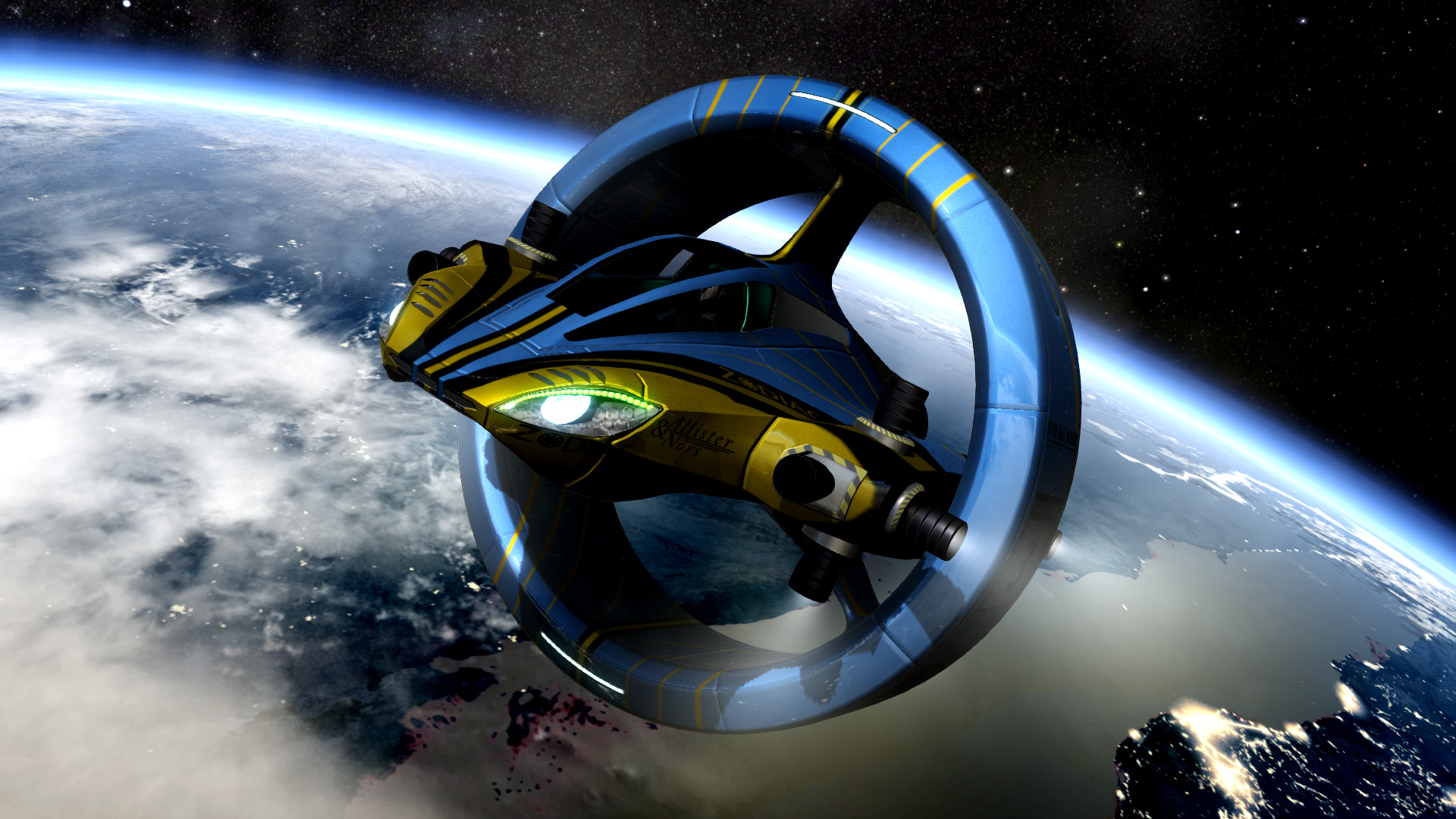
My Saturday-night co-op radar went dark the second I loaded Orbital Racer: this is strictly a solo experience, PC-only, with no split-screen, no online multiplayer, and menus that still require a mouse even when you're playing on a controller. So before anything else, if you were hoping to drag friends into this one, park that idea. What you do get is a genuinely unusual 6DOF space racer that attempts something most developers sensibly avoid: stripping away every physical road and asking you to race purely through a sequence of floating checkpoint rings hung in the void around Saturn, Venus, asteroid fields, and orbital stations. There are two modes, and they feel almost like different games. Action mode hands you missiles, mines, and other powerups, letting you blast through the checkpoint hoops at reckless speed against up to eleven AI rivals. It's the more approachable entry point, though reviewers have flagged that the weapons feel toothless because opponents can spam unlimited decoys to shrug off missiles, making combat more of a distraction than a genuine threat. Simulation mode is where Orbital Racer gets serious: ships obey Newtonian physics, thrusters follow plausible force models, and the correct racing line means pointing at the next checkpoint before you've cleared the current one. That planning-ahead mindset is genuinely unlike anything in a conventional racer, and when it clicks, the satisfaction is real. A full flight school exists specifically to help players wrap their heads around it, which is a thoughtful addition. The career layer adds a light management dimension: you build funds, attract sponsors, and plan travel across the solar system, since events are scheduled by in-universe time and you can't always teleport to Mars on a whim. It's a subtle layer of realism, but the progression feedback is thin. After a race, you see prize money and standings; nothing announces an unlock or points you toward a logical next step. That open-ended structure tips from freeing to directionless faster than it should. The AI is challenging enough to sting, particularly at the front of the grid where your thrusters apparently lag behind the pack at race start, creating a frustrating early-race bumper-car effect that punishes clean finishes in the prior round. The orientation problem is the most common complaint across the community, and it's legitimate. Without walls, kerbs, or track geometry to anchor your sense of direction, you depend entirely on HUD arrows and glowing rings to know where you're going. The dual-arrow system (current checkpoint, next checkpoint) is a reasonable attempt at a solution, but reviewers consistently found the competing HUD elements cluttered and sometimes misleading, especially at speed. A gamepad works fine in the actual races once you're past the menu friction; there's no wheel or HOTAS support flagged, so sim-hardware owners won't get any special benefit here. The visuals are clean and sharp at 1080p/60fps without drama, and the soundtrack draws praise for atmosphere. Bottom line: Orbital Racer is a one-developer passion project aimed at a sliver of the audience that genuinely wants Newtonian physics in their racing game. That sliver will find real depth in Simulation mode. Everyone else will bounce off the disorienting checkpoint-only structure, the absent multiplayer, and the thin career rewards well before the concept fully opens up. The 43% Steam rating isn't unfair, but it's also not the whole story for the right player. Riley, Scout Team

Orbital Racer

Orbital Racer

14 dic 2017Paweł DywelskiMovie Games S.A.
GamerScout opina

Solo space-sim physics meets checkpoint racing across 24 tracks and 8 real solar system locations, but a 43% Steam rating tells you this niche experiment earns its audience the hard way.

PC
ProtonDB Silver
Mejor precio disponible
€0.00
en N/A
Mínimo histórico: €0.15

Comparar precios(0 tiendas)

Cargando precios...

We may earn a commission when you buy games through links on this page — at no extra cost to you. It never affects our rankings or verdicts.

Historial de precios

Historical low
€0.1526 Jun 2026
Keyshops
€0.15€0.16€0.16€0.175 Jun11 Jun17 Jun22 Jun28 Jun
Tracking prices since 5 Jun 2026
Create alert

Capturas y multimedia

Captura

Acerca de Orbital Racer

My Saturday-night co-op radar went dark the second I loaded Orbital Racer: this is strictly a solo experience, PC-only, with no split-screen, no online multiplayer, and menus that still require a mouse even when you're playing on a controller. So before anything else, if you were hoping to drag friends into this one, park that idea. What you do get is a genuinely unusual 6DOF space racer that attempts something most developers sensibly avoid: stripping away every physical road and asking you to race purely through a sequence of floating checkpoint rings hung in the void around Saturn, Venus, asteroid fields, and orbital stations. There are two modes, and they feel almost like different games. Action mode hands you missiles, mines, and other powerups, letting you blast through the checkpoint hoops at reckless speed against up to eleven AI rivals. It's the more approachable entry point, though reviewers have flagged that the weapons feel toothless because opponents can spam unlimited decoys to shrug off missiles, making combat more of a distraction than a genuine threat. Simulation mode is where Orbital Racer gets serious: ships obey Newtonian physics, thrusters follow plausible force models, and the correct racing line means pointing at the next checkpoint before you've cleared the current one. That planning-ahead mindset is genuinely unlike anything in a conventional racer, and when it clicks, the satisfaction is real. A full flight school exists specifically to help players wrap their heads around it, which is a thoughtful addition. The career layer adds a light management dimension: you build funds, attract sponsors, and plan travel across the solar system, since events are scheduled by in-universe time and you can't always teleport to Mars on a whim. It's a subtle layer of realism, but the progression feedback is thin. After a race, you see prize money and standings; nothing announces an unlock or points you toward a logical next step. That open-ended structure tips from freeing to directionless faster than it should. The AI is challenging enough to sting, particularly at the front of the grid where your thrusters apparently lag behind the pack at race start, creating a frustrating early-race bumper-car effect that punishes clean finishes in the prior round. The orientation problem is the most common complaint across the community, and it's legitimate. Without walls, kerbs, or track geometry to anchor your sense of direction, you depend entirely on HUD arrows and glowing rings to know where you're going. The dual-arrow system (current checkpoint, next checkpoint) is a reasonable attempt at a solution, but reviewers consistently found the competing HUD elements cluttered and sometimes misleading, especially at speed. A gamepad works fine in the actual races once you're past the menu friction; there's no wheel or HOTAS support flagged, so sim-hardware owners won't get any special benefit here. The visuals are clean and sharp at 1080p/60fps without drama, and the soundtrack draws praise for atmosphere. Bottom line: Orbital Racer is a one-developer passion project aimed at a sliver of the audience that genuinely wants Newtonian physics in their racing game. That sliver will find real depth in Simulation mode. Everyone else will bounce off the disorienting checkpoint-only structure, the absent multiplayer, and the thin career rewards well before the concept fully opens up. The 43% Steam rating isn't unfair, but it's also not the whole story for the right player.

Riley
Riley · Scout Team

Sports & racing

Etiquetas

steam6DOFNewtonian PhysicsCheckpoint RacingCareer ModeSolo OnlySpace Sim RacingGamepad CompatiblePhysics Mastery

Requisitos del sistema

Mínimos

Processor
Intel i5 - 4210H (4x 2.9 GHz) or AMD Phenom II X4 980 (4x 3.7 GHz)
Memory
4 GB RAM
Graphics
GeForce GTX 960M (4GB) or Radeon R9 M375X (4GB)
Storage
8 GB available space

Sigue explorando

Community Discussion

Be the first to comment on Orbital Racer.

Reseñas y valoraciones

Steam
43%(110)

Información del juego

Desarrolladora
Paweł Dywelski
Distribuidora
Movie Games S.A.
Fecha de lanzamiento
14 dic 2017

Alerta de precio

¡Recibe un aviso cuando el precio baje de tu objetivo!

Crear alerta

Compra mejor: guías útiles

¿Buscas más? Mira juegos como Orbital Racer →

Preguntas frecuentes sobre Orbital Racer

¿Cuánto cuesta Orbital Racer?

El precio de Orbital Racer cambia a menudo y varía según la tienda, la edición y la región. La tabla de precios en vivo de esta página compara las ofertas más baratas en stock de tiendas de claves de confianza como Eneba y Kinguin, para que siempre veas el precio más bajo actual antes de comprar.

¿Dónde puedo comprar Orbital Racer más barato?

Compara los precios de Orbital Racer en todas las tiendas verificadas en la tabla de precios de esta página. Listamos las ofertas de claves y tiendas más baratas en stock, actualizadas con frecuencia, para que siempre veas la mejor oferta actual antes de comprar.

¿En qué plataformas está disponible Orbital Racer?

Orbital Racer está disponible en PC.

¿Cuándo se lanzó Orbital Racer?

Orbital Racer se lanzó el 14 de diciembre de 2017.

¿Quién desarrolló Orbital Racer?

Orbital Racer fue desarrollado por Paweł Dywelski y publicado por Movie Games S.A..