Compara los precios de Headspun en tiendas de claves de confianza y encuentra la mejor oferta. Desarrollado por Superstring. Publicado por Superstring. Lanzado el 28/8/2019. Disponible en PC, Xbox. Géneros: Adventure, RPG. Puntuación Metacritic: 51/100.

A genuinely clever premise about logic versus emotion inside a broken brain, let down by hollow minigames, buggy systems, and choices that change nothing.

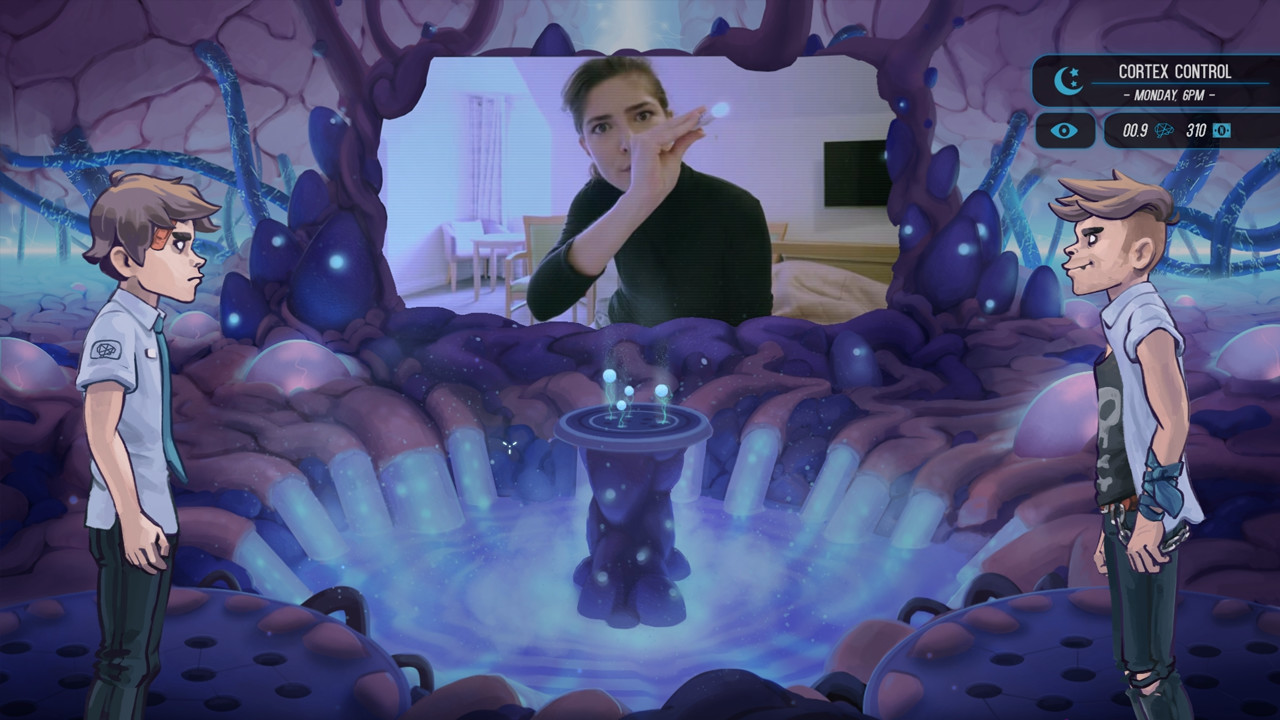
My first thought loading up Headspun was that someone had finally committed to the Inside Out metaphor in a way that could actually land. You step into the role of Ted, the rational CEO of Cortex - a literal brain-office belonging to Theo Kavinsky, a 25-year-old who has just woken from a five-week coma after a car accident. Most of Cortex's staff are dead, departments like the Memory Bank and Dream Cinema are gutted, and your foil Teddy, the primal emotional counterpart to Ted's careful logic, is running loose and picking fights. On paper, the tension between those two characters is the backbone of a genuinely interesting RPG-adjacent story about recovery, identity, and what we choose to remember. The FMV sequences - shot in first-person to simulate Theo's hospital-bed perspective - are where the game is most alive. Visitors arrive: a neurologist, friends, family. You feed Theo dialogue choices and watch the world outside the Cortex unfold. The acting is modest-budget but committed, the dry British wit in the Cortex dialogue actually lands more often than not, and the hand-painted 2D art style, all purples and blues with Gorillaz-adjacent character designs, gives the whole thing a distinctive visual identity. The synthwave soundtrack adds atmosphere without overwhelming the sparse FMV audio. These moments are genuinely worth seeing. The problem is the architecture around those moments. The bulk of your time is spent running minigames - button-mashing to simulate weight-lifting, timing prompts for reading, basic arithmetic puzzles - to earn Neurocredits, which fund Cortex repairs and staff hires. These minigames are repetitive from the second loop and never deepen. The economy is simultaneously breakable and vague: it is easy to amass far more Neurocredits than you can meaningfully spend, while other upgrade systems hide their functionality so completely that you can finish the game without knowing they existed. Worse, the FMV dialogue choices carry no real narrative weight - the story moves the same way regardless of what Theo says, which is a particular sting in a game that pitches itself as being about the war between logic and emotion. Players expecting meaningful branching will leave frustrated. Bugs compound every frustration. Subtitle timing is unreliable, some side sequences auto-complete because the upgrade pacing outruns the story triggers, and there are documented moments where the game locks progression entirely until a reload. The control scheme is a hybrid mess: the minigames feel better on a controller, the menus demand a mouse, and the two never comfortably coexist. There is also a structural issue worth flagging: the game presents what feels like an ending around the six-hour mark, and many players will close it there. Those who push on reportedly find a more complete resolution to the Ted-versus-Teddy arc, but nothing in the game communicates this. A hidden better ending is not a design feature if it requires accident to find. Headspun is the kind of indie that makes you want to write a strongly-worded note to an alternate-universe version of it where the minigame loop was designed with the same care as the premise. The concept of a consciousness-as-management-sim, told through FMV and a character conflict between reason and instinct, is legitimately original. What shipped in 2019 at a Metacritic of 51 is a game that runs out of gameplay before it runs out of story, and runs out of story before it runs out of runtime. If you are drawn to experimental narrative games and can forgive rough edges, the FMV vignettes and the Ted-Teddy dynamic offer enough to justify a discounted look. If choices mattering to you is a baseline requirement, this will leave you cold. Monika, Scout Team

Headspun

Headspun

28 ago 2019Superstring
GamerScout opina

A genuinely clever premise about logic versus emotion inside a broken brain, let down by hollow minigames, buggy systems, and choices that change nothing.

PCXbox
Mejor precio disponible
€0.00
en N/A
Mínimo histórico: €2.19

Comparar precios(0 tiendas)

Cargando precios...

We may earn a commission when you buy games through links on this page — at no extra cost to you. It never affects our rankings or verdicts.

Historial de precios

Historical low
€2.1915 Jun 2026
Keyshops
€2.02€2.14€2.26€2.385 Jun11 Jun17 Jun22 Jun28 Jun
Tracking prices since 5 Jun 2026
Create alert

Capturas y multimedia

Captura

Acerca de Headspun

My first thought loading up Headspun was that someone had finally committed to the Inside Out metaphor in a way that could actually land. You step into the role of Ted, the rational CEO of Cortex - a literal brain-office belonging to Theo Kavinsky, a 25-year-old who has just woken from a five-week coma after a car accident. Most of Cortex's staff are dead, departments like the Memory Bank and Dream Cinema are gutted, and your foil Teddy, the primal emotional counterpart to Ted's careful logic, is running loose and picking fights. On paper, the tension between those two characters is the backbone of a genuinely interesting RPG-adjacent story about recovery, identity, and what we choose to remember. The FMV sequences - shot in first-person to simulate Theo's hospital-bed perspective - are where the game is most alive. Visitors arrive: a neurologist, friends, family. You feed Theo dialogue choices and watch the world outside the Cortex unfold. The acting is modest-budget but committed, the dry British wit in the Cortex dialogue actually lands more often than not, and the hand-painted 2D art style, all purples and blues with Gorillaz-adjacent character designs, gives the whole thing a distinctive visual identity. The synthwave soundtrack adds atmosphere without overwhelming the sparse FMV audio. These moments are genuinely worth seeing. The problem is the architecture around those moments. The bulk of your time is spent running minigames - button-mashing to simulate weight-lifting, timing prompts for reading, basic arithmetic puzzles - to earn Neurocredits, which fund Cortex repairs and staff hires. These minigames are repetitive from the second loop and never deepen. The economy is simultaneously breakable and vague: it is easy to amass far more Neurocredits than you can meaningfully spend, while other upgrade systems hide their functionality so completely that you can finish the game without knowing they existed. Worse, the FMV dialogue choices carry no real narrative weight - the story moves the same way regardless of what Theo says, which is a particular sting in a game that pitches itself as being about the war between logic and emotion. Players expecting meaningful branching will leave frustrated. Bugs compound every frustration. Subtitle timing is unreliable, some side sequences auto-complete because the upgrade pacing outruns the story triggers, and there are documented moments where the game locks progression entirely until a reload. The control scheme is a hybrid mess: the minigames feel better on a controller, the menus demand a mouse, and the two never comfortably coexist. There is also a structural issue worth flagging: the game presents what feels like an ending around the six-hour mark, and many players will close it there. Those who push on reportedly find a more complete resolution to the Ted-versus-Teddy arc, but nothing in the game communicates this. A hidden better ending is not a design feature if it requires accident to find. Headspun is the kind of indie that makes you want to write a strongly-worded note to an alternate-universe version of it where the minigame loop was designed with the same care as the premise. The concept of a consciousness-as-management-sim, told through FMV and a character conflict between reason and instinct, is legitimately original. What shipped in 2019 at a Metacritic of 51 is a game that runs out of gameplay before it runs out of story, and runs out of story before it runs out of runtime. If you are drawn to experimental narrative games and can forgive rough edges, the FMV vignettes and the Ted-Teddy dynamic offer enough to justify a discounted look. If choices mattering to you is a baseline requirement, this will leave you cold.

Monika
Monika · Scout Team

RPGs

Etiquetas

singleplayerachievementscontroller-supportcloud-savestier:indieFMVManagement SimBrain-BuildingBranching DialogueNarrative-DrivenIdle-AdjacentConsciousness ThemeBritish Indie

Requisitos del sistema

Mínimos

OS
Windows 8.1 64-bit
Memory
2 GB RAM
DirectX
Version 11
Storage
7500 MB available space
Graphics
NVIDIA GeForce GTX 260 / AMD Radeon HD 5750. OpenGL 3.3
Processor
Core i3 / AMD A6 2.4Ghz

Recomendados

OS
Windows 10 64-bit
Memory
4 GB RAM
DirectX
Version 11
Storage
7500 MB available space
Graphics
Direct X 11.0 compliant video card with 2GB RAM (NVidia GeForce GTX 750 or AMD Radeon HD 7850)
Processor
Quad Core 2.3GHz or equivalent processor

Sigue explorando

Community Discussion

Be the first to comment on Headspun.

Reseñas y valoraciones

Metacritic
51

Información del juego

Desarrolladora
Superstring
Distribuidora
Superstring
Fecha de lanzamiento
28 ago 2019

Alerta de precio

¡Recibe un aviso cuando el precio baje de tu objetivo!

Crear alerta

Compra mejor: guías útiles

Preguntas frecuentes sobre Headspun

¿Cuánto cuesta Headspun?

El precio de Headspun cambia a menudo y varía según la tienda, la edición y la región. La tabla de precios en vivo de esta página compara las ofertas más baratas en stock de tiendas de claves de confianza como Eneba y Kinguin, para que siempre veas el precio más bajo actual antes de comprar.

¿Dónde puedo comprar Headspun más barato?

Compara los precios de Headspun en todas las tiendas verificadas en la tabla de precios de esta página. Listamos las ofertas de claves y tiendas más baratas en stock, actualizadas con frecuencia, para que siempre veas la mejor oferta actual antes de comprar.

¿En qué plataformas está disponible Headspun?

Headspun está disponible en PC, Xbox.

¿Cuándo se lanzó Headspun?

Headspun se lanzó el 28 de agosto de 2019.

¿Quién desarrolló Headspun?

Headspun fue desarrollado por Superstring.

¿Merece la pena comprar Headspun?

Headspun tiene una puntuación Metacritic de 51/100, lo que lo convierte en uno de los títulos destacados de Adventure. Mira las reseñas completas, las valoraciones y los tiempos de duración en esta página para decidir.