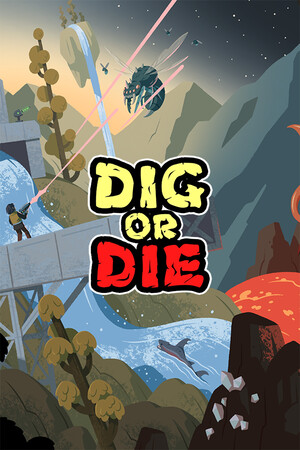
Dig or Die
If Terraria and a tower-defense game had a no-nonsense survival child with physics homework, this is it. A tighter, goal-driven loop that rewards smart builders and punishes the reckless ones.
Comparar precios(0 tiendas)
Cargando precios...
We may earn a commission when you buy games through links on this page — at no extra cost to you. It never affects our rankings or verdicts.
Historial de precios
Capturas y multimedia
Acerca de Dig or Die
I went into Dig or Die expecting another Terraria-with-a-reskin situation, and the first hour almost confirmed that suspicion. Plasma rifle in hand, miniaturizer humming, the familiar 2D sandbox rhythms kicked in immediately. Then night fell, and about forty creatures with the homing instincts of heat-seeking missiles chewed through my hastily stacked walls in seconds. That is the moment Dig or Die stops pretending to be a casual sandbox and reveals its real personality: a tightly scoped, goal-forward survival-strategy hybrid where sloppy base design gets you killed on a schedule. The central loop is more disciplined than its genre cousins. There are five Auto-Builder tiers to climb, and each upgrade unlocks new crafting recipes plus new ore types your Miniaturizer can actually harvest. It is a Metroidvania-style gating system dressed up in survival clothing, and it keeps the pacing honest. You are not just pottering around a sandbox; you are always working toward the next tier, the next weapon, and ultimately assembling a rocket ship from components like Titanium, a Demon's Skin, Deadly Radioactive Blood, and a Diamond that requires Explosives to mine. The weapon roster grows with you: early Plasma Shotguns give way to Rocket Launchers, Laser Guns, Gatling guns, and a Plasma Sniper Rifle that the community argues about endlessly in terms of whether it is worth the crafting slot. Weapons even carry a recoil mechanic that doubles as a traversal tool, letting you rocket-jump across chasms. That kind of systemic thinking is exactly what keeps this from feeling like a content-thin clone. The physics system is where Dig or Die earns its Metacritic 76 rather than something lower. Structures have real weight limits, and building too far horizontally without support columns will bring the whole thing down on your head. Water is fully simulated: rain accumulates, fills dug-out spaces, and can flood your underground base if you have not routed drainage tunnels. Building hydroelectric generators in underground rivers to power your most advanced turrets is genuinely clever. The custom game modes add variety past the main campaign: Sky World drops you on a procedurally generated archipelago of floating islands, Under the Sea buries your starting zone beneath a massive ocean, and Base Defense strips out exploration entirely for pure fortification puzzles. Hazardous Events can layer on Meteor Showers, Earthquakes, Volcano Eruptions, or the magnificently absurd Sharkstorm. That said, the honest negatives are real and worth naming. The visuals are the game's weakest point by some distance. The art has a faded, washed-out quality that reviewers have compared to mid-2000s Flash games, and the enemy variety does not come close to what Terraria or Starbound offer in terms of biome personality. The night-attack enemy pathing is essentially psychic: creatures know exactly where you are and will dig through your walls to reach you rather than navigate around them, which removes some of the tactical satisfaction of a well-planned maze. Content depth also plateaus for some players around the midgame, once the Auto-Builder upgrade rhythm becomes familiar. It is not a filler-quest problem exactly, but a content-volume one: the loop is good, the pool it is drawn from is just narrower than the genre's best. For the right player, none of that matters. If you want a 2D survival game with a defined ending, structural physics that actually punish careless building, and nights that function as genuine tower-defense stress tests rather than minor inconveniences, Dig or Die delivers that with clean mechanical focus. The co-op mode on PC means you can drag a friend into the chaos too. Just do not come in expecting Terraria's breadth or Starbound's lore.

RPGs
Etiquetas
Requisitos del sistema
Mínimos
- Processor
- Intel 2.4 GHz, Amd FX-8350 or better
- Memory
- 1 GB RAM
- Graphics
- 256MB video memory, capable of shader model 2.0
- DirectX
- Version 9.0
- Storage
- 500 MB available space Additional Note…
Sigue explorando
Community Discussion
Be the first to comment on Dig or Die.
Reseñas y valoraciones
Información del juego
- Desarrolladora
- Gaddy Games
- Distribuidora
- Gaddy Games
- Fecha de lanzamiento
- 10 jul 2018